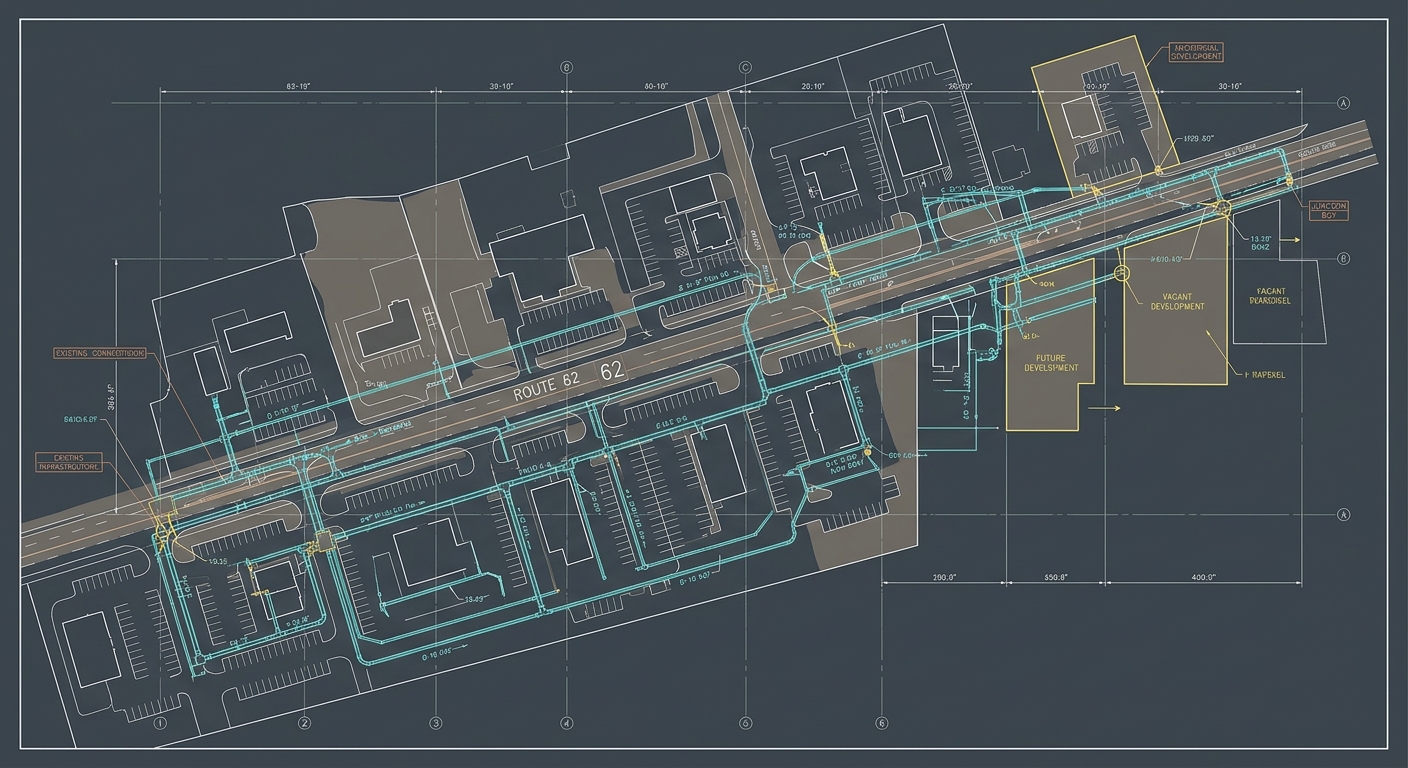
Water infrastructure RFPs in Wyoming jumped to 7 in the last 30 days under a narrow keyword search, 4.4 times the monthly average, and that number understates what's actually happening. Broaden the query to include water mains, treatment plants, wastewater, and sewer systems, and the count reaches 63 RFPs in May 2026 alone, up from single digits for most of 2025. The issuers span the state from Laramie to Douglas to Casper to Cheyenne to Gillette, covering everything from water treatment plant replacements to sluice gate upgrades to transmission main repairs. Wyoming is not building incrementally. It is attempting to close a century-old infrastructure gap in a single construction season.
Three funding streams hit the state almost simultaneously, and their timing explains the spike. In July 2025, Congress passed and President Trump signed the One Big Beautiful Bill Act, which directed $1 billion to the Bureau of Reclamation for western water conveyance. Wyoming captured $100 million of that for the Fort Laramie Canal tunnels, with the Department of the Interior announcing the commitment on March 17, 2026. Rep. Harriet Hageman and Sens. Cynthia Lummis and John Barrasso had championed the project for years; Hageman had already secured $14.6 million in community project funding as a down payment. The Fort Laramie Canal is not a minor facility: when one of its tunnels collapsed in July 2019, it severed irrigation to more than 100,000 acres of farmland across Goshen County and into Nebraska. That collapse exposed just how fragile Wyoming's early-1900s Bureau of Reclamation backbone actually is.
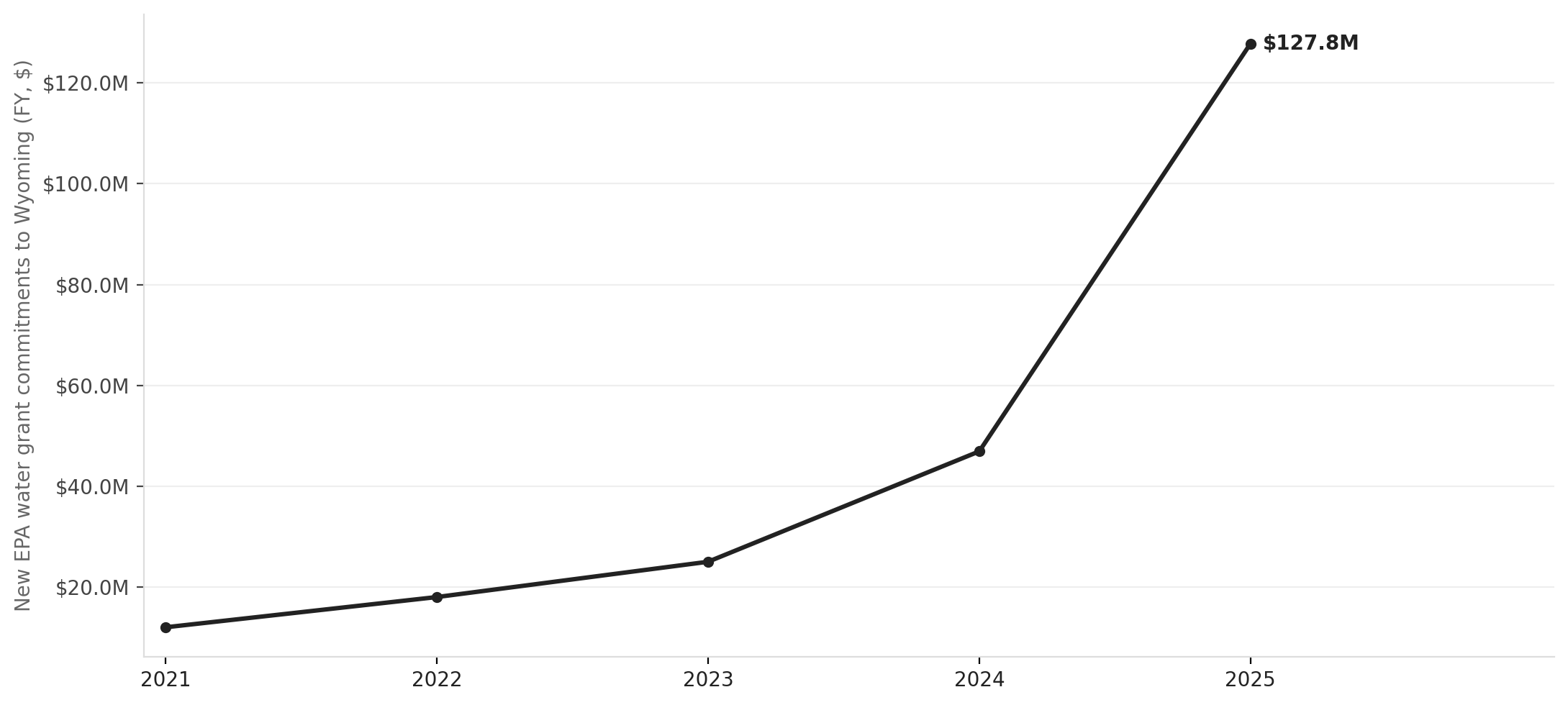
Layered on top of the federal conveyance money is Wyoming's largest-ever EPA water grant year. The state's active EPA water portfolio now stands at $165.5 million committed across 27 grants running through 2031 and 2032, with $127.8 million of that started in FY2025 alone, nearly three times the $46.9 million committed in FY2024. Then, at the February 2026 budget session, the Wyoming Legislature passed the Omnibus Water Bill, adding $22.5 million in state construction grants and $7.2 million in loans for municipal and irrigation projects. The Legislature's $75 million State Infrastructure Matching Fund, drawing on a 1:4 state-to-federal ratio against IIJA grants, is amplifying each of these dollars further.
Source: NationGraph.
The result is a procurement wave that is visibly geographic rather than concentrated in one city or one agency. Laramie is out with an RFQ for a full Water Treatment Plant Replacement and a separate Wyoming Avenue waterline upgrade. Douglas is replacing its WTP transmission main. Casper has issued RFPs for FY26 Priority Water Main Improvements and for sluice gate repairs on the Central Wyoming Regional Water System. Evansville is bidding out water and sewer infrastructure on the Wildcat No. 2 corridor. The spread across Albany, Converse, Natrona, and Laramie counties is not coincidental. It reflects a statewide execution wave that has been building since Gov. Mark Gordon created Wyoming's first centralized Grants Management Office in 2024, specifically to absorb IIJA funding that small municipalities lacked the staff to pursue on their own.
What makes the timing urgent is that the money is arriving in the same season the underlying water system is under genuine stress. Wyoming faces an estimated $700 million in statewide water infrastructure needs, according to the Wyoming Water Development Office, which has begun shifting its grant share from 67 percent to 50 percent of project costs as that backlog outpaces available funds. Gov. Gordon called 2026 "one of our toughest water years ever" and warned in March that the Colorado River Compact situation could be "existential" for Wyoming's water rights. Wyoming holds senior appropriation rights on the Colorado system, but seniority is worth little if river flows collapse, and the state's aging conveyance infrastructure means it cannot fully use the water it does have rights to.
For residents in the affected municipalities, the most direct consequence is construction. Water main replacements in Casper, Laramie, and Douglas will mean lane closures, service interruptions, and multi-year project timelines. Treatment plant replacements take longer still. The Wyoming Water Development Office's shift toward covering a smaller share of project costs also means local governments will need to carry more of the financing burden on future projects, which makes the current grant window particularly consequential for communities that want to lock in favorable terms.
The signal to watch over the next 90 days is contract awards. The RFP volume confirms that projects have cleared the funding and design hurdles that stalled them for years; what happens at the bid-opening stage will show whether Wyoming's contractor market can absorb this volume or whether the execution wave creates its own bottleneck. A construction labor shortage in rural Wyoming could push timelines and costs upward even as the dollars sit committed. How fast shovels follow the RFPs is the next test of whether this once-in-a-generation window closes with a full generation's worth of work actually done.