Maine issued 12 solar RFPs in the last 30 days against a 12-month monthly average of roughly 4.2, a 2.9x spike that puts the state ahead of every other New England jurisdiction. Massachusetts logged 9 over the same window, Connecticut 8, and New Hampshire and Vermont combined for just 2. The surge is concentrated almost entirely in one county and traces back to a single legislative clock that is now running.
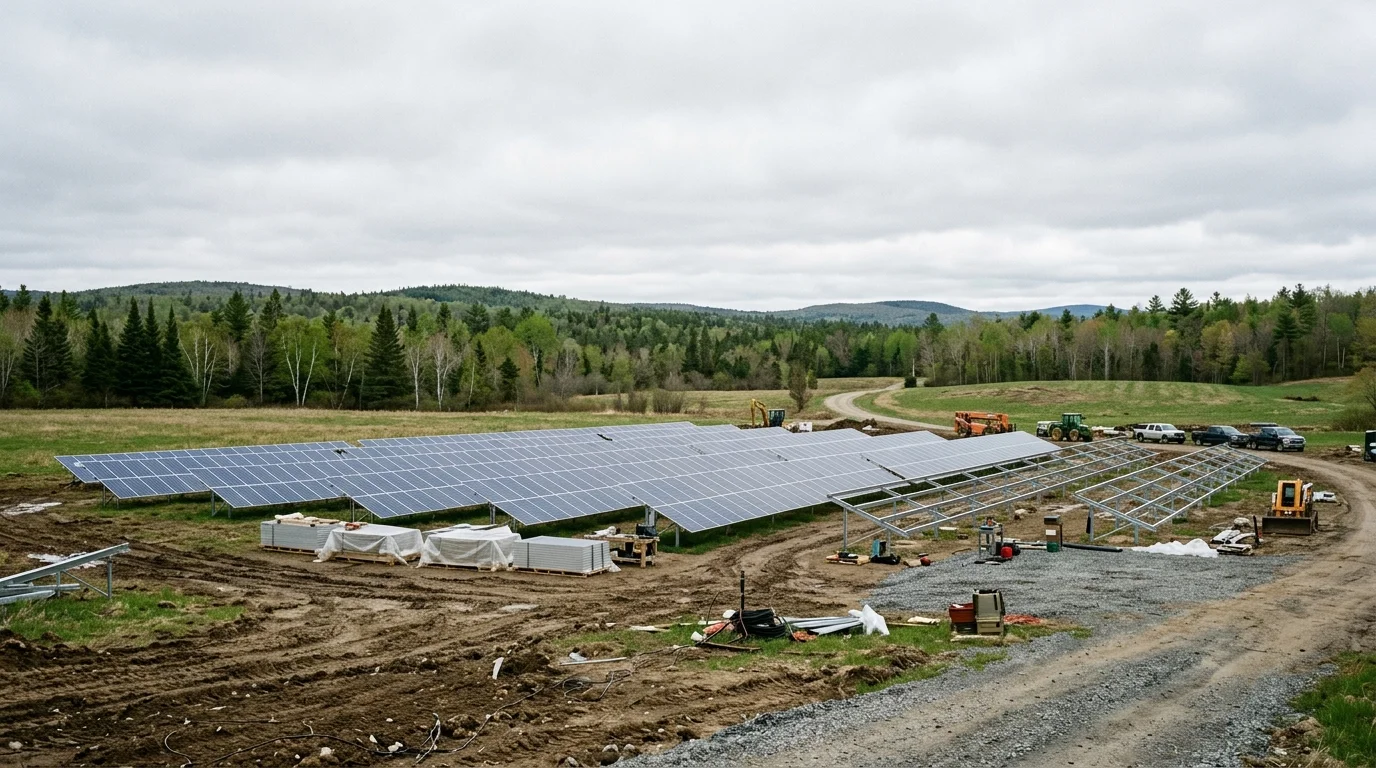
Eleven of the 12 filings are applications before Augusta-area planning boards, originating from at least six distinct solar entities working across Kennebec County. BD Solar Church Hill LLC is seeking amended approval for an 86.8-acre, 20.2 MW farm. Augusta Community Solar LLC, a Midcoast Solar subsidiary, has a 1 MW AC project in queue. SR Commerce Solar LLC, Civic Center Solar LLC, MEVS ASA LLC, and Revision Energy, with a 160 kW rooftop system, round out the developer field. The twelfth filing is the Maine Department of Energy Resources issuing a competitive solicitation for clean energy supply, meaning the state itself is simultaneously in the market alongside the developers it regulates.
The driver is a deadline, not an opening. LD 1777, signed by Governor Janet Mills in June 2025, shut down new enrollment in Maine's community solar net energy billing program, applied retroactive monthly fees of $2.80 to $6 per kW-AC on existing arrays, and cut compensation to existing projects by roughly 20%. The law simultaneously required DOER to publish draft guidance for a replacement community solar program by September 30, 2026, with the PUC then having 120 days to approve or reject it. That timetable is the engine behind the current permitting rush. Developers who do not know what the successor program will look like are doing the one thing they can control: getting projects into local permitting queues now, betting that anything already in the pipeline will be positioned to enroll the moment new rules clear.
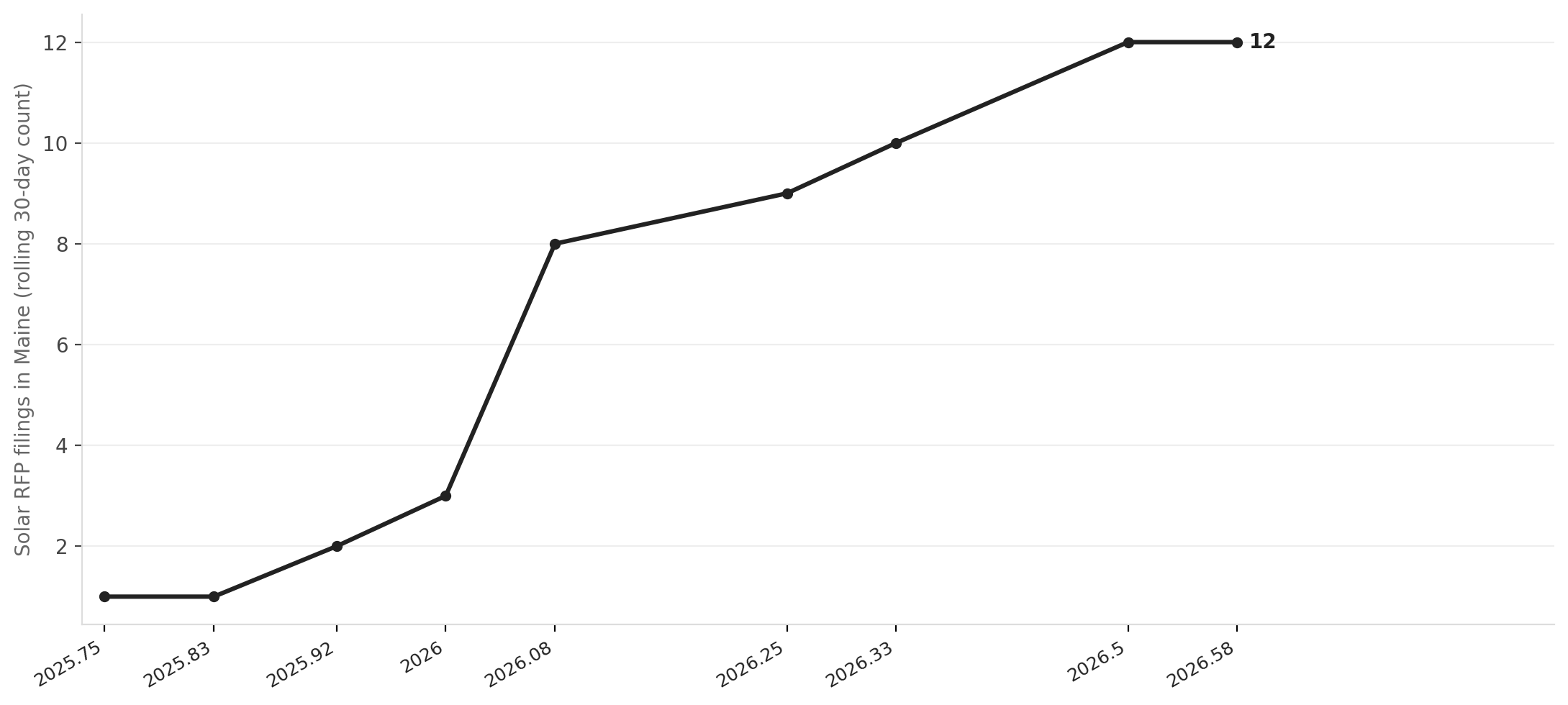
Source: NationGraph.
The time series makes the mechanism visible. Solar RFP filings in Maine were near zero in fall 2025, the months immediately after LD 1777's passage. Activity climbed to 8 in February 2026, 10 in May, and 12 in the most recent 30-day window, tracing the arc of developer urgency building toward the September cliff. According to Solar Power World, the policy change has virtually stopped new community solar development in the conventional sense, which is precisely why a different kind of development is accelerating: smaller, project-by-project local approvals rather than utility-scale program enrollment.
The larger developers that dominated Maine's community solar boom have already stepped back. Nautilus Solar and Nexamp have both stated publicly they will not bring new community solar projects to Maine under the current rules. Gregg Felton, CEO of Altus Power, called the law a rug pull when it passed. That retreat has cleared the local permitting lanes for a different tier of developer, the kind that can run a project through a county planning board rather than a statewide program office.
A second legislative catalyst is layered on top. LD 1730, signed by Governor Mills on April 6, 2026, made Maine the third U.S. state to legalize plug-in solar up to 1,200 watts, adding a new residential permitting category that sits entirely outside the community solar framework LD 1777 disrupted. Revision Energy's 160 kW rooftop filing is the kind of project that fits this new pathway. The two laws are pulling in opposite directions on community-scale solar while simultaneously creating new on-site opportunities at the residential and small-commercial level.
The financial backstop behind all of this activity is large but not yet in the market. Maine DOER holds a $62.1 million EPA Solar for All grant with only $203,000 outlayed so far, and a $65.4 million DOE grid infrastructure grant running through 2029. Competitive disbursements are planned for 2026. Developers working through local planning boards now are positioning for a moment when federal grant dollars, a new state program framework, and their already-approved projects could align.
For residents of Kennebec County, the near-term consequence is a planning board calendar that looks nothing like it did two years ago. Augusta's board is now processing applications involving hundreds of acres and tens of megawatts across multiple concurrent dockets. For the state as a whole, Maine has a statutory mandate for 80% renewable electricity by 2030 and 100% by 2040, and it held the highest community solar capacity per capita in the country before LD 1777. The replacement program that DOER must draft by September 30 will determine whether that infrastructure lead survives the transition or gets dismantled project by project in county hearing rooms.
The next signal to watch is the DOER draft guidance itself. If it arrives on schedule and offers a workable compensation structure, the current permitting surge becomes a launching pad. If it is delayed or contested at the PUC, projects now in the Augusta queue will be waiting in a regulatory vacuum well into 2027.