Federal mental health grant starts in Illinois totaled $17.4 million over the trailing 90 days, up 162% from $6.7 million in the same window one year earlier. The numbers look like a funding boom. They are closer to a bill coming due.
The surge is concentrated almost entirely at three Chicago-area research universities: Northwestern University accounts for $8.5 million of that total, up from $1.5 million in the prior-year window, a 481% spike. The University of Illinois and the University of Chicago each contributed roughly $4.1 million, compared with $537,000 and $694,000 respectively in the same period last year. No other Illinois institution registers meaningfully in the current window. Illinois leads every Midwest peer state in the same 90-day stretch, outpacing Michigan ($13.5M), Missouri ($13.2M), Wisconsin ($8.6M), Ohio ($8.5M), Minnesota ($7M), and Indiana ($5.1M).
The reason for that lead is less about Illinois's research ambitions than about the depth of the freeze it endured. As Senator Dick Durbin noted in July 2025, 900 NIH awards to Northwestern alone had been frozen or terminated by that point, halting roughly $160 million in research. The Trump administration's mass grant terminations in early 2025 effectively suspended the federal funding pipeline to Illinois's largest research institutions for months. Northwestern reached a formal agreement with the federal government in November 2025 to restore hundreds of millions in frozen NIH and Department of Defense awards. That agreement, combined with Congress approving $27.9 billion for NIH in the FY2026 budget, a $415 million increase from the prior year, set the stage for a compressed wave of new grant period start dates hitting the books in spring 2026. What reads as a 162% year-over-year surge is substantially a single year's worth of awards, plus a portion of last year's delayed awards, landing in a single quarter.
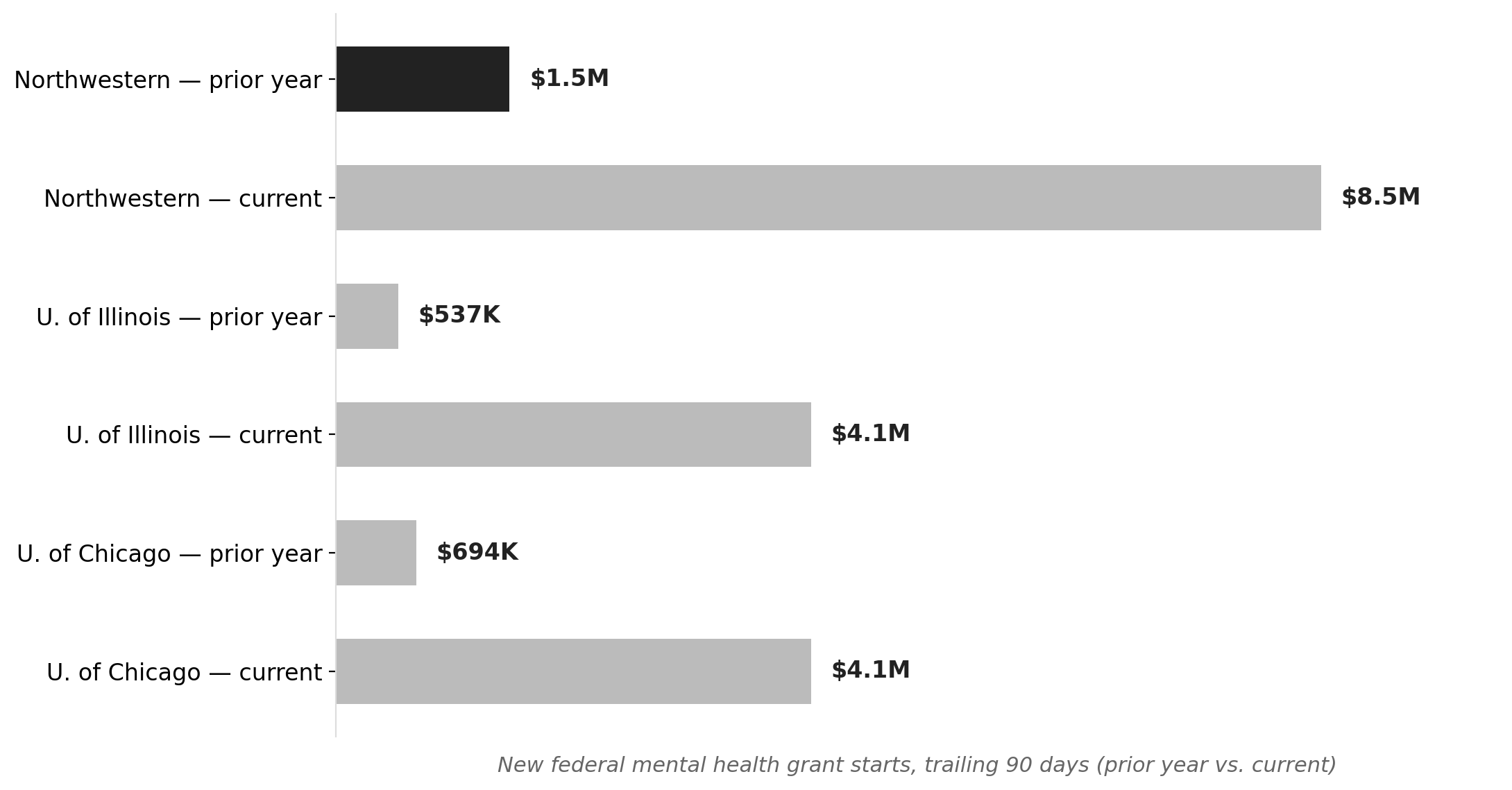
Source: NationGraph.
The dominant programs in the current window are NIH's Mental Health Research Grants and Allergy and Infectious Diseases Research programs, both routed through HHS. These are not new initiatives. They are the continuation of multi-year research portfolios that were briefly severed from their funding and then reconnected. Northwestern's active NIMH portfolio alone spans more than a dozen multi-year grants running through 2027 to 2029.
The backlog effect also obscures a less visible risk. Research teams that went months without confirmed funding did not simply pause: some lost staff, deferred participant recruitment, or compressed timelines that cannot be easily recovered. Chicago Health Online has reported on the downstream toll of the freeze on local research operations. The grant dollars are restored; the institutional disruption may not be fully reversible.
Illinois is also unusually exposed to this kind of federal volatility. NIH funding to Illinois institutions totaled $1.23 billion in 2024, supporting more than 15,500 jobs statewide, and Northwestern conducts the largest single share of that research. Swings in federal research policy hit Illinois harder than they hit most peer states precisely because of that concentration.
Beyond the research pipeline, the state's behavioral health system is navigating its own structural shift. Governor Pritzker signed an executive order in February 2025 merging the Illinois Department of Human Services' Division of Mental Health and Division of Substance Use Prevention and Recovery into a single Division of Behavioral Health and Recovery, a consolidation intended to reduce silos in service delivery. IDHS currently holds a $31.4 million SAMHSA Community Mental Health Block Grant active through September 2026 and a $23.2 million SAMHSA PRNS grant, both of which run separately from the NIH research awards driving this quarter's surge. Those block grants face their own renewal uncertainty: in January 2026, SAMHSA briefly sent termination letters on approximately $2 billion in discretionary behavioral health grants nationally before reversing course within 24 hours following bipartisan pushback.
Running beneath both the research restoration and the block grant volatility is a workforce problem that neither resolves. Illinois's Behavioral Health Workforce Center projects more than 3,300 unfilled behavioral health provider positions statewide by 2030, with the sharpest shortages in Central and Southern Illinois, regions that receive little of the Chicago-anchored NIH research investment.
The next signal to watch is the September 2026 expiration of the SAMHSA block grant. If Congress does not extend or replace it cleanly, the $31.4 million flowing to community mental health centers across the state faces a disruption that would look nothing like a research-funding backlog and would be felt by patients rather than laboratories.