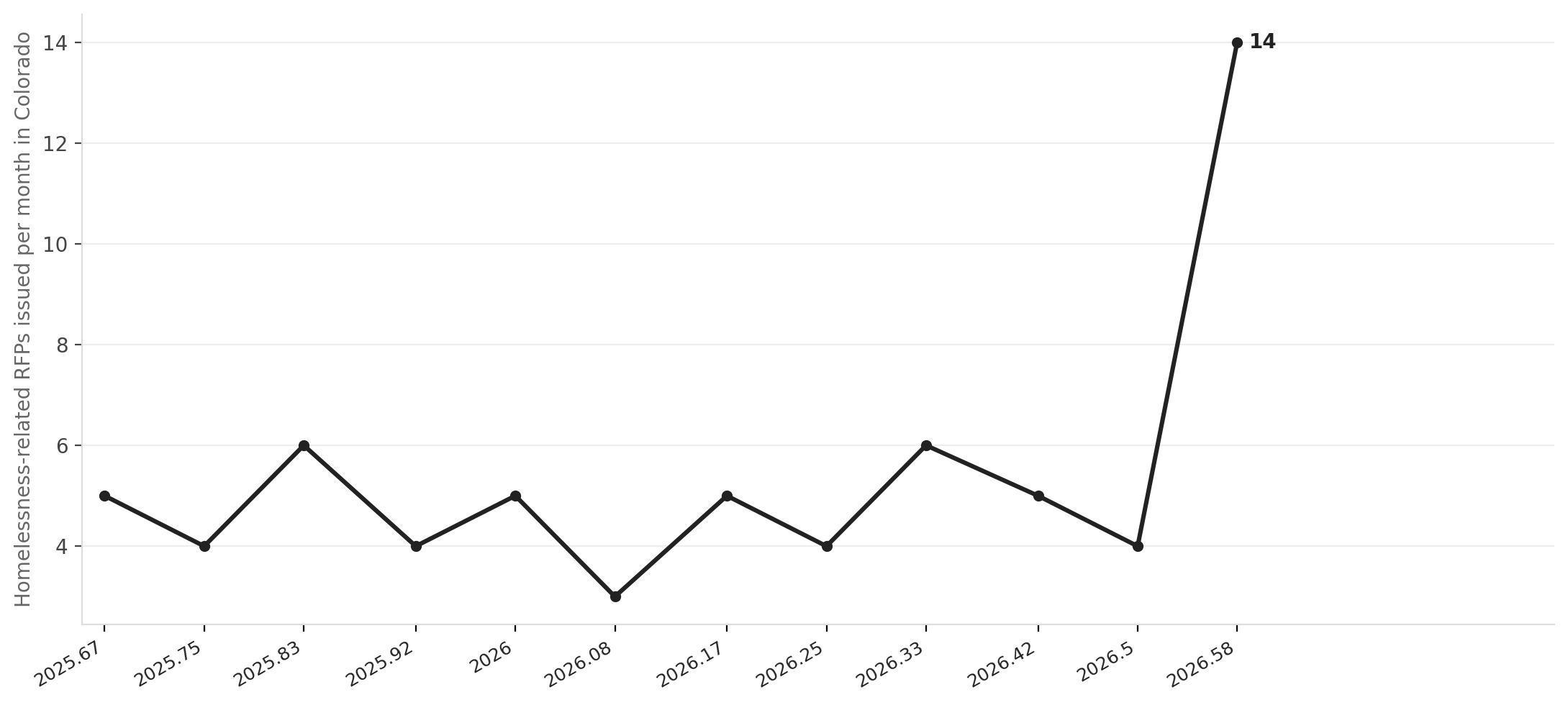
Colorado has issued 14 homelessness-related RFPs in the last 30 days, nearly three times the trailing monthly average of roughly five, and the surge is not a sign of momentum so much as a hard deadline bearing down on the state's largest city.
Nine of those 14 solicitations originate from Denver County, almost all from the city's Department of Housing Stability (HOST). The postings span specialized shelter programs, family emergency shelters, rapid rehousing, street outreach, and Emergency Solutions Grant re-awards, in other words, the full stack of services Denver has assembled over four years. The reason they are all on the market at once: Denver HOST's Five-Year Strategic Plan, which has governed the city's homelessness investments since 2022, expires on December 31, 2026. Every incumbent contract tied to that plan must be re-competed before the clock runs out.
That deadline alone would be enough to explain the sprint. But two pieces of state legislation are compressing the timeline further and spreading the procurement pressure beyond Denver's borders. HB26-1202, effective August 12, 2026, creates a new framework allowing any combination of local governments to form multijurisdictional homelessness response authorities with the power to seek grants and issue bonds. It also requires the state Department of Local Affairs to deliver a full statewide homelessness strategy in January 2027. Separately, HB26-1192 restructures the existing Homeless Prevention Activities Program, rewriting the rules under which many current service arrangements operate.
Source: NationGraph.
Together, the two bills give suburban jurisdictions political cover, and practical incentive, to lock in their own service frameworks before the new architecture takes effect. Thornton, in Adams County, has issued two RFPs for a Housing and Homelessness Strategy and Implementation Toolkit. Aurora, in Arapahoe County, has posted one for homeless services programming. These are not cities with long track records of homelessness procurement. Their appearance in the solicitation landscape this month is a direct reflection of what KUNC has described as Colorado's historically fragmented response: suburban governments that previously deferred to Denver are now building their own capacity before the statewide framework formalizes who is responsible for what.
The scale of what is being re-competed matters. Colorado carries roughly $203 million in active federal homelessness grants across 113 awards and eight agencies, but only about $90.5 million of that, just under 45 percent, has been outlayed. The remaining $112 million in committed-but-unspent federal dollars cannot be drawn down without service contracts in place. A gap in the provider network is not just a policy failure; it is a direct financial exposure. Colorado's $9.1 million HUD Continuum of Care grant to the state Department of Local Affairs expired July 31, 2026, adding another direct trigger to the re-contracting calendar.
The urgency is underscored by what HOST set out to accomplish. The 2022 strategic plan carried a stated goal of zero unsheltered homelessness in Denver by December 31, 2026, the same date the plan sunsets. Colorado's statewide Point-in-Time count recorded 14,000 people experiencing homelessness on a single January night in 2023, a 39 percent increase from the prior year. State Sen. Judy Amabile, a sponsor of HB26-1202, has pointed to housing costs, addiction, and mental health as interconnected drivers, saying the state needs "a coherent strategy." The legislation is, in part, a response to the recognition that Denver cannot absorb the problem alone.
For the service providers currently holding HOST contracts, the next few months are an existential procurement window. Organizations that miss a re-bid cycle do not simply lose one contract; they risk losing the operational continuity that makes competitive applications credible in the first place. For residents, the practical question is whether Denver and the emerging suburban authorities can complete this re-contracting sprint without service gaps during what is typically the highest-demand stretch of the calendar.
The next concrete signal to watch is August 12, when both HB26-1202 and HB26-1192 take effect. If multijurisdictional authority formation moves quickly after that date, expect a second wave of RFPs from county coalitions testing the new framework. If HOST's re-contracting hits delays, the gap between its December 31 plan expiration and the January 2027 statewide strategy deadline from DOLA will be the moment to watch most closely.