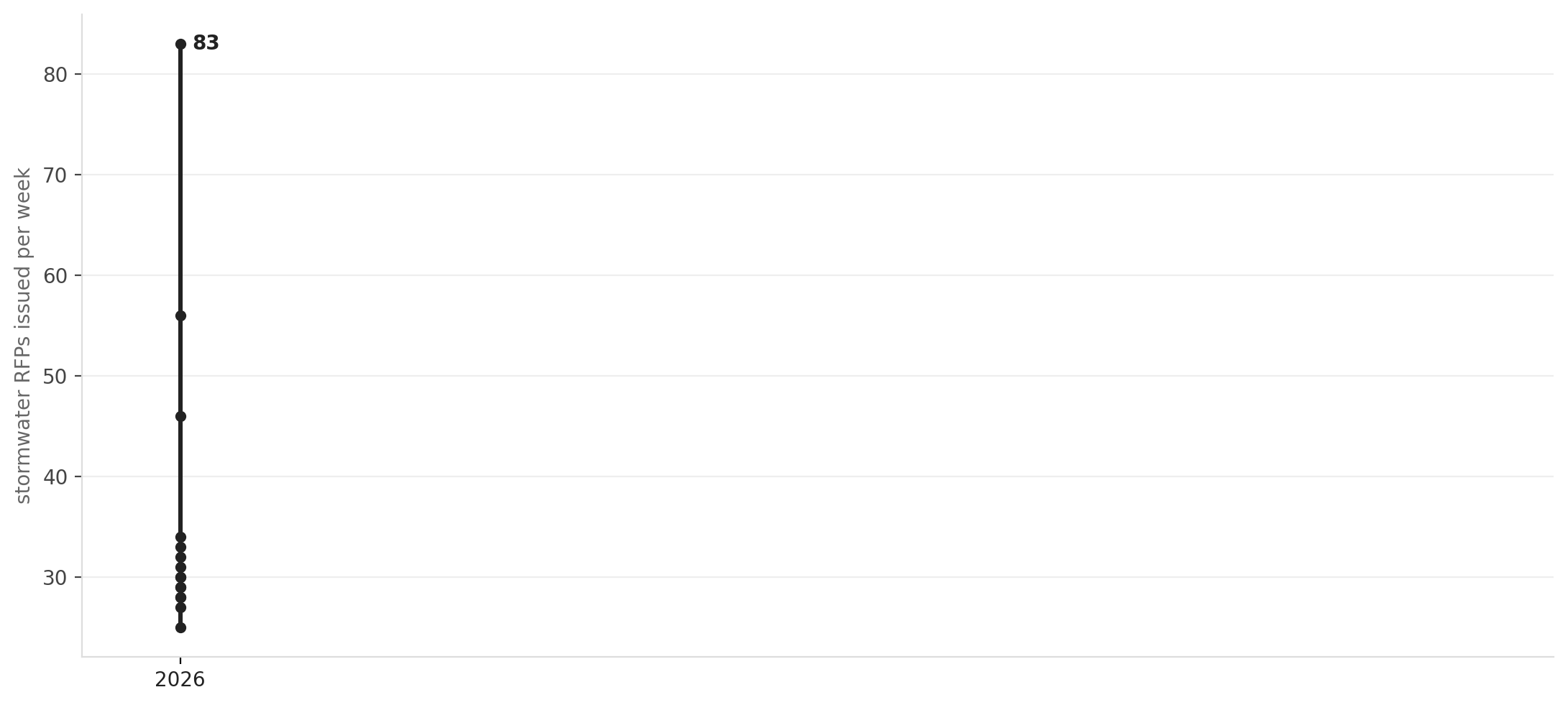
Virginia localities issued 104 stormwater management RFPs in the 30 days ending May 12, 2026, against a trailing 12-month monthly average of roughly 30.5. That 3.4x surge is not a blip: weekly volumes spiked to 83 in early February, pulled back, and are rising again, with 56 RFPs in the most recent partial week alone. The state's 30-day total is more than double North Carolina's 50, ruling out a regional weather or funding event. This is a Virginia-specific regulatory emergency.
The emergency has two clocks running at once. The first is already past: Virginia's VESM Regulation (9VAC25-875) took full effect on July 1, 2025, tightening the phosphorus discharge standard for new development from 0.41 to 0.26 pounds per acre per year and making the new VRRM 4.1 compliance methodology mandatory for every stormwater plan submitted after that date. A one-year transition period had given the design community time to adapt; as of last July there was no further grace. The second clock expires in roughly seven weeks. Under the 2023-2028 MS4 General Permit (9VAC25-890), every Phase II MS4 permittee in Virginia must demonstrate 40% Chesapeake Bay TMDL pollutant load reductions by June 30, 2026. Jurisdictions that cannot document compliance face DEQ enforcement action. Together, the two deadlines created a compliance wedge that localities spent much of the past year trying to navigate on paper and are now trying to meet with actual infrastructure.
The procurement geography reflects which jurisdictions are most exposed. Loudoun County, the fastest-growing locality in the state, leads with 26 RFPs, carrying the double burden of permitting new development under the tighter phosphorus standard while retrofitting existing systems for TMDL compliance. James City County follows with 19, Hampton with 12, Charlottesville with 10, and Accomack County with 9. The spread from Northern Virginia's growth corridor to the historic Peninsula to coastal Tidewater to the Eastern Shore is not coincidental: it maps almost exactly onto the geography of Virginia's MS4-permitted jurisdictions, which are concentrated in the Chesapeake Bay watershed and face the hardest reduction targets.
Source: NationGraph.
The work being bid spans the full range of compliance-driven capital expenditure. Charlottesville is seeking 2D stormwater watershed modeling. Christiansburg has posted industrial park stormwater upgrade solicitations. Stream restoration design, basin retrofits, and ditch-cleaning campaigns appear across multiple jurisdictions. None of this is discretionary maintenance spending. Every one of these contracts is a locality trying to generate documented, measurable pollutant load reductions before June 30.
Virginia sits at a particular pressure point in the Bay restoration effort. It is the largest single-state contributor to the Bay's nutrient load and has more MS4-regulated localities in the watershed than any other state. The June 30 milestone confirmed in Virginia Beach's 2025 TMDL Action Plan and in Fredericksburg's Phase III plan reflects a regulatory schedule that Virginia's General Assembly set in motion in 2016, with July 2025 as the first date when all transition accommodations expired. Maryland rolled its Phase III requirements out on a different calendar, which is why the current procurement surge appears to be a Virginia story rather than a Bay-wide one.
The financial backdrop is real. An active EPA Chesapeake Bay program grant portfolio of more than $24 million is flowing to Virginia DEQ through 2028-2031, giving localities a federal funding base to draw against. Virginia's 2025 General Assembly session also passed 20 new environmental laws effective July 1, 2025, adding obligations that overlap with the stormwater compliance timeline. And DEQ has published a new stormwater fee schedule effective July 1, 2026, meaning the cost of non-compliance will rise just as the enforcement window opens.
The question the procurement surge does not answer is capacity. Engineering firms that specialize in stormwater modeling, stream restoration design, and VRRM 4.1 compliance work are finite. Localities that began procurement in January or February have a reasonable shot at awarded contracts, mobilized crews, and documented progress before June 30. Jurisdictions issuing RFPs in the week of May 4 are betting that design-build timelines can compress, that consultants have bench capacity, and that DEQ will credit good-faith contracting activity as evidence of progress even if physical work is not complete.
The full 100% TMDL reduction target is not due until October 31, 2028, which means June 30 is a checkpoint, not a final exam. But DEQ's enforcement posture at the checkpoint will signal how the remaining two and a half years play out. Watch for the agency's post-June compliance communications: they will either accelerate the second half of this procurement cycle or buy jurisdictions more runway than the current deadline suggests.