Iowa's flood-control procurement volume has hit 64 open solicitations in the last 30 days, roughly 4.5 times the state's monthly baseline of about 14, and the state leads every neighboring Midwest state by a wide margin. Wisconsin logged 19 flood RFPs in the same window; Minnesota logged 14. The surge is not a single story. It is two federal timelines running simultaneously, and communities across Iowa are trying to execute both at once.
The first timeline is recovery. Under FEMA Disaster Declaration DR-4796, issued after Iowa's June 2024 severe storms and flooding, local governments are now deep in the unglamorous work of hazard mitigation grants: demolitions, asbestos inspections, property title transfers. Rock Valley, a small city in Sioux County, is currently soliciting all three for five flood-damaged homes it has acquired through FEMA's Hazard Mitigation Grant Program. The buyouts are the endpoint of a process that began when those homes flooded almost two years ago. The procurement activity showing up now reflects how long the HMGP pipeline actually takes from disaster declaration to contractor on site.
The second timeline is a federal window that did not exist six months ago. FEMA's Building Resilient Infrastructure and Communities program, known as BRIC, was canceled in April 2025 by acting FEMA administrator Cameron Hamilton, who called it wasteful and ineffective. The cancellation froze roughly $3.6 billion in previously committed awards nationwide. A coalition of 22 states sued, and on December 11, 2025, U.S. District Judge Richard G. Stearns ruled the cancellation unlawful. On March 6, 2026, he gave FEMA 21 days to issue a new notice of funding opportunity. FEMA complied on March 25, opening a combined FY2024-FY2025 application window worth $1 billion, with a federal deadline of July 23, 2026.
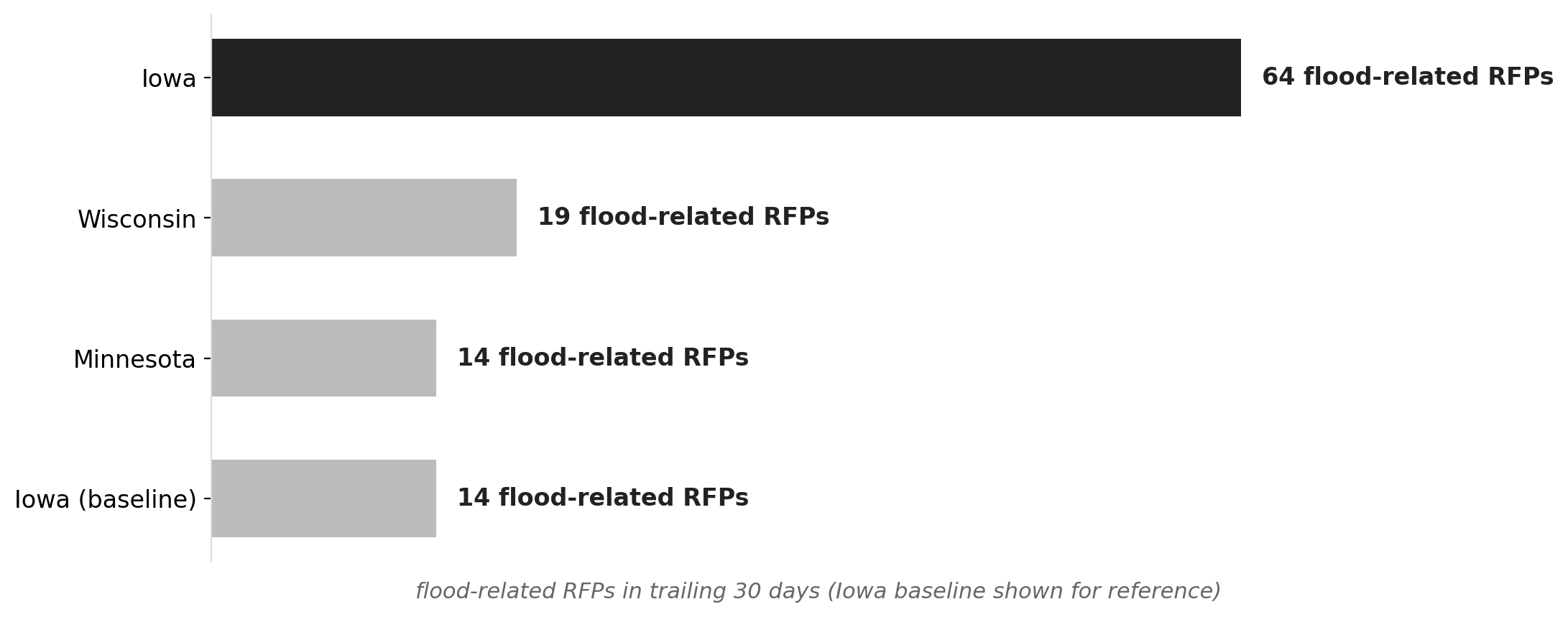
Source: NationGraph.
State hazard mitigation offices typically set their own notice-of-intent deadlines weeks or months ahead of the federal cutoff, and Iowa's HSEM is no exception. That means local governments filing for BRIC money are working against a spring deadline, not a summer one, compressing pre-application consulting, engineering, and environmental scoping into a matter of weeks. Coralville's recent RFQ for FEMA Hazard Mitigation Assistance consulting is a direct leading indicator: cities do not hire HMA consultants unless they are actively preparing a federal application, and the timing aligns precisely with the BRIC pre-application window.
Layered on top of both programs is a fresh $14.3 million FEMA Flood Mitigation Assistance grant awarded to Iowa Homeland Security on April 24, 2026, running through April 2029. That award unlocks sub-grant contracting at the local level, adding another procurement trigger that lands squarely in the current 30-day window.
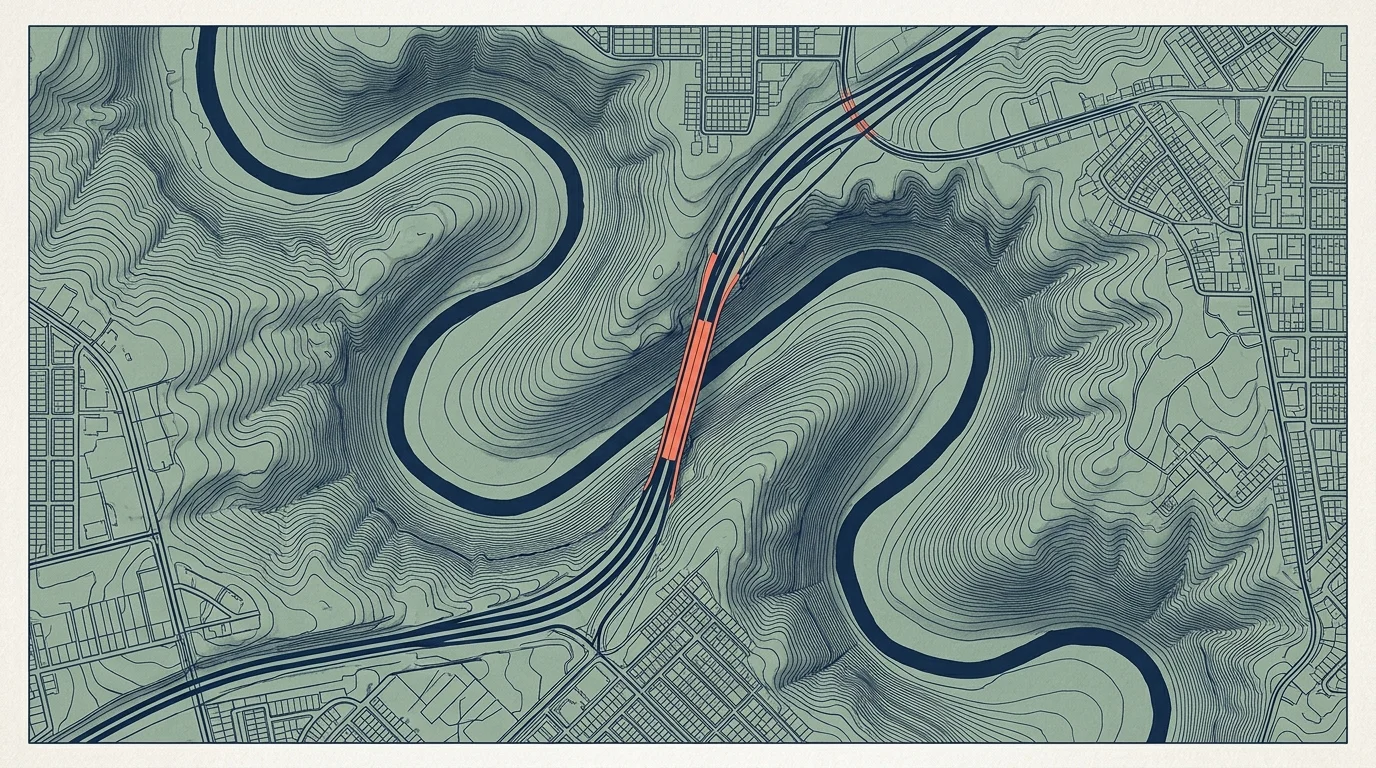
Iowa is not a state that stumbled into this moment unprepared. It has recorded 52 presidentially declared disasters since 1990, and its response to chronic flooding produced one of the more studied mitigation finance structures in the country: a 2012 sales-tax increment program that funded Dubuque's Bee Branch Watershed project, a $249.6 million effort to restore a buried creek and protect thousands of homes from basement flooding. Dubuque has secured $163 million in grants across the project's phases, and the reinstated BRIC program matters directly to the city because seven phases remain unfunded. The program's reinstatement, however, comes with a narrowing: only construction-ready infrastructure projects qualify under the new rules, a restriction that advantages cities like Dubuque, which already holds completed engineering for future phases, and disadvantages smaller communities still in planning.
That structural divide is visible in Iowa's current procurement mix. Rock Valley is in demolition mode, executing recovery work that precedes any future mitigation application. Dubuque is positioned to apply for capital construction funding immediately. Cities in between are hiring consultants to figure out which category they fall into before the state deadline closes. The 64 RFPs capture all three postures at once.
For Iowa residents, the practical implication is that the communities absorbing the most flood damage in 2024 are now simultaneously managing the slowest-moving part of federal recovery, the buyout and demolition pipeline, while also having to sprint on a funding window that may not reopen if this BRIC cycle closes without a successor appropriation. Congressional reauthorization of BRIC beyond the court-ordered FY2024-FY2025 round remains unresolved.
The next signal to watch is whether Iowa HSEM publishes its formal notice-of-intent deadline for BRIC pre-applications. When that date appears, the current procurement sprint will either sharpen into a final push or reveal which communities missed the window entirely.