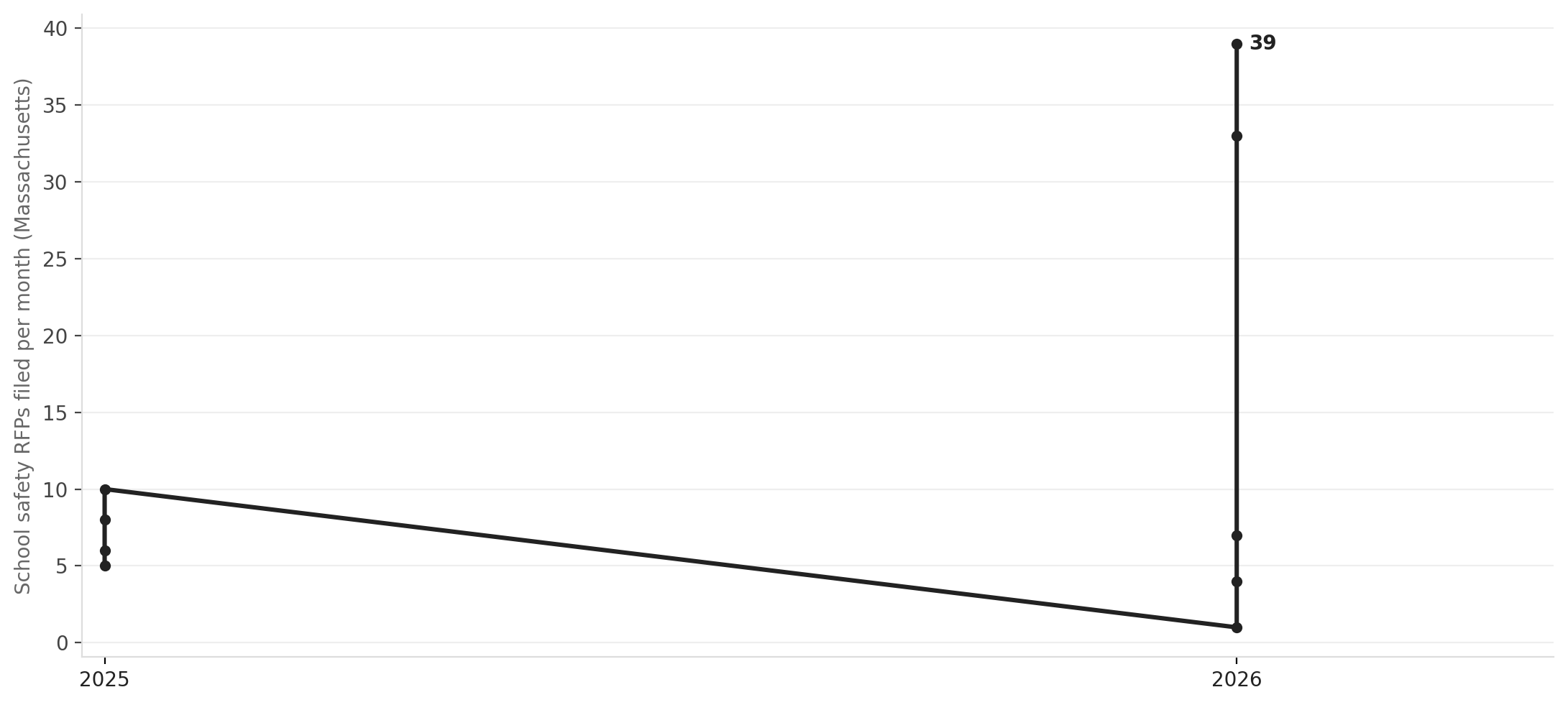
Massachusetts logged 39 school safety RFPs in the 30 days ending early May 2026, nearly five times the trailing 12-month average of about eight per month. Sixty-two percent of them, 24 out of 39, came from a single city: Springfield. The spike is not a statewide policy shift. It is one district in a race against a federal deadline.
The mechanism is straightforward. The Trump administration terminated roughly $106 million in ESSER K-12 infrastructure grants to Massachusetts, with more than $47 million of that sum committed specifically to Springfield Public Schools for intercom upgrades, security systems, and classroom communication infrastructure. Springfield Superintendent Trecia Dinnall responded by describing the affected projects as already underway or near completion, and the city's procurement office began issuing a wave of school-by-school RFPs to lock in contracts before the funding formally evaporates. The procurement record confirms it: monthly RFP volume across Massachusetts ran between one and ten filings from September 2025 through March 2026, then jumped to 33 in April alone.
The irony is structural. A federal action designed to pull back school safety money is, in the short run, accelerating school safety spending. Springfield's deliberate decision to channel ESSER dollars into one-time capital improvements rather than recurring staff costs means the district has real infrastructure projects in progress. Canceling the funding mid-stream does not un-install an intercom. It creates a contracting emergency.
Source: NationGraph.
The RFPs themselves are granular and school-specific. Filings cover classroom sound enhancement and safety intercom installations at Rebecca Johnson Elementary, Samuel Bowles Elementary, Kensington International School, Liberty Elementary, Mary O. Pottenger Elementary, and Brookings Elementary, among others across Springfield's 57-building inventory. Each represents a separate procurement action, which is why a single infrastructure program appears as two dozen distinct bids in the statewide count. Boston contributed one RFP (school safety personnel uniforms for 90 to 100 staff) and Oak Bluffs contributed one. This is overwhelmingly a Springfield story.
Mayor Sarno and Superintendent Dinnall said publicly that the intercom and communications systems were planned as deliberate, one-time capital improvements. Governor Healey called the cuts an attempt to take Massachusetts backwards on pandemic recovery and school safety. Senator Ed Markey demanded Education Secretary Linda McMahon reverse course. None of that political pressure has stopped the clawback, which is why the procurement queue is moving as fast as it is.
Springfield's exposure is not incidental. The city is Massachusetts' third-largest, a high-poverty, majority-minority district that received one of the largest ESSER allocations in the state precisely because its school infrastructure needs were among the most acute. Districts that used ESSER for recurring costs, like additional counselors or substitute teachers, face a different kind of fiscal cliff when the funding ends. Springfield's infrastructure bet means the district faces contract disputes and unfinished buildings instead, but it also means there is something concrete to finish.
A parallel federal funding stream is running in a different direction. Four School Safety National Activities grants totaling roughly $14.6 million landed in Massachusetts in January 2026, flowing to William James College ($4.1 million), the City of Boston ($4.1 million), UMass Boston ($4.1 million), and Springfield College ($2.3 million for a Holyoke-Springfield School Mental Health Pipeline Partnership). These awards focus on behavioral health pipelines rather than physical infrastructure, and they represent a federal school safety posture that is simultaneously cutting ESSER capital funds and adding mental health capacity. The Healey-Driscoll administration's Safer Schools and Communities Initiative, which distributed nearly $3 million to 42 districts for physical security upgrades including central communication systems, adds a third layer to what has become a complicated, multi-source funding landscape.
For families in Springfield, the practical question is whether the intercom and classroom safety installations at their children's schools will be completed before any funding dispute freezes the work. For school administrators across Massachusetts, Springfield's procurement wave is an object lesson in capital planning under federal uncertainty: districts that converted ESSER dollars into physical infrastructure now face a different set of risks and decisions than those that spent on services.
The next signal to watch is whether Springfield's contracting push succeeds in closing out projects before any federal claw-back mechanism takes effect, and whether Massachusetts pursues litigation to recover the terminated funds. A court ruling or a negotiated settlement could reshape the math for the remaining projects still in the RFP queue.