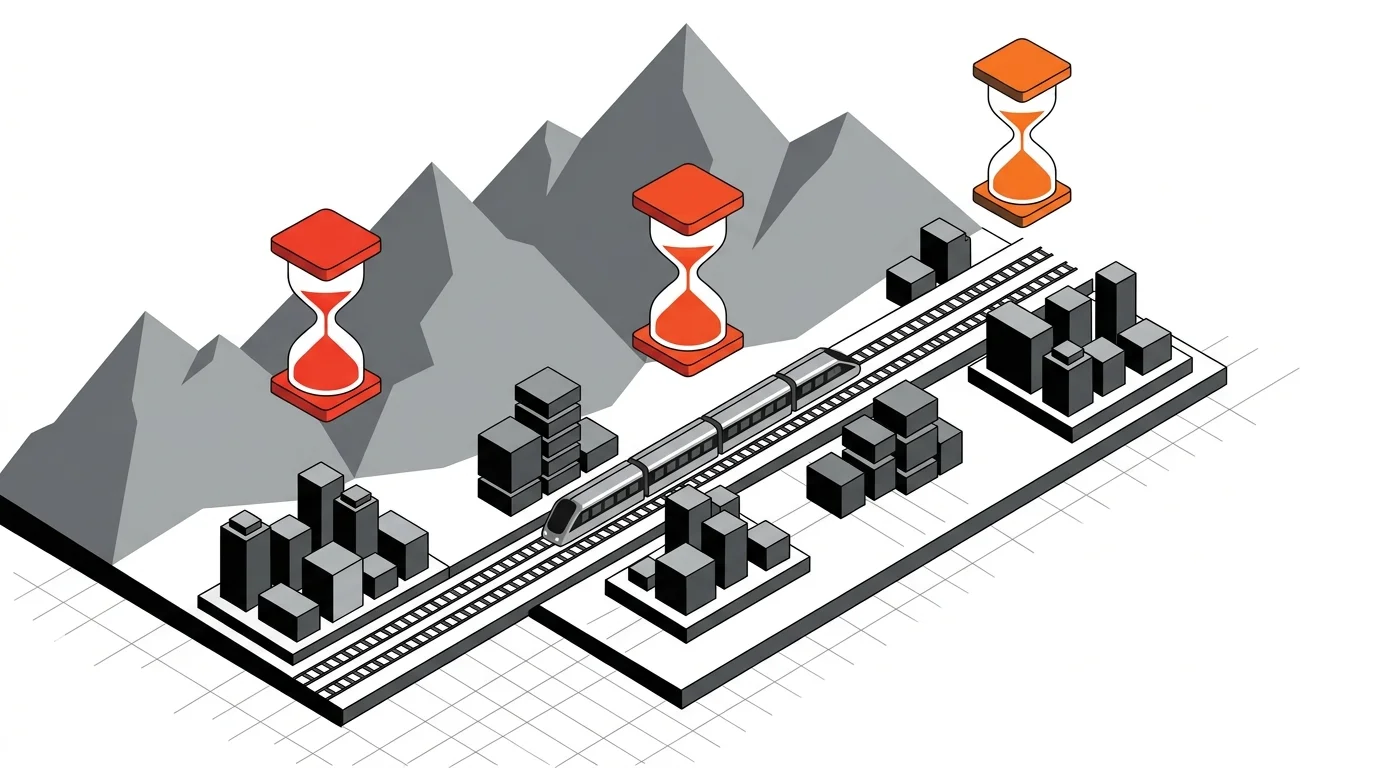
Federal transit grants awarded to Utah have hit $61.1 million in the last 90 days, a 271% surge over the $16.5 million committed in the same window a year ago, and the acceleration is not accidental. Three deadlines are stacking up at once, and state officials are moving fast enough that Utah now leads the entire Mountain West in transit grant receipts, with Colorado pulling in $28.9 million and Nevada $8.8 million over the same period.
The largest single piece is a $49.3 million Federal Transit Formula Grant awarded to the Utah Transit Authority on February 11, followed by a $5.5 million formula tranche six days later. UDOT collected an additional $5.5 million in Rural Areas and Tribal Transit Program funding on March 23. Together those awards push UTA's total active federal transit grant portfolio to roughly $192 million across 14 grants running through 2029. The money flowing now is operating capital, but it is also a signal: Utah is proving it can absorb federal dollars cleanly, which matters enormously for what comes next.
What comes next is the FrontRunner 2X Full Funding Grant Agreement, expected in August 2026. The project, detailed on the FTA's Capital Investment Grant profile, would double-track 11 segments of the commuter rail spine running from Ogden through Salt Lake City to Provo, add one station, and purchase 10 new trainsets, with construction beginning this year and service opening in 2030. Full Funding Grant Agreements require demonstrated federal confidence in a project's readiness and local match commitment. The formula grants flowing now help establish that record.
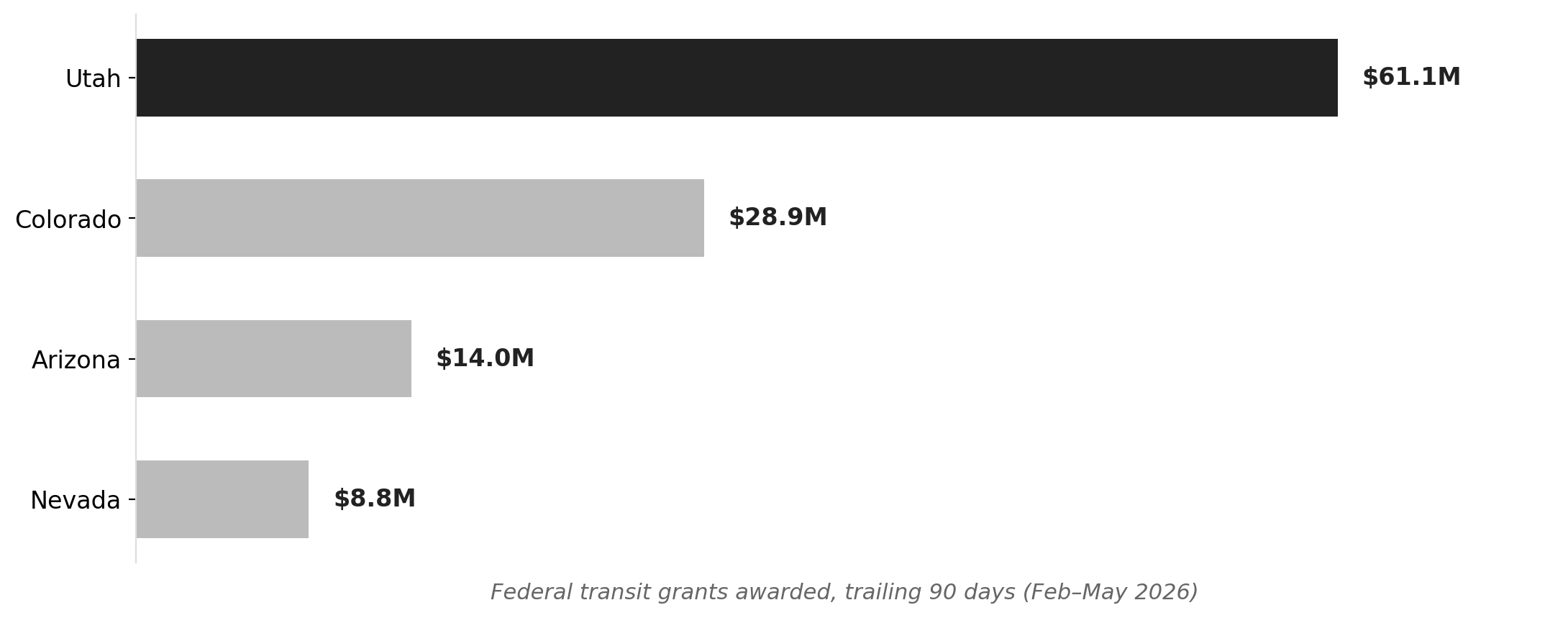
Source: NationGraph.
The second deadline is harder and more universal. The Bipartisan Infrastructure Law expires September 30, 2026. Without Congressional reauthorization, transit formula funding reverts to pre-IIJA levels, erasing billions in annual commitment nationwide. That expiration is directly compressing the obligation window for transit agencies across the country, but Utah is positioned to capture more than its nominal share because it has live projects, legislative backing, and a geography that focuses political will into a single corridor.
That geography is worth pausing on. Roughly 82% of Utah's population lives along the Wasatch Front, the Salt Lake-Provo-Ogden corridor of about 2.8 million people. There is no debate about competing alignments or rival metro priorities. FrontRunner is the spine, and everyone in the state's transit conversation knows it. The Kem C. Gardner Policy Institute at the University of Utah projects the Wasatch Front will add 31% more residents while demand for rail service grows 76%, driven by I-15 congestion that already makes the commuter rail line a practical alternative rather than an aspirational one.
The third deadline is the one no bureaucratic process can delay. Salt Lake City hosts the 2034 Winter Olympics, and the transit infrastructure expected to move athletes, officials, and spectators needs to be operational well before the opening ceremony. U.S. Transportation Secretary Sean Duffy visited Utah in April 2025 and made his priorities explicit, saying he wants to invest in transit projects that "are on budget, that are clean, that are safe, that move people". UTA, which served more than 40 million customers in 2025 and received APTA's top system award, fits that description on paper. The Olympics give Utah's congressional delegation unusual bipartisan leverage in a funding environment where transit often struggles to build coalitions.
The Utah Legislature reinforced the push during the 2026 session. SB 242 expanded FrontRunner bonding authority and directed $3 million toward rural bus replacement, ensuring that the federal rural and tribal grants UDOT is pulling in have a matching state commitment behind them. That combination of formula funding, capital project positioning, and state appropriation is the package UTA is presenting to Washington as it waits for the August FFGA decision.
For Wasatch Front commuters, the practical stakes are straightforward. FrontRunner 2X would roughly double capacity on a line that already runs near its limits during peak hours. The difference between a system that can absorb the region's next decade of growth and one that cannot will depend heavily on whether the August agreement closes on schedule and whether Congress moves to extend or replace the IIJA before the September cliff. If the reauthorization stalls and the FFGA slips, construction timelines compress toward the 2034 window with very little margin.
The next signal to watch is the August grant agreement. If FTA signs the FrontRunner 2X FFGA before the IIJA expires, Utah will have locked in the capital commitment regardless of what reauthorization looks like. If the agreement drags past September, the state enters a more complicated negotiating environment just as the funding law that made the deal possible runs out.