Federal grants for hurricane recovery water infrastructure in South Carolina hit $30.3 million in the last 90 days, a 3,241 percent increase over the same window last year, and more than North Carolina, Georgia, and Tennessee received combined in the same period.
The surge is almost entirely attributable to a single policy move: Congress passed the American Relief Act in December 2024, appropriating $3 billion nationally in EPA State Revolving Fund disaster relief specifically for water infrastructure resilience in states hit by Hurricanes Helene and Milton. South Carolina's $30.3 million allocation arrived in April 2026, eighteen months after Helene killed 49 people in the state and damaged nearly 5,000 homes when septic systems failed and water treatment plants flooded.
The EPA awarded all three grants on April 8 to the South Carolina Department of Environmental Services: $17.8 million for drinking water improvements and $12.5 million for clean water and septic resilience projects. The money runs through 2033 and prioritizes replacing decentralized septic systems with centralized sewer connections in communities where those systems failed during the storm.
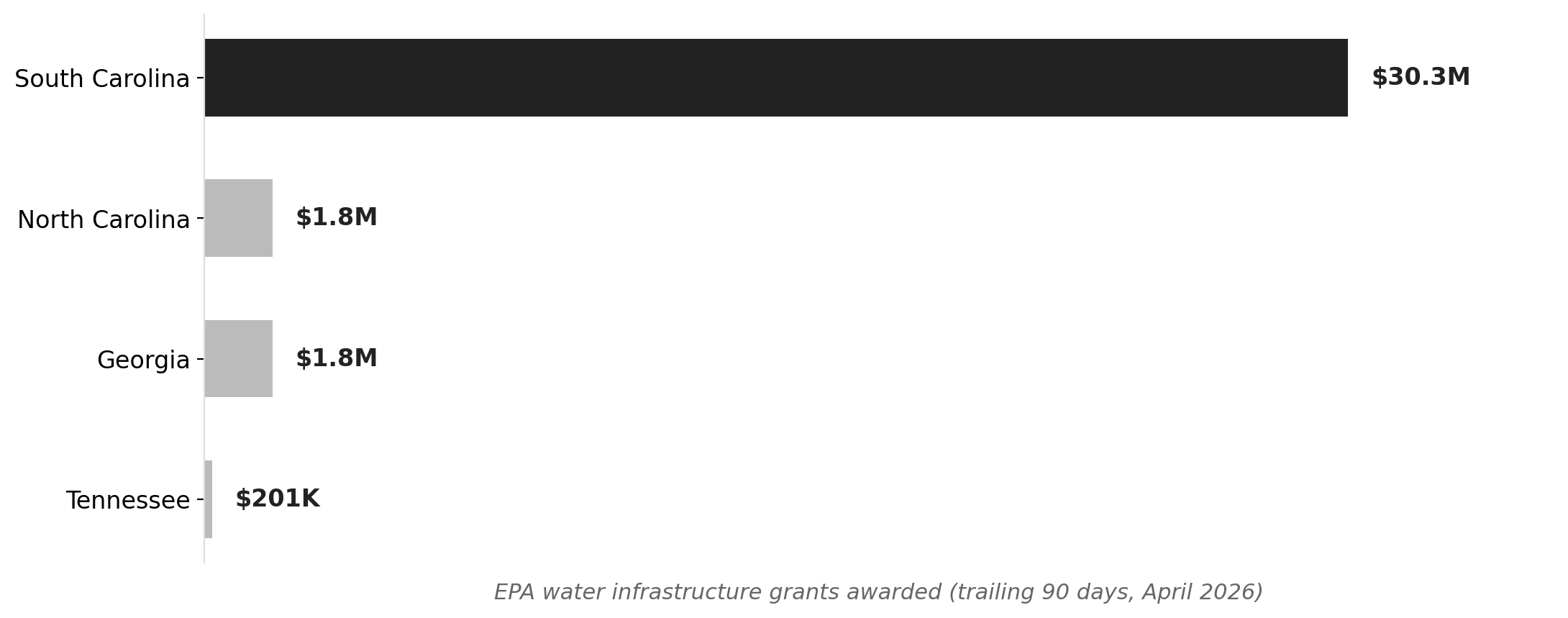
Source: NationGraph.
South Carolina is moving faster than its neighbors not because it suffered more damage, North Carolina's death toll from Helene was twice as high, but because it identified a targeted fix and positioned itself to capture federal dollars earmarked for that exact problem. The state's 187-mile coastline and rapidly developing Lowcountry face compounding pressure: coastal flooding, inland hurricane rainfall that dumped eight to twenty-four inches across the Upstate during Helene, and aging decentralized wastewater systems serving thousands of rural homes. When Helene hit in September 2024, counties like Beaufort and parts of the Upstate lost functioning sanitation for weeks. Septic system failure became the primary public health risk.
The federal legislation Congress passed three months after the storm gave South Carolina a path to fix that vulnerability permanently. The American Relief Act tied disaster recovery dollars specifically to infrastructure hardening, not temporary repairs, but long-term resilience investments. South Carolina's application focused on septic-to-sewer conversions and wastewater treatment upgrades in areas where decentralized systems had proven inadequate. The state received its allocation faster than larger neighbors because it had already mapped the failure points.
Governor Henry McMaster proposed a $240 million state-level disaster relief budget in January 2025, including $150 million for local governments denied federal FEMA assistance and $40 million to replenish the state's Disaster Relief and Resilience Reserve Fund. That state money is covering gaps the federal system won't touch. The EPA grants are covering the infrastructure that failed.
South Carolina now has $157 million in active hurricane-related water infrastructure grants running through 2033, combining the new April allocation with $127 million already in motion from earlier awards. The state is converting disaster recovery into a decade-long rebuild focused on systems that won't fail next time, centralized sewer in flood-prone areas, treatment plants with backup power, stormwater infrastructure sized for the rainfall totals Helene delivered.
The disproportion in federal allocations reflects a structural shift in how disaster recovery dollars flow. Traditional FEMA Public Assistance covers debris removal, emergency protective measures, and facility repairs. South Carolina identified $1.3 billion in FEMA-eligible damage from Helene, and that money is moving through separate channels. The EPA grants are different: low-interest State Revolving Fund loans with principal forgiveness, structured to leverage private capital and stretch federal dollars further. South Carolina is using them to pay for infrastructure that serves both immediate recovery and long-term development pressure.
The timeline matters. Hurricane season begins June 1. The state is racing to obligate these grants and break ground on projects before the next storm arrives. The money covers planning, design, and construction through 2033, but the clock is shorter than that: communities that lost septic systems in 2024 need functioning sanitation before summer.
What comes next depends on how fast the state can move dirt. The grants are awarded. The question now is whether South Carolina can convert federal recovery dollars into hardened infrastructure faster than the next hurricane arrives.