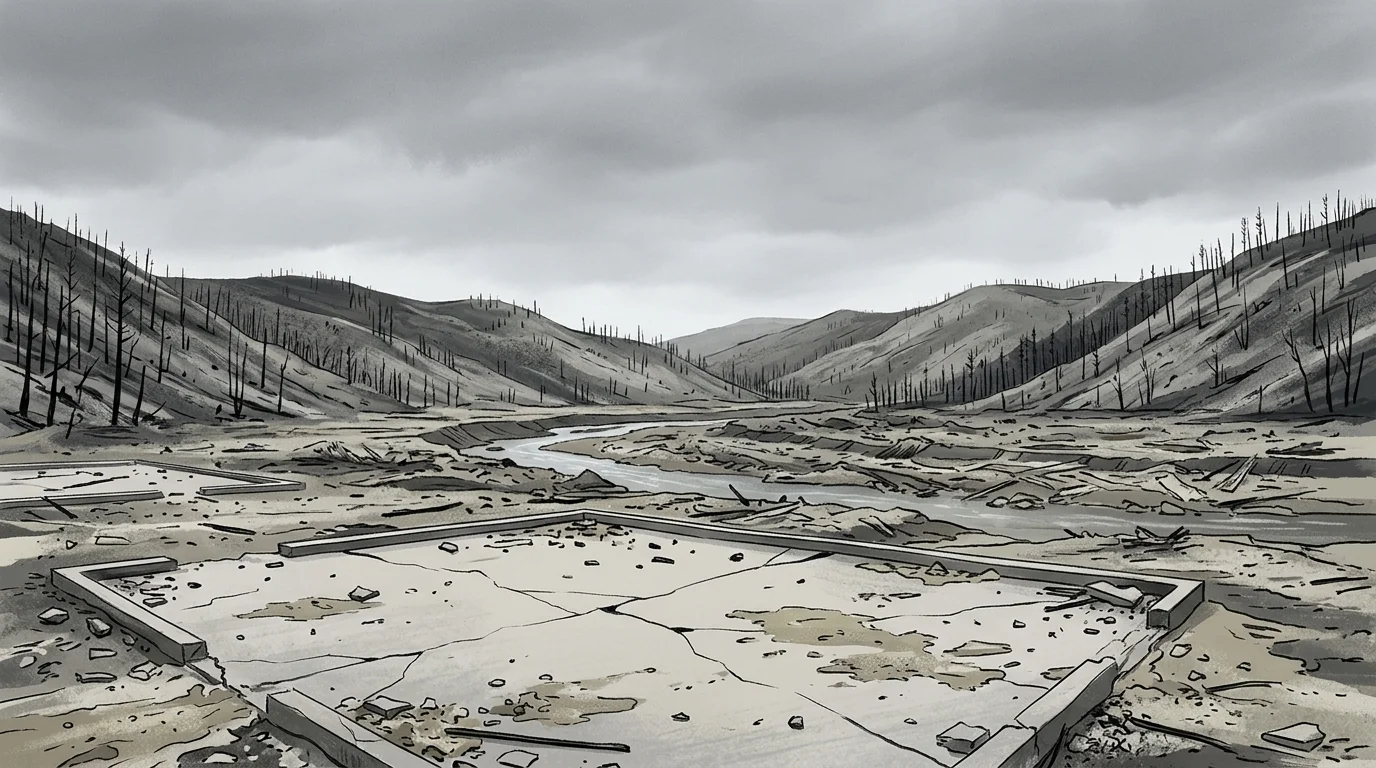
Eighteen months after Hurricane Helene tore through northeast Tennessee, federal agencies are still cutting checks for road repairs in increments of $63,000. The money arrived within days of the storm. The bureaucracy needed to spend it moves at a different speed.
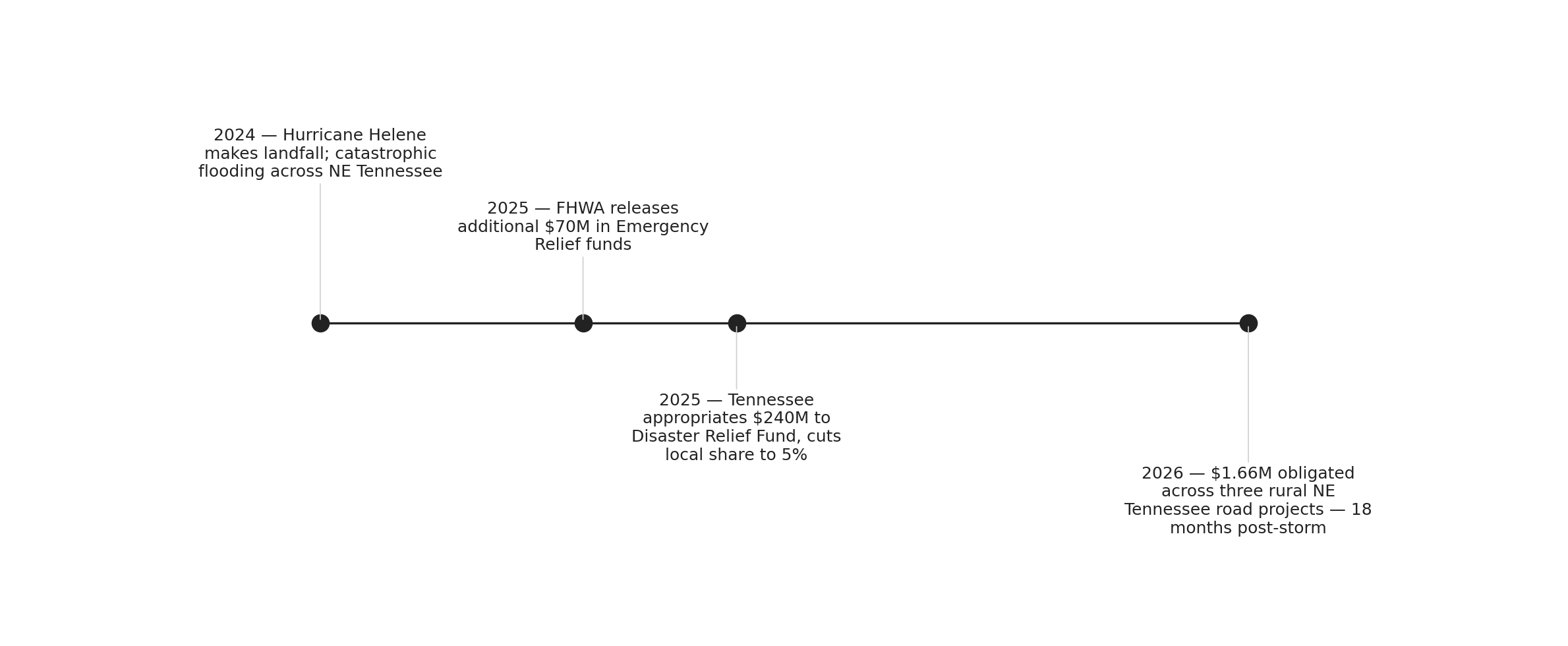
The Federal Highway Administration released $32 million in Emergency Relief funding to Tennessee on October 5, 2024, three days after President Biden declared a major disaster for eight Appalachian counties. By March 2025, FHWA had sent another $70 million. But in April 2026, Carter, Johnson, Unicoi, Sullivan, and Hawkins counties are still receiving individual project obligations totaling $1.66 million for roads damaged in September 2024. The largest single project, a $1.52 million rebuild of State Route 159 in Johnson County, was obligated this month. The smallest, a $63,000 culvert replacement in Carter County, came through in February.
The constraint is not money. Biden authorized 100% federal reimbursement for Helene emergency work, and Tennessee appropriated $240 million to its Disaster Relief Fund while reducing local cost-share requirements from 12.5% to 5%. The constraint is the rural counties themselves. FHWA's Emergency Relief program requires each project to pass through a gauntlet of damage assessments, engineering plans, environmental reviews, and federal obligation paperwork before a single bulldozer moves. In Johnson County, where the median household income is $36,000 and the county seat has fewer than 2,000 residents, that process takes time the county does not have.
Source: NationGraph.
Northeast Tennessee's Appalachian counties are among the state's poorest, with steep terrain that makes every washed-out culvert a potential community isolation event. Roads here are not amenities; they are lifelines. When Helene dumped catastrophic rainfall on the region in late September 2024, it killed 15 people in Tennessee through direct freshwater flooding and closed Interstate 40 and Interstate 26 at the North Carolina state line. State Routes 159, 107, and 37, narrow two-lane roads threading through mountain valleys, were buried under debris or undermined by floodwaters. Some remain under repair today.
The Tennessee Department of Transportation manages the FHWA funds and parcels them out to local jurisdictions, but TDOT cannot write the local engineering plans or complete the site-specific assessments federal rules require. Counties must do that themselves, and rural Appalachian counties do not have idle engineering staff waiting for disasters. They hire consultants, request extensions, and move as fast as their administrative capacity allows. The result is a recovery timeline measured in years, not months.
Tennessee faces an $82.7 billion infrastructure backlog statewide, and rural counties struggle to access even routine federal funding due to lack of grant-writing expertise. Disaster recovery accelerates nothing. It adds another layer of paperwork to systems already operating at capacity. Unicoi County's repair of a bridge on State Route 107, obligated in March 2026, required eighteen months of back-and-forth between local officials, TDOT engineers, and federal reviewers before construction could begin. The work itself will take weeks. The approval process took a year and a half.
FEMA has provided $16 million in additional recovery funding to Tennessee as of January 2025, and the state's Disaster Relief Fund remains well-capitalized. But dollars on a balance sheet do not repair roads. Engineers do, and rural counties do not have enough of them. The Administrative capacity gap is structural, and it predates Helene. The Appalachian Regional Commission has documented chronic infrastructure deficits across its 13-state footprint for decades, driven in part by the inability of small jurisdictions to compete for competitive federal grants or manage complex reimbursement programs.
The paradox is this: the federal government can move billions in disaster declarations faster than a mountain county can file the paperwork to fix a single bridge. Helene made landfall in September 2024. FHWA sent the first tranche of money five days later. But the system is built for speed at the top and friction at the bottom, and the people who need the roads fixed the most are the ones least equipped to navigate the process that pays for them.
The next hurricane season begins June 1. Tennessee's Appalachian road network is still being restored from the last one. The question is not whether federal disaster aid works. It is whether it works fast enough to matter in places where administrative capacity is as scarce as the money is not.