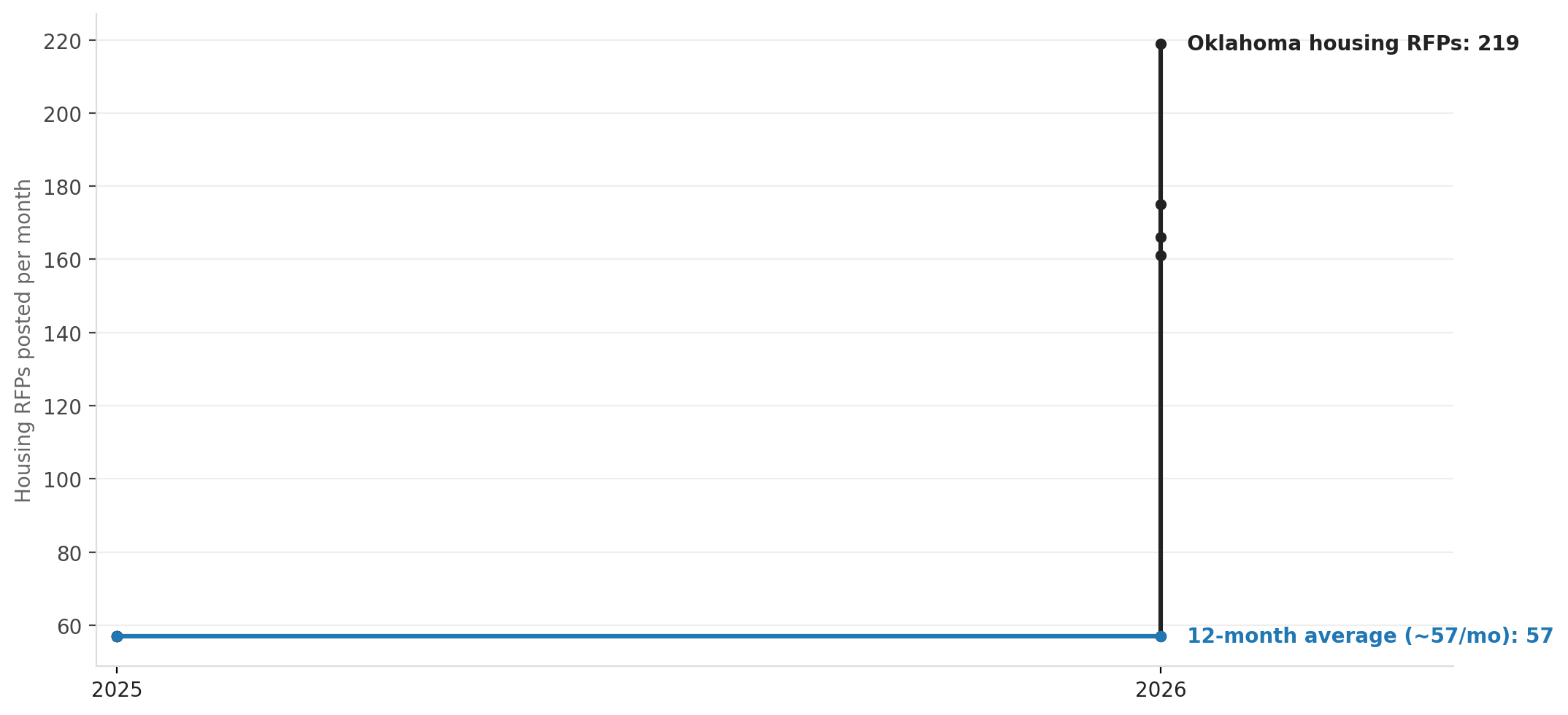
Oklahoma posted 175 housing construction and rehabilitation solicitations in the last 30 days, against a 12-month monthly average of roughly 57. That is a 3.1x spike, and it did not come from nowhere: February 2026 saw 219 such requests, March 166, April 161. The state's procurement machinery has been running well above its historical baseline for months.
The money behind that activity is specific. The federal government obligated $38.5M in new HUD housing grants to Oklahoma agencies in the last 90 days, spread across 58 individual awards. The Oklahoma Housing Finance Agency leads the list at $16M, followed by the Tulsa Housing Authority at $9.2M and the Oklahoma City Housing Authority at $7M. All three are now tendering contracts, which is why the RFP count looks the way it does.
The other major force driving the surge is operating on a different legal track entirely. Cherokee Nation issued 29 housing rehab solicitations in the last 30 days, covering 10 counties across northeast Oklahoma: Sequoyah, Delaware, Adair, Cherokee, Craig, Mayes, Wagoner, Muskogee, Rogers, and Tulsa. That activity flows directly from the permanent reauthorization of Cherokee Nation's Housing, Jobs and Sustainable Communities Act, signed in September 2024, which committed $120M to tribal homebuilding and rehab and has already initiated more than 2,800 projects. Because the tribe administers its own HUD partnerships and funds its housing authority independently of the Oklahoma statehouse, it is largely insulated from the political dynamics stalling action at the state level.
Source: NationGraph.
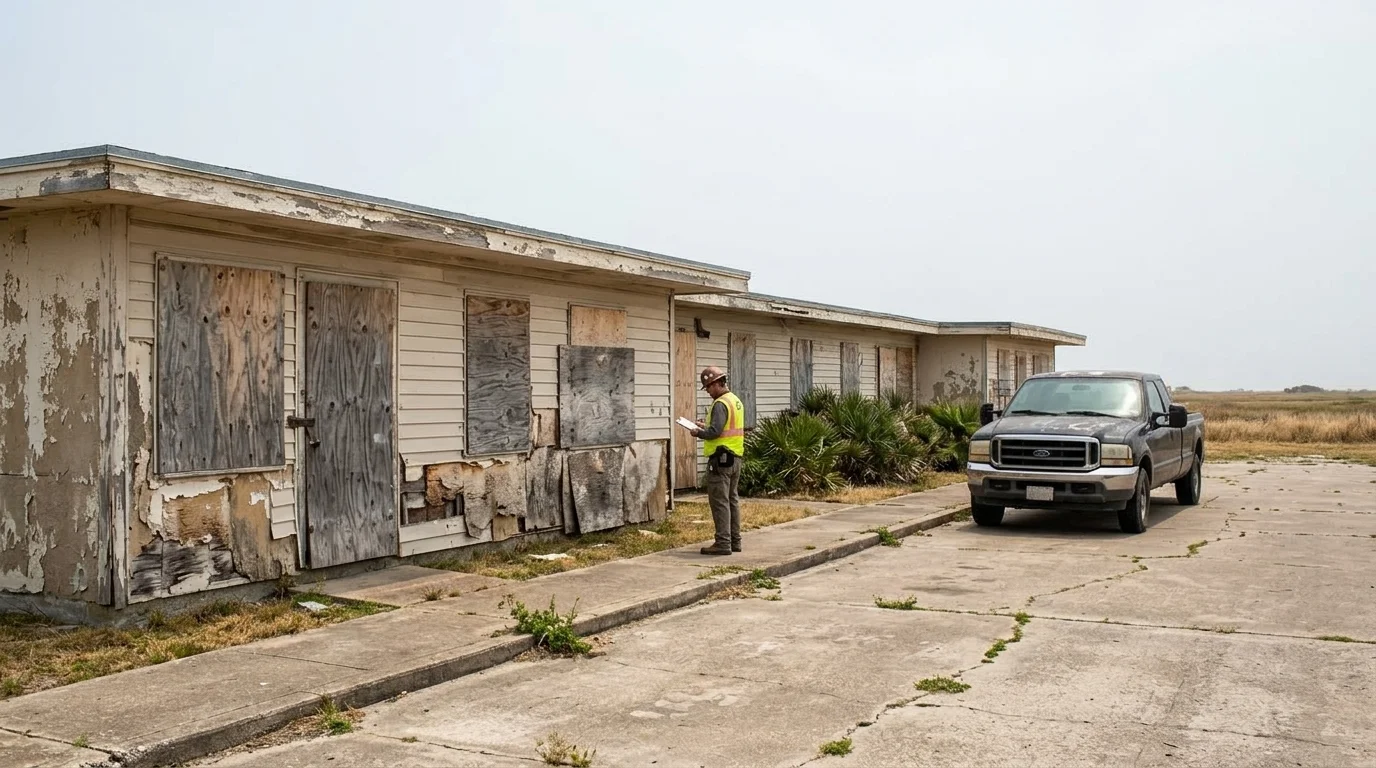
Those dynamics are worth naming plainly. Oklahoma faces a shortage of more than 80,000 rental homes affordable to extremely low-income households, a figure the National Low Income Housing Coalition and Oklahoma Watch have both documented. The perverse companion fact is that the state has hundreds of thousands of vacant units that are too deteriorated to be affordably inhabited. Oklahoma Policy Institute analyst Sabine Brown put the structural problem directly: "We're not building enough housing, and we have aging housing that is dropping off the market." The homes exist on paper; they do not exist as usable shelter.
The state legislature has not filled that gap. Governor Stitt vetoed SB 128, a bipartisan eviction reform bill that would have extended notice timelines for renters, in 2025. Several supply-side housing bills failed in the same session. Oklahoma already operates one of the most tenant-unfavorable legal environments in the country, where a renter can go from one day late on rent to eviction in under two weeks. The result is that housing authorities and tribal governments have become the primary construction actors in the state, not by design but by default.
A third force is adding urgency to the timeline: HB3335, the Oklahoma Housing Act of 2026, is pending with an effective date of November 1, 2026. Agencies that want to move projects under the current regulatory framework have reason to get procurement done before that date resets the rules. That deadline pressure is visible in the monthly RFP numbers.
The economic rationale for the current pace of activity is not in dispute. A May 2026 Urban Institute report found that 45 Oklahoma affordable multifamily developments generated $276M in labor income and are projected to produce $126M in tax revenue over 10 years. Those figures apply to projects that are already built. The pipeline now in procurement will, if completed, generate comparable returns.
On the tribal side, Cherokee Nation is also doing something with no state-level equivalent. It is the first tribe in the country to administer HUD's Section 184 Skilled Workers Demonstration Loan Program, using housing construction specifically to recruit public safety officers and healthcare workers to hard-to-fill positions in its service area. That is a procurement strategy tied directly to workforce, not just shelter.
For residents in Tulsa, Oklahoma City, and the 10-county Cherokee Nation footprint in northeast Oklahoma, the practical implication of a 3.1x RFP surge is that more construction contracts will be awarded in the next 12 months than in any comparable period in recent years. Whether the units get built on schedule depends on contractor capacity, materials costs, and whether HUD grant timelines hold.
The next signal to watch is the November 1 effective date for HB3335. If the Oklahoma Housing Act of 2026 passes and takes effect as written, it will reset the regulatory environment under which housing authorities operate. Agencies that have not awarded contracts by then will be working under a new framework. The procurement clock is running.