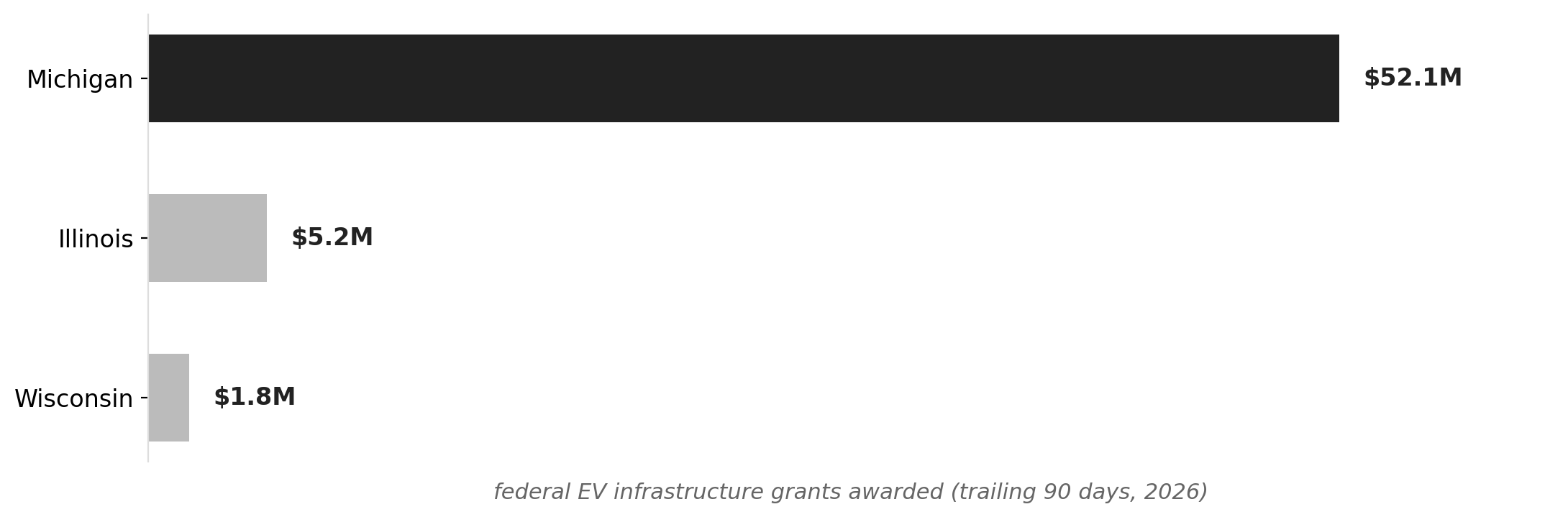
Michigan received $52.1 million in federal electric vehicle infrastructure grants in the last 90 days, a 112-fold increase over the $460,000 awarded in the same window last year. The March surge came after federal highway officials certified Michigan's interstate charging corridors as complete, unlocking the second half of the state's six-year allocation and clearing the way for chargers in cities, rural gaps, and medium-duty vehicle routes.
All five grants came from the U.S. Department of Transportation's National Electric Vehicle Infrastructure program, with $50.6 million landing in March 2026 alone. Four identical awards went to the Michigan Department of Transportation for corridor expansion. The timing was deliberate: MDOT had been waiting for the Federal Highway Administration to approve its fiscal year 2026 deployment plan and certify the state as "fully built out" under NEVI's two-phase structure, which required states to complete 50-mile charging intervals along interstates before spending on anything else.
FHWA issued that approval in early April 2026, following revised guidance the Trump administration released in August 2025. The new rules let states self-certify buildout status and streamlined planning requirements after a chaotic 15-month stretch in which the administration froze all NEVI funding, rescinded state plans, and then restarted approvals under looser standards. Michigan submitted its updated plan under the August framework and won certification within weeks, authorizing the state to spend the remaining $51 million of its $106 million total NEVI allocation.
Source: NationGraph.
That $51 million can now go to geographic gaps between corridors, community charging hubs in Detroit and Grand Rapids, medium-duty vehicle routes serving commercial fleets, and underserved rural counties. MDOT has 83 NEVI-funded charging stations already in deployment from the corridor-focused Rounds 1 and 2, more operational federally funded chargers than any other state. The agency also piloted the nation's first wireless charging installation with NEVI dollars, testing inductive pads on a Detroit-area roadway.
Michigan's $52 million in new grants dwarfs the rest of the Midwest. Illinois took in $5.2 million over the same 90 days; Wisconsin received $1.8 million. Michigan's total NEVI allocation is ten times larger than Wisconsin's and roughly double Illinois's, a function of the formula's weighting toward lane miles and vehicle registrations. One in five jobs in Michigan ties to the automotive sector, and the state has added more than 15,000 mobility and EV manufacturing positions since 2019, concentrating demand for commercial charging infrastructure around assembly plants in Wayne, Oakland, and Macomb counties.
Governor Gretchen Whitmer set a goal in 2019 of supporting 2 million electric vehicles by 2030 and achieving statewide carbon neutrality by 2050. But her legislative budget requests for state-funded EV subsidies, $108 million proposed between 2022 and 2026, have all failed in the Republican-controlled legislature, forcing the buildout to rely almost entirely on federal dollars. MDOT, the Department of Environment, Great Lakes, and Energy, and the Office of Future Mobility and Electrification jointly administer the NEVI program, coordinating site selection with utilities and private charging operators.
The August 2025 guidance shift was the key variable. Before the freeze, states faced strict federal review cycles and narrow eligibility rules that limited spending to fixed 50-mile interstate intervals. The revised guidance from Transportation Secretary Sean Duffy cut administrative layers and expanded eligible uses, letting states move faster and spend on community priorities once corridor requirements cleared. Michigan's April certification means it met the 50-mile standard and can now deploy chargers based on local demand rather than federal route mandates.
The $51 million authorization expires at the end of fiscal year 2026, giving MDOT six months to commit the funds. The agency has not yet released a deployment timeline for the discretionary phase, but the March grant velocity suggests it is prioritizing speed over extended planning cycles. The next signal to watch is MDOT's site selection announcements for Round 3, expected by late spring, which will show whether the state directs the majority of remaining dollars to Detroit's urban core or spreads them across the Upper Peninsula and rural western counties that saw minimal buildout in earlier rounds.