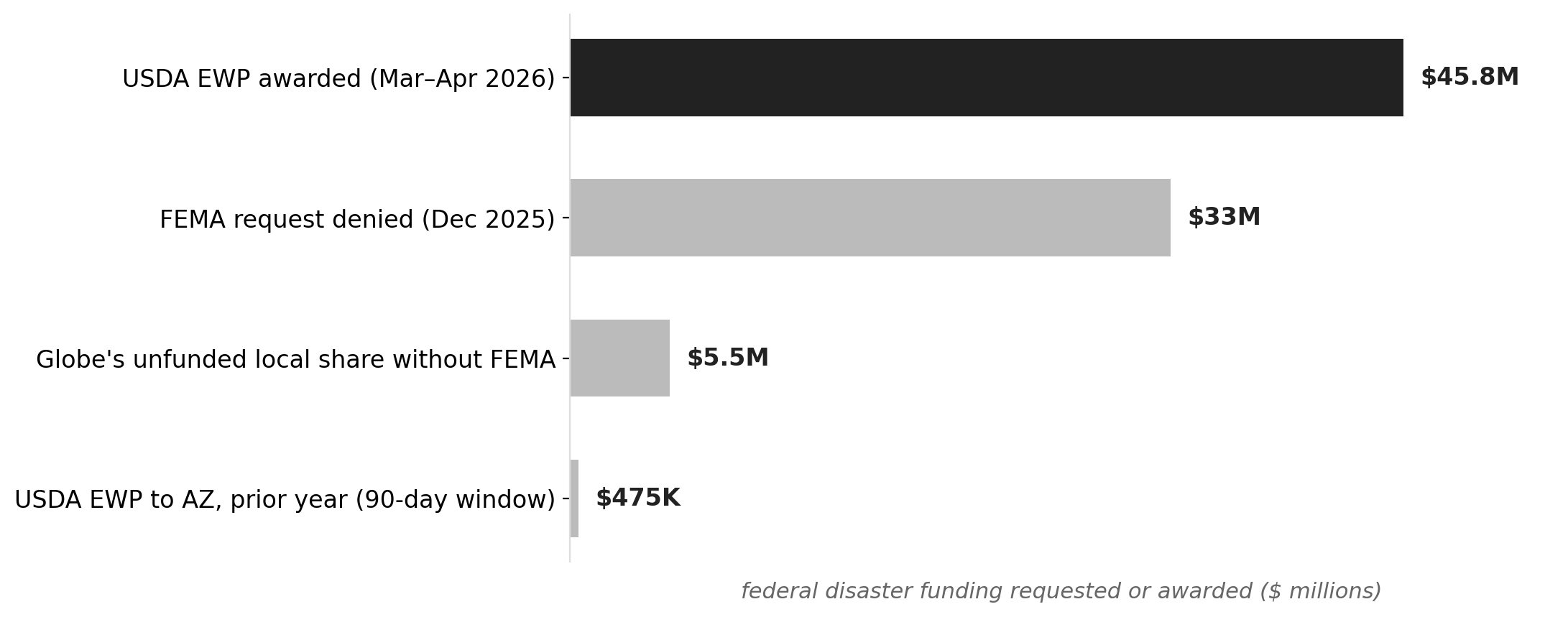
Federal grants for flood control in Arizona hit $45.8 million in the last 90 days, up from $475,000 in the same window a year ago, a 9,550 percent increase driven entirely by two USDA Emergency Watershed Protection grants to Gila County and the city of Globe. The awards landed in March and April 2026, three months after FEMA denied the state's disaster declaration request for the same floods.
Gila County received $26.5 million and Globe $19.3 million, the first USDA watershed protection grants to Arizona since at least 2020. Both run through September or October 2026, six- to seven-month windows that align with the start of Arizona's monsoon season. The speed matters: USDA's Emergency Watershed Protection program does not require a FEMA disaster declaration or a presidential signature. The state NRCS conservationist can approve within 60 days of a local sponsor's request.
The September 2025 floods killed at least three people, caused over $100 million in damage by the state's revised assessment, and sent 1,000 propane tanks through downtown Globe when floodwaters reached 20 feet in places. Governor Katie Hobbs requested $33 million in federal disaster relief. FEMA denied the request on December 20, saying damages did not exceed state and local capacity. Hobbs appealed January 16. The appeal remained under review as of mid-March, when the USDA grants were announced.
Source: NationGraph.
Gila County is home to 40,600 people, with Globe, the county seat, accounting for 7,200. Over 70 percent of county land is federally owned, leaving a narrow tax base that local officials cited in their FEMA appeals. Globe Mayor Al Gameros told reporters in March that without FEMA, the city's share of flood mitigation costs would rise from $2.1 million to $5.5 million. The USDA awards effectively covered that gap and then some.
The institutional structure explains the turnaround. FEMA's disaster declaration process runs through the White House and involves damage thresholds tied to state population and revenue. USDA's Emergency Watershed Protection program operates independently under the Natural Resources Conservation Service and focuses on imminent watershed hazards, sediment, debris flows, unstable slopes. A county or municipality can request EWP funds directly through its local NRCS office. The agency evaluates engineering feasibility and the threat to life and property, not whether damages exceed a political threshold.
Arizona had not received EWP funding in at least six years before these awards. The program has been available since the 1950s, but its use varies widely by state and year depending on local knowledge and the nature of the disaster. Flooding that leaves behind watershed instability, damaged culverts, eroded channels, debris-choked drainages, fits the program's mandate better than wind or fire damage.
Gila County and Globe are now racing the monsoon calendar. Both grants expire in early fall 2026, giving contractors a narrow window to stabilize drainages, remove debris, and harden infrastructure before summer storms arrive. The county's $26.5 million will fund sediment removal, channel restoration, and culvert replacement across multiple watersheds. Globe's $19.3 million targets downtown drainage improvements and slope stabilization near residential areas that flooded in September.
FEMA's appeal process continues in parallel. If the agency reverses its December denial, Arizona could receive additional funds for longer-term reconstruction and hazard mitigation grants. But those dollars, if they come, will arrive months after the USDA work is underway. The practical effect is that rural communities hit by watershed disasters now have a faster federal option if they know where to look.
The next signal to watch is whether other Arizona counties begin filing EWP requests. Mohave County also flooded in September 2025 and was included in the state's FEMA request. If Mohave follows Gila County's path to USDA, it would confirm that the agency has become the go-to for rural flood recovery when FEMA says no.