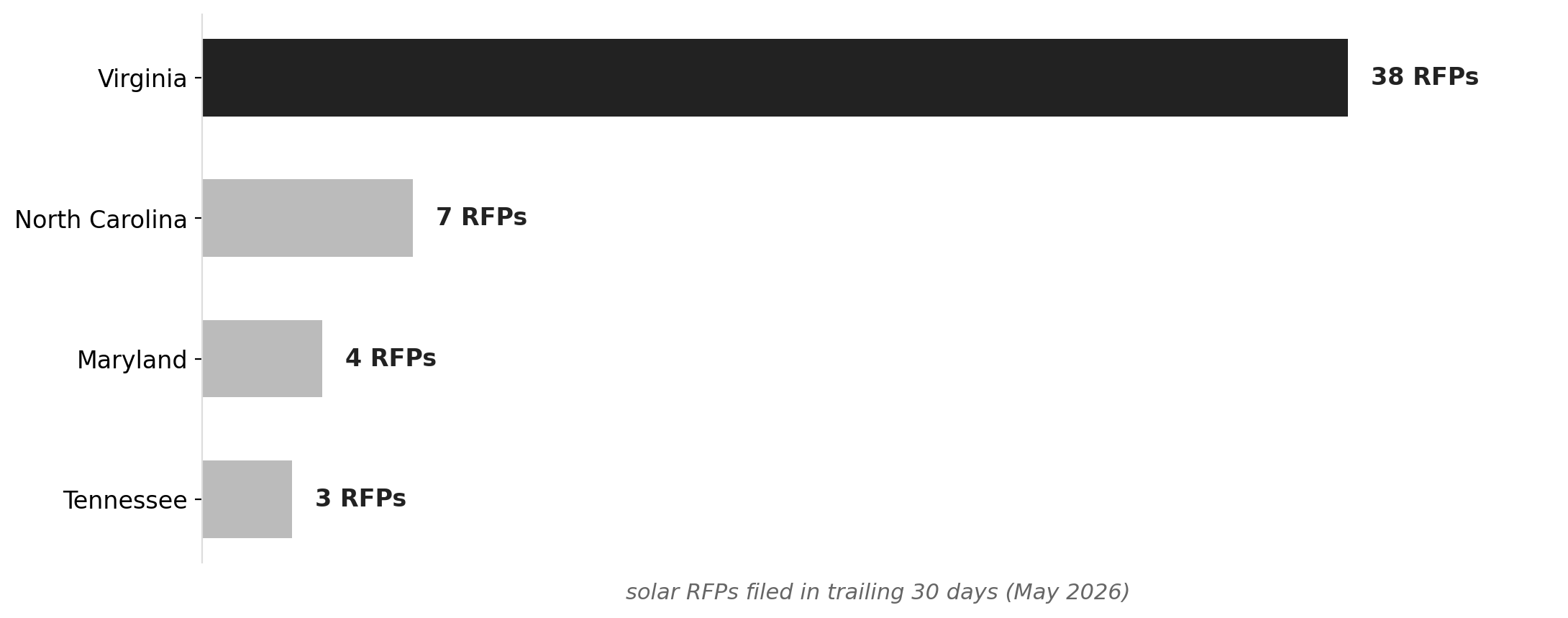
Virginia localities filed 38 solar procurement requests in the last 30 days, against a 12-month average of about 7.5 per month, a 5.1x spike that dwarfs anything happening in neighboring states. North Carolina logged 7 solar RFPs in the same window, Maryland 4, Tennessee 3. Virginia is not riding a regional wave. It is responding to a set of hard deadlines converging on July 1, 2026.
The immediate trigger is Governor Abigail Spanberger's 2026 clean energy package, signed this spring after a newly Democratic General Assembly flipped 13 seats in November 2025. Three interlocking bills are reshaping procurement timelines simultaneously. SB 254/HB 807 mandates the release of 525 megawatts of new shared solar capacity by July 1, six weeks away. The Distributed Generation Expansion Act (HB 628/SB 175) quadruples the distributed generation carveout in the Virginia Clean Economy Act from 1% to 4.5% through 2030. And the FAST Act (HB 1065), described by Advanced Energy United as "the strongest surplus interconnection law across the country to date", requires Dominion Energy and APCo to assess existing solar projects for surplus interconnection potential and run competitive RFP pilot programs. Localities and utilities alike are working against the same clock.
A second pressure point arrived from the State Corporation Commission. Its May 1, 2026 deadline to rule on Dominion's proposal to restructure net metering export credits (NEM 2.0) created a parallel scramble: customers and commercial buyers who interconnect before the ruling lock in the current 1:1 retail credit rate. According to a breakdown published by IpSun Solar, the shift away from retail-rate credits could meaningfully reduce the economics of rooftop and small commercial solar installed after the ruling. That regulatory cliff accelerated RFP activity well before the July legislative deadline.
The RFPs themselves span a range of procurement types: school solar power purchase agreements, municipal franchise agreements for community solar, landfill solar lease opportunities, and on-site photovoltaic feasibility studies. Christiansburg (Montgomery County) and James City County account for the bulk of the volume. The scale of activity in those two jurisdictions reflects, in part, batched ingestion of multi-year procurement archives, but the underlying solicitations are real and active. School solar PPAs and landfill lease agreements do not appear in procurement databases unless someone is seriously pursuing them. DOE conservation grants already flowing into Virginia school systems, $15 million to Richmond City Schools and $11.5 million to Nottoway County Schools, suggest federal capital is also accelerating local timelines.
The deeper driver beneath all of this is Virginia's electricity demand crisis. Northern Virginia hosts the largest concentration of hyperscale data centers in the world, and those facilities are projected to consume electricity equivalent to 60 percent of all Virginia homes. Over 43,000 megawatts of proposed renewable projects sit stalled in the PJM interconnection queue, unable to reach the grid fast enough to meet load growth. A Dominion spokesman has said the utility needs "as much power generation as we can get from every source." The VCEA's 2026 compliance benchmarks make that urgency structural: Phase I utilities must hit 17 percent renewable generation this year, Phase II utilities must hit 29 percent, or face $45 per megawatt-hour penalties. Dominion has already petitioned the SCC for approval of 4,500 megawatts of solar as part of a 16,100-megawatt VCEA requirement. The Virginia Mercury has reported that the Spanberger administration specifically framed the energy package around customer affordability, not just climate targets, a signal that cheap, distributed solar has become a ratepayer issue, not just an environmental one.
The scale of unmet demand is not hypothetical. Virginia's original 200-megawatt shared solar program was fully awarded across 52 projects and still had waitlists. The new 525-megawatt mandate in SB 254/HB 807 exists precisely because the prior program was exhausted. Governor Spanberger's office noted at signing that the expanded program includes a dedicated carveout for low-income subscribers, adding a social equity requirement on top of the volume mandate.
For Virginians watching their electricity bills, the next signal to track is how quickly Dominion and APCo publish the FAST Act RFP pilot programs and whether the SCC approves the 4,500-megawatt solar petition before the summer compliance window closes. Localities that filed procurement documents in the last 30 days are betting those approvals come through. How many of those 38 RFPs result in signed contracts before July 1 will be the first real test of whether the legislative deadlines translate into megawatts on the grid.