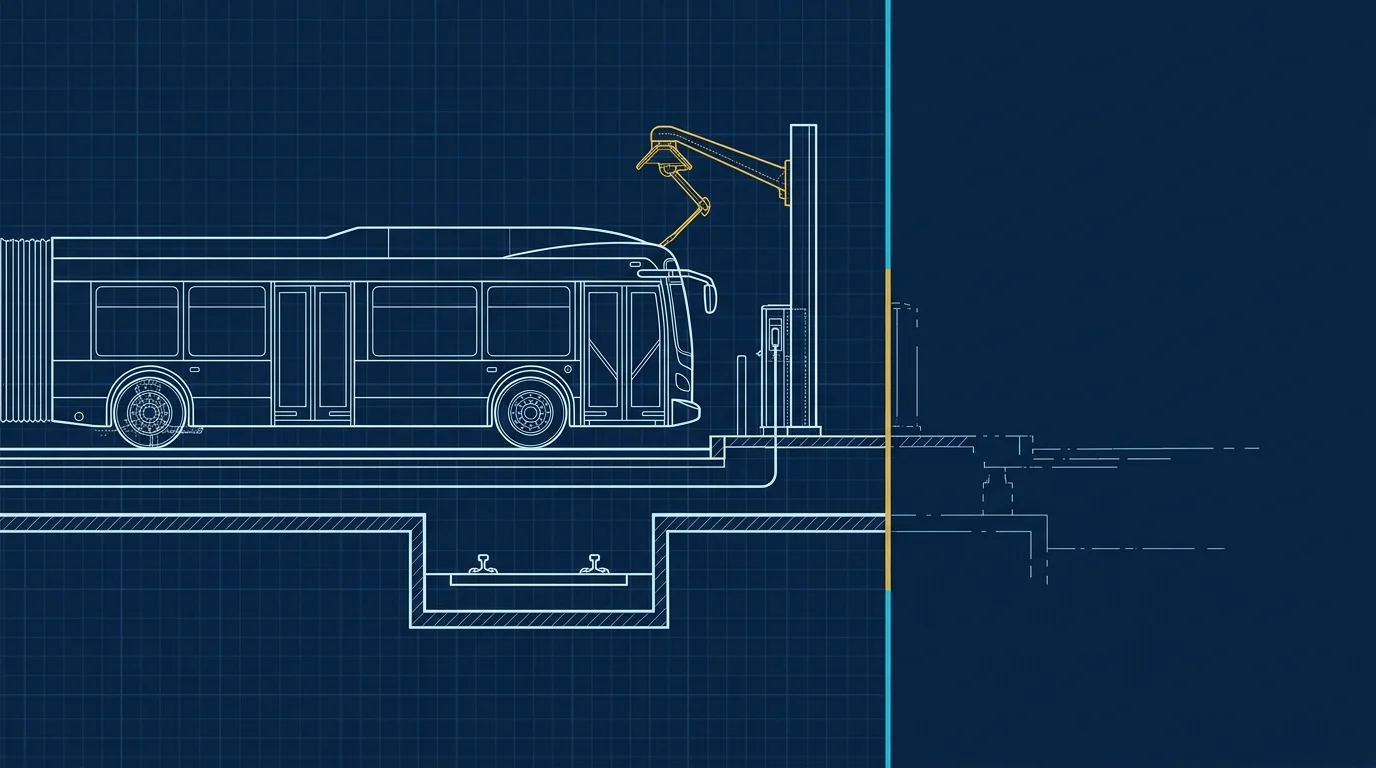
Ohio has issued 26 EV charging RFPs in the last 30 days, against a 12-month average of roughly 2.9 per month. That is an 8.9x spike, and it dwarfs every Midwest peer: Illinois managed 5 in the same window, Michigan 4, Pennsylvania 1. The surge is not driven by political enthusiasm for electric vehicles. It is driven by a court order, a funding deadline, and a congressional threat that have combined to open a narrow window Ohio cities are sprinting to fill.
The proximate trigger was ODOT Director Pamela Boratyn's April 9 announcement that Ohio would deploy $51 million in NEVI Round 3 formula funds, plus $26 million in private match, across 64 fast-charging sites statewide. Developers include BP Products North America, Tesla, Pilot Travel Centers, Sheetz, Aldi, and United Dairy Farmers. The $77 million total represents Ohio's largest single NEVI deployment since the program began and brings the state's cumulative NEVI receipts to $140 million since FY2022.
But the money had been sitting frozen for nearly 11 months. In February 2025, the Trump administration issued an executive order directing agencies to halt IIJA EV-charging disbursements. The freeze held through most of 2025, leaving states with approved plans and no authority to obligate. Ohio had 19 NEVI stations operational and 12 under construction, but Round 3 was locked. The logjam broke on January 23, 2026, when U.S. District Judge Tana Lin ruled in Washington v. U.S. Department of Transportation that the freeze was, as ACT News reported, "arbitrary, capricious, and in excess of statutory authority" under the Administrative Procedure Act, barring USDOT from withholding funds for any reason not authorized by Congress. ODOT's April announcement followed within weeks of that ruling taking full effect.
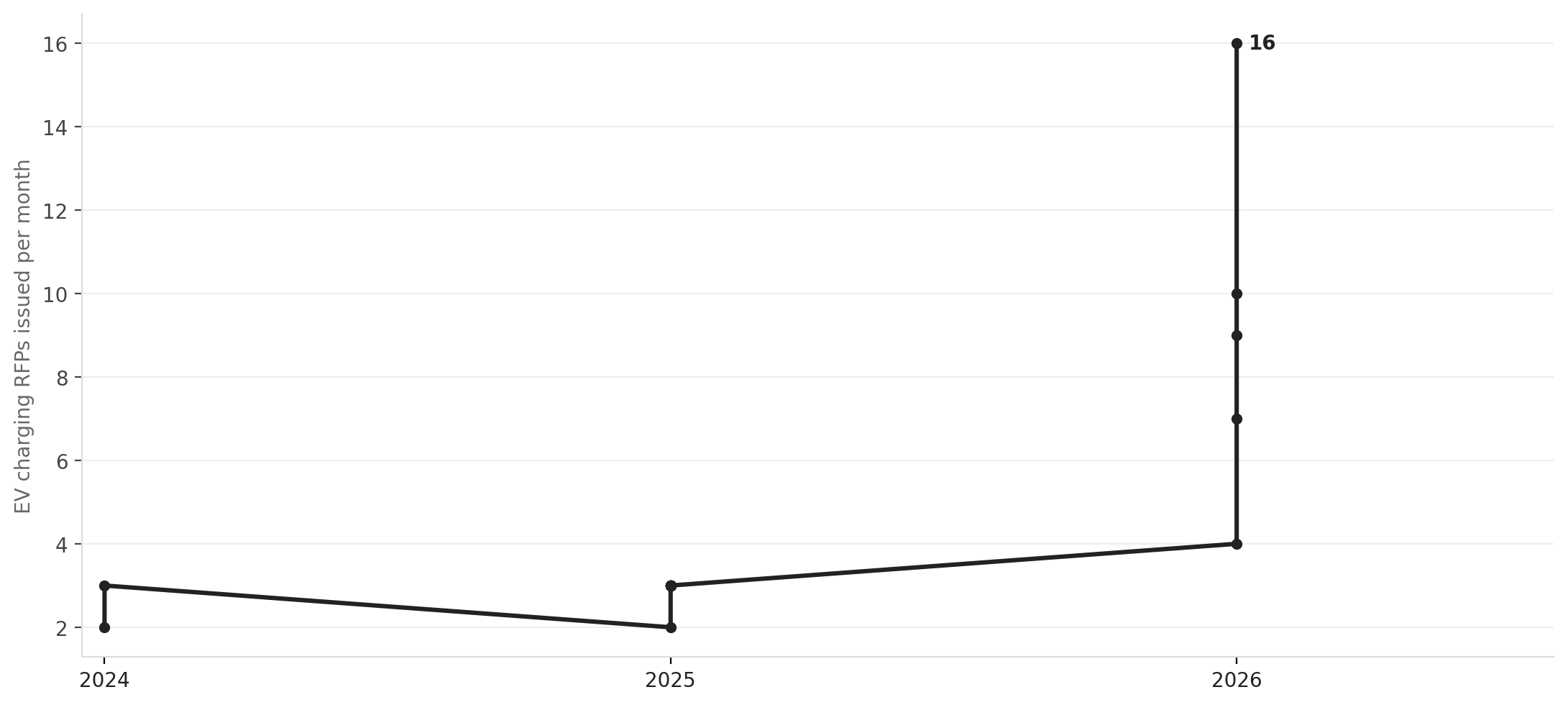
The procurement spike reflects that sequencing precisely. NationGraph RFP data show February 2026 at 9 listings and March at 7, a gradual ramp that began immediately after the January ruling. April hit 16, the highest single month in at least 18 months. The trailing 30-day window captures the sharpest part of that acceleration.
Geographically, the activity is concentrated in Southwest Ohio in ways that go beyond ODOT's own site awards. Cincinnati accounts for roughly 15 of the 26 raw listings, spread across three distinct municipal projects: charging infrastructure at the Mt. Washington parking garage, equipment at 3CDC-managed garages in Over-the-Rhine and the CBD, and installations at city recreation centers. Hamilton and Middletown each have active procurements for DC fast-charge equipment. These are municipal governments, not ODOT, using the Round 3 announcement as a signal to pursue parallel local procurements, likely drawing on a mix of NEVI subawards and city capital budgets.
The off-corridor flexibility is new and matters. FHWA certified Ohio's alternative fuel corridors as "fully built out" in fall 2025, a designation that allows ODOT to place NEVI-funded sites away from designated highway corridors for the first time. That expanded the eligible universe of locations, which helps explain why municipal garages and recreation centers are now in scope for projects that previously would have been limited to highway-adjacent fueling stations.
The urgency behind the sprint is not just about bureaucratic momentum. A pending FY2026 DOT appropriations bill in Congress would transfer $503.8 million in NEVI formula grants and $300 million in NEVI competitive grants to general FHWA highway programs, for a combined $879 million shift. Eno Center for Transportation analysts have flagged the congressional route as a greater long-term threat than the executive freeze, because a statutory transfer would not be reversible by court order. States that have obligated funds before any such bill passes are in a fundamentally different position than states still sitting on unobligated balances. Ohio is not among the 20 states that sued to restore NEVI access, but it has moved more aggressively than any of them in the weeks since the ruling.
For Ohio drivers, the practical effect of this procurement sprint is an accelerated buildout on corridors that already carry some of the highest freight and passenger volumes in the Midwest. I-70, I-71, I-75, I-76, and I-77 all cross the state, making Ohio's charging network a de facto national asset for long-distance EV travel. The state crossed 126,000 registered EVs in 2025, and EVs hit 5 percent of new vehicle registrations in September 2025 for the first time. Demand is building; the question has always been whether federal infrastructure funding would keep pace.
The next signal to watch is whether Congress moves the FY2026 appropriations bill before the summer recess. If it does, states with fully obligated NEVI funds will be protected. States that waited will not. Ohio, for now, is not waiting.