
For the tens of thousands of New Yorkers living with HIV, antiretroviral therapy has turned a once-fatal diagnosis into a manageable condition. But a second threat has emerged in its place: cigarette smoking, which now kills more people with HIV than the virus itself. New York City researchers are trying to change that with a smartwatch app that uses artificial intelligence to detect when someone is reaching for a cigarette and intervene in real time.
The project, called Sense2Quit, just received a $581,543 federal grant from the National Institute on Drug Abuse to fund a large clinical trial. The award likely represents one year of a multi-year study that will enroll 450 HIV-positive smokers across New York City.
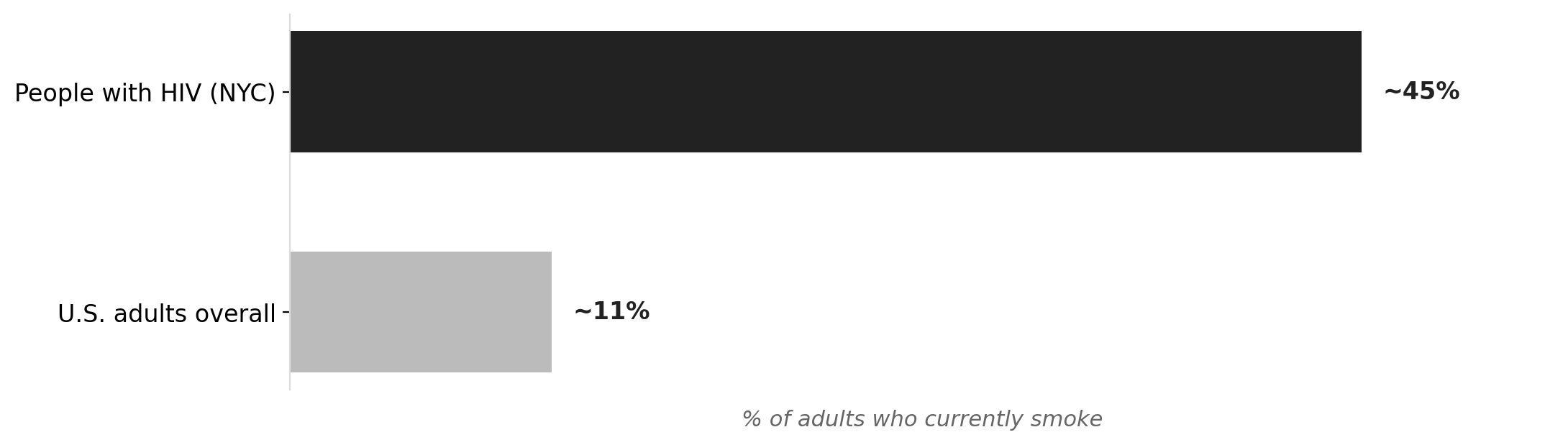
The stakes are hard to overstate. Roughly 45% of people with HIV in New York City smoke cigarettes, a rate three to four times higher than the general adult population. Poverty, housing instability, mental health conditions, and substance use all contribute to those elevated rates, and standard quit programs have struggled to make a dent. Studies going back more than a decade have found that HIV-positive people on effective treatment lose more years of life to smoking than to HIV.
Source: NationGraph.
The Sense2Quit app works through a paired smartwatch that uses machine learning to recognize the distinctive wrist movements of someone lighting up or raising a cigarette. When it detects that gesture, the app delivers personalized behavioral support before the cigarette is finished. The idea is to reach people at the exact moment they're most vulnerable, rather than waiting for them to seek help on their own schedule.
Researchers have already run a pilot with 60 participants that showed the app was feasible, well-accepted, and retained users despite the social and economic challenges common in this population. The new trial will compare Sense2Quit against a physical activity app to measure whether the smoking intervention actually works. The primary measure: whether participants have stopped smoking entirely at six months, confirmed through biochemical testing.
The HIV epidemic's geography matters here. New York City has roughly 100,000 residents living with diagnosed HIV, the largest concentration in the country, with the highest burden concentrated in the Bronx, Central Brooklyn, Harlem, and parts of Queens. Those same neighborhoods carry the heaviest toll of tobacco-related illness. The city's public hospital system serves a large share of this population and has been investing in digital health tools, making it a natural testing ground.
The trial is expected to generate evidence strong enough to inform whether this kind of AI-powered intervention could be adopted more broadly in clinical care. Results are likely several years away, given the six-month follow-up period and the scale of enrollment ahead.