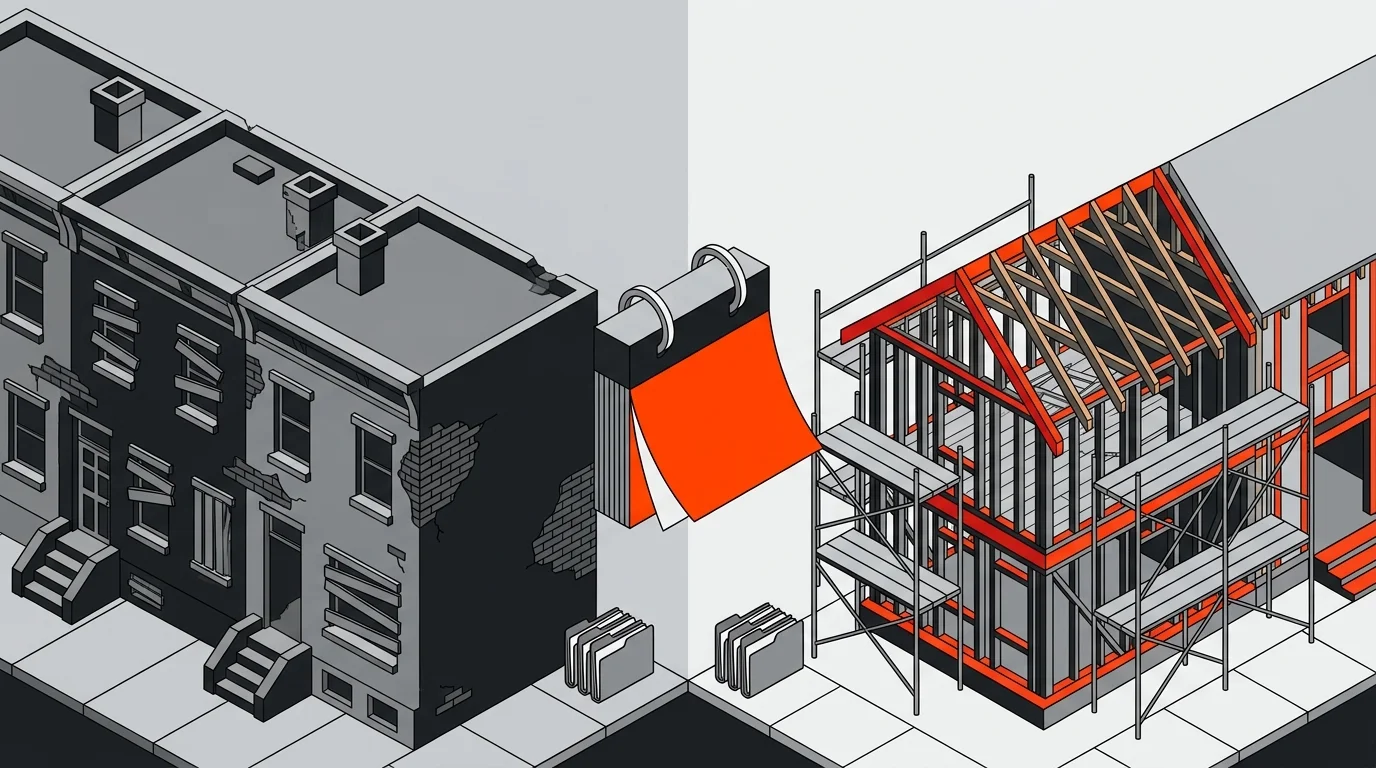
Ohio's local housing agencies issued roughly 68 housing RFPs in the last 30 days, close to double the pre-July 2025 monthly average, and the surge has almost nothing to do with organic demand and almost everything to do with a bureaucratic deadline. Agencies that won awards under Governor DeWine's Welcome Home Ohio program have until June 30, 2026, the close of the state fiscal year, to turn those awards into executed contracts. The clock is running.
The underlying policy trigger was H.B. 96, Ohio's FY2026-2027 biennial budget, which DeWine signed on June 30, 2025, allocating $91.2 million to Welcome Home Ohio for property acquisition, rehabilitation, and new construction targeting income-eligible buyers. The Ohio Housing Finance Agency opened the application window on December 8, 2025, and closed it January 16, 2026. Award execution followed immediately: RFP volume hit 113 in February 2026 alone, the highest single-month count in the dataset, then settled into the 39-to-68 range through spring as agencies moved from planning to procurement.
The practical result is a statewide procurement wave that looks uneven on the surface but follows a coherent logic. The top issuer over the last 30 days is the City of Lorain, with 17 housing RFPs, followed by Greene County with 13. Columbus, Toledo, and Cincinnati Metropolitan Housing Authority each account for three. Lorain is a legacy industrial city with sustained vacancy and a federally supported Community Development Block Grant program that gives it infrastructure to move quickly. Greene County, suburban Dayton, sits at the opposite end of the housing market: it is issuing RFPs not to address abandonment but to address supply shortfalls in a growing county. The same state program, two very different underlying housing problems.
That split reflects a structural reality the OHFA's FY2026 Housing Needs Assessment, released in September 2025, documented across all 88 counties: cost-burdened households are not concentrated in one type of market. Ohio's legacy cities need rehabilitation-focused investment; its suburban growth counties need production. Welcome Home Ohio covers both, with per-property acquisition caps of up to $100,000 for foreclosure-sale purchases and separate rehabilitation and construction tracks.
Layered on top of the state program is a concurrent federal infusion. HUD committed $164.6 million in new Section 8 Housing Choice Voucher grants to Ohio metropolitan housing authorities starting April 1, 2026, spread across 222 individual grants. Cuyahoga MHA received $32.9 million combined; Columbus MHA received $29.2 million; Cincinnati MHA received $17.8 million. Ohio's total active federal housing grant portfolio from HUD stands at $1.58 billion obligated, with $909 million already outlaid. The voucher renewal did not by itself cause the RFP surge, but it arrived simultaneously, adding procurement pressure on the metro authorities already managing WHO award execution.
The Federal Home Loan Bank of Cincinnati added another layer: its companion Welcome Home Program for down payment and closing cost grants reopened April 6, 2026, giving buyers and developers one more funding source to sequence against.
What explains why Lorain and Greene County are moving faster than Columbus and Cuyahoga is partly institutional capacity and partly portfolio size. Larger metro housing authorities manage more complex federal compliance requirements, which slow procurement timelines. Smaller municipal and county agencies with discrete WHO award pools can issue RFPs more directly. The Greater Ohio Policy Center has noted that 60 percent of state GDP comes from counties projected to lose population, framing housing investment in legacy markets as an economic stabilization tool, not just a social program. Lorain's procurement pace fits that framing: it is moving to absorb capital before the fiscal year closes.
For residents watching the housing market, the signals to track are straightforward. Contracts executed before June 30 will produce construction and rehabilitation starts that become visible in permit data through late 2026 and into 2027. Communities that did not move their WHO awards into procurement by late spring risk returning unspent funds. Ohio House Democrats have separately proposed a $100 million residential development loan program, sponsored by Rep. Karen Brownlee, that would extend the legislative momentum beyond the current biennium if it advances.
The June 30 fiscal year-end is the next hard checkpoint. Agencies that have issued RFPs but not yet executed contracts have weeks, not months, to close. The procurement numbers visible now are the leading indicator; construction activity will be the lagging one.