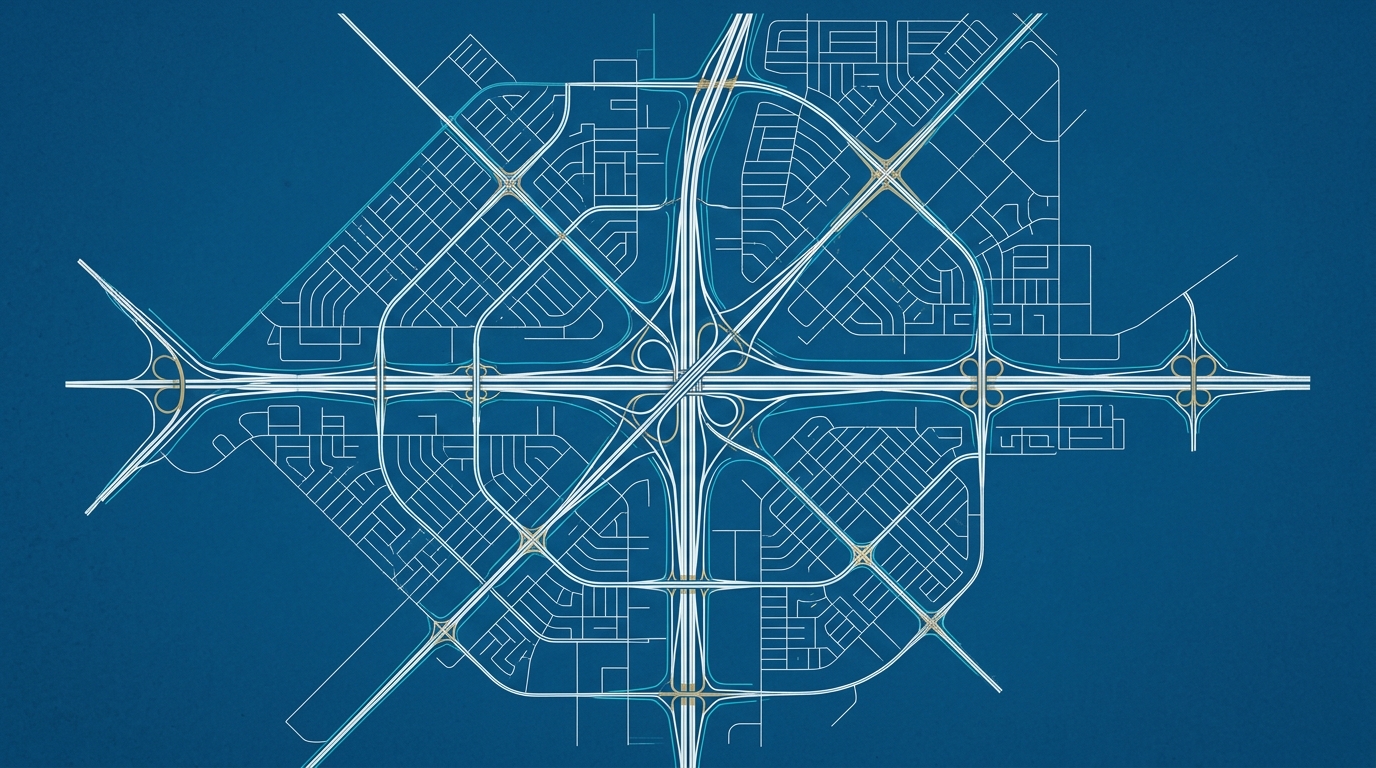
Grayson County, Texas is getting a state highway widened as local roads struggle to keep pace with one of the fastest-growing corners of the Dallas-Fort Worth region, a transformation driven largely by Texas Instruments' decision to build a massive semiconductor campus in Sherman.
The Texas Department of Transportation is seeking contractors to add lanes to an unspecified state highway in the county, a project that reflects the infrastructure pressure building across the Sherman-Denison area. The specific road, cost estimate, and construction timeline are not yet public and would be detailed in the full bid documents.
The stakes behind the project are hard to overstate. Texas Instruments announced plans in 2022 to build a $30 billion-plus semiconductor fabrication campus in Sherman, one of the largest private investments in Texas history. The federal government backstopped the project in 2024 with a preliminary award of up to $1.6 billion in CHIPS Act funding. At full buildout, TI's campus is projected to create roughly 3,000 direct jobs, with ripple effects that could multiply that figure two or three times over.
The county's population has already climbed from about 120,000 in 2010 to over 140,000 by 2020, and growth projections point sharply upward. Housing subdivisions and commercial development are spreading across the county even before the semiconductor plant reaches full capacity, putting pressure on a road network designed for a much quieter era.
Grayson County officials have flagged roads, water supply, and wastewater capacity as the three biggest stress points in managing the boom. TxDOT has been planning multiple capacity improvements in the area, and the Sherman-Denison Metropolitan Planning Organization has identified several corridors as needing upgrades. This project appears to be part of that broader response.
Texas has significantly expanded its highway construction capacity since voters passed Proposition 1 in 2014 and Proposition 7 in 2015, redirecting oil and gas tax revenue and sales tax revenue into the State Highway Fund. TxDOT's current ten-year plan programs more than $100 billion in projects statewide, giving the agency resources to move quickly on corridors where demand is outrunning capacity.
Critiques of lane-addition projects as a long-term congestion strategy have gained traction in urban Texas, where added capacity often fills with new traffic within years. In exurban counties like Grayson, where baseline capacity is genuinely thin relative to arriving demand, those arguments carry less weight locally. Either way, contractors bidding on this project will find out soon enough whether TxDOT's timeline matches the pace of growth already reshaping the county.