San Mateo County, one of the most expensive places to live in the United States, is opening a new round of low-interest loans for affordable housing developers as it tries to keep pace with a housing crisis that has pushed median home prices past $1.5 million and left more than 30 percent of renters spending more than they can afford on housing.
The county's Affordable Housing Fund is now accepting applications for its 14th lending cycle, offering long-term, deferred-payment loans to projects that create or preserve below-market-rate units. Over the previous 13 cycles since the fund launched in 2013, the county has awarded more than $400 million and helped finance over 5,000 affordable homes across the San Francisco Peninsula.
The fund was created after California dissolved its redevelopment agencies in 2012, eliminating what had been the primary local tool for financing affordable housing statewide. San Mateo County responded by drawing on Measure K, a half-cent sales tax approved by voters that same year, to capitalize a replacement fund. The approach has since been cited as a model for other counties facing the same void.
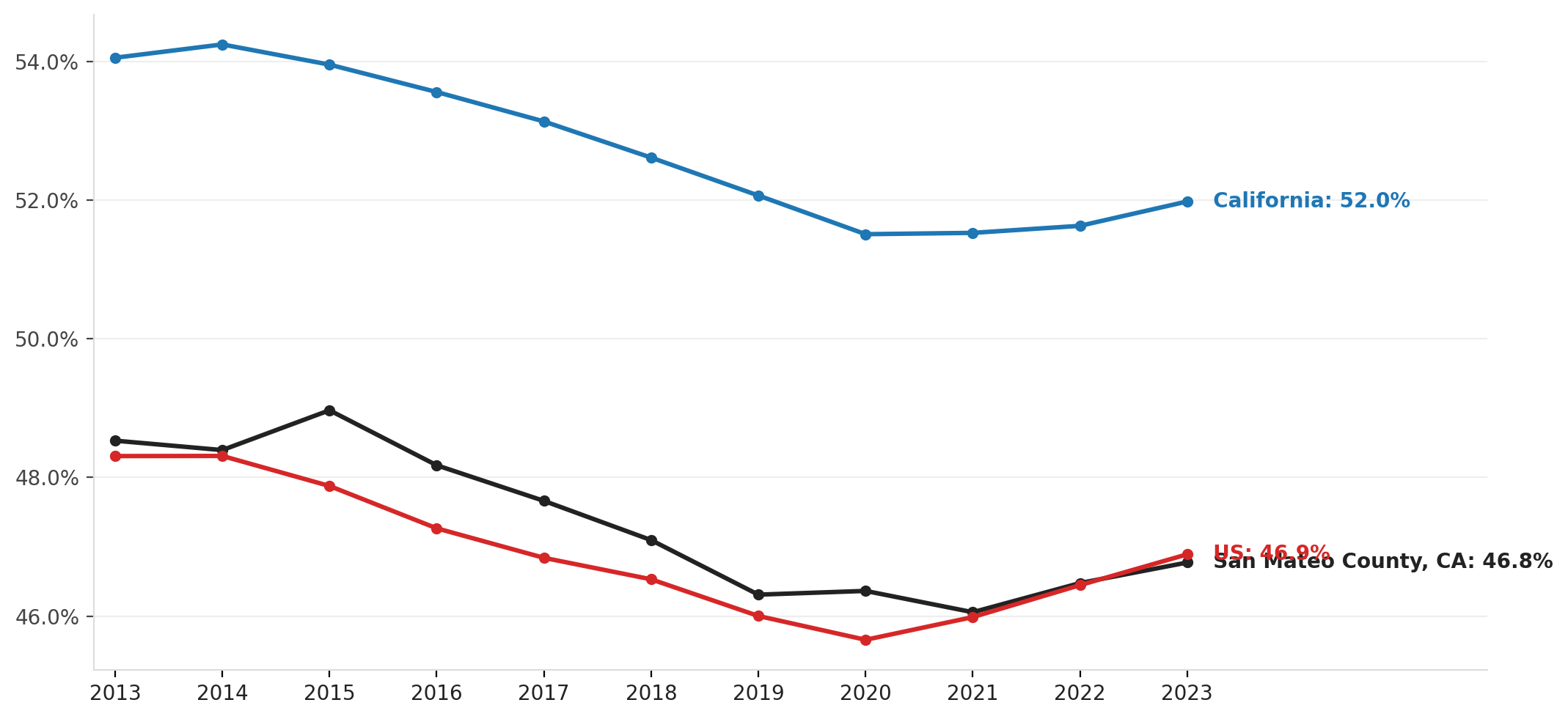
Source: U.S. Census Bureau, American Community Survey.
But the scale of the problem keeps growing. Under the state's current housing planning cycle, San Mateo County jurisdictions are required to plan for tens of thousands of new units through 2031, with a significant share at below-market rates. At the same time, the cost of actually building affordable housing in the Bay Area has soared, with per-unit development costs frequently reaching $700,000 to $900,000 or more. That means AHF loans rarely cover a project on their own. Instead, developers layer them with federal Low-Income Housing Tax Credit equity, state grants, and other sources to assemble the financing needed to break ground.
The county's essential workers, seniors on fixed incomes, service employees, and immigrant families have borne the sharpest edges of the affordability gap, even as the county's median household income exceeds $130,000. The disconnect between wealth and affordability in San Mateo County is among the starkest in the nation.
How much funding will be available in this 14th cycle has not been publicly specified in the county's notice, and a timeline for loan awards was not disclosed. Developers interested in applying can find details through the county's Department of Housing.