Federal flood-control money flowing into South Carolina has jumped 1,058 percent in the last 90 days, from $2.6 million in the same window a year ago to $30.3 million now. Every dollar of that surge arrived on a single date: April 8, 2026, when the EPA formally awarded two grants to the SC Department of Environmental Services, one for $17.771 million in drinking water infrastructure and one for $12.506 million in clean water and septic resilience.
The money has a specific origin. The American Relief Act of 2025 (P.L. 118-158), signed on December 21, 2024, allocated $3 billion in supplemental EPA State Revolving Fund dollars exclusively to six states struck by Hurricanes Helene and Milton. South Carolina's $30.277 million is its proportional share under the formula EPA used. According to EPA's announcement of the award, the grants target exactly the vulnerabilities Helene exposed: aging rural drinking-water systems and decentralized wastewater infrastructure, including the widespread septic reliance in interior counties that standard disaster-recovery programs do not cover well.
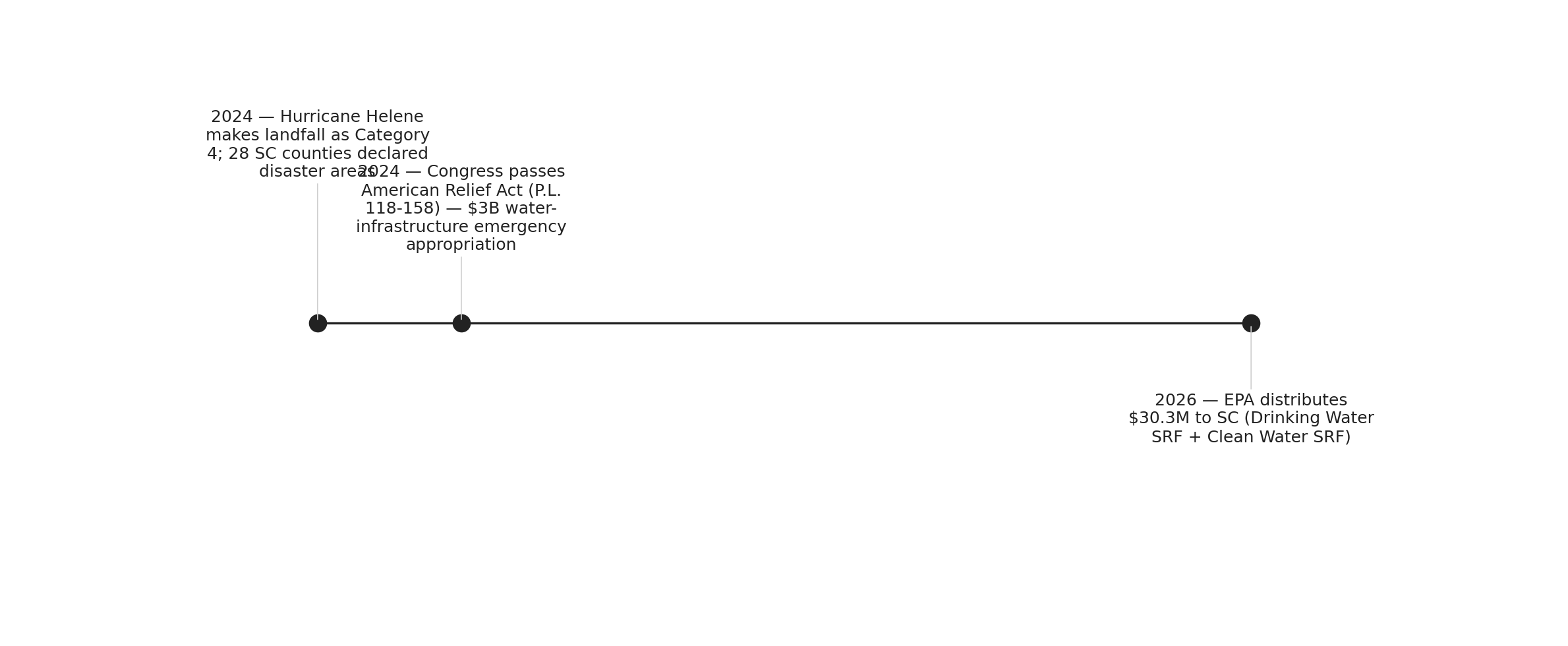
That 18-month gap between Helene's landfall and these dollars clearing the federal pipeline is the central fact of this story. The storm made landfall on September 26, 2024, as a Category 4 hurricane, and President Biden issued a major disaster declaration for 28 South Carolina counties three days later. More than 430,000 households registered for FEMA assistance. Congress appropriated the supplemental water funds in December of that year. EPA began distributing allocations to states only in April 2026. The money is now on South Carolina's books as the 2026 Atlantic hurricane season has already begun.
Source: NationGraph.
The state is not starting from scratch. The SC Office of Resilience already manages 81 active flood mitigation projects, and the new EPA tranche lands on a functioning implementation apparatus. USDA Watershed Protection grants of $4.8 million and $3.6 million are already running in Georgetown and Williamsburg counties, reaching coastal and inland communities simultaneously. What the EPA awards add is scale and a specific focus on water and wastewater systems, the infrastructure category SCOR has flagged as having an unmet recovery need exceeding the combined totals of the 2015 Flood, Hurricane Matthew, and Hurricane Florence.
South Carolina also stands out sharply against its neighbors. In the same 90-day window, Florida recorded $6.1 million in new flood-related federal grant starts, Virginia recorded $881,000, and North Carolina and Georgia recorded zero new starts. That ordering is somewhat counterintuitive: North Carolina bore far heavier physical damage from Helene and ultimately received $337 million under the same EPA program, but North Carolina's allocation was distributed across an earlier set of award dates that fall outside the current 90-day comparison window. South Carolina's concentrated April 8 award date is what drives the statistical spike.
The program's scope and the specificity of its design matter for what comes next. The EPA's implementation memorandum for the supplemental SRF awards requires states to prioritize projects that directly address storm damage or reduce future storm vulnerability, which constrains how SC Department of Environmental Services can deploy the funds. Septic-to-sewer conversions, drinking-well hardening, and stormwater separation in flood-prone communities are the expected project types. Unlike FEMA Hazard Mitigation Grant Program awards, which often fund elevation or acquisition of individual structures, these SRF dollars flow to utilities and local governments for infrastructure capital.
For residents in the 28 declared counties, the practical effect of this money will be visible over the next two to three construction seasons, not immediately. Water system upgrades are not shovel-ready by default; environmental review, engineering, and procurement all take time. The SC Department of Environmental Services will need to identify and rank eligible projects, a process the department has indicated it is already moving through following the April award.
The question the state's resilience planners are now working against is whether that project pipeline can move fast enough. FEMA's most recent South Carolina state profile notes that the state's inland river systems and Low Country coast are exposed to the same storm system through different mechanisms, a compounding vulnerability Helene confirmed. With $30 million now obligated and a construction window that effectively runs from late summer 2026 through fall 2027, the pace of project selection in the coming weeks will determine how much of that hardening can realistically be in the ground before the following season.