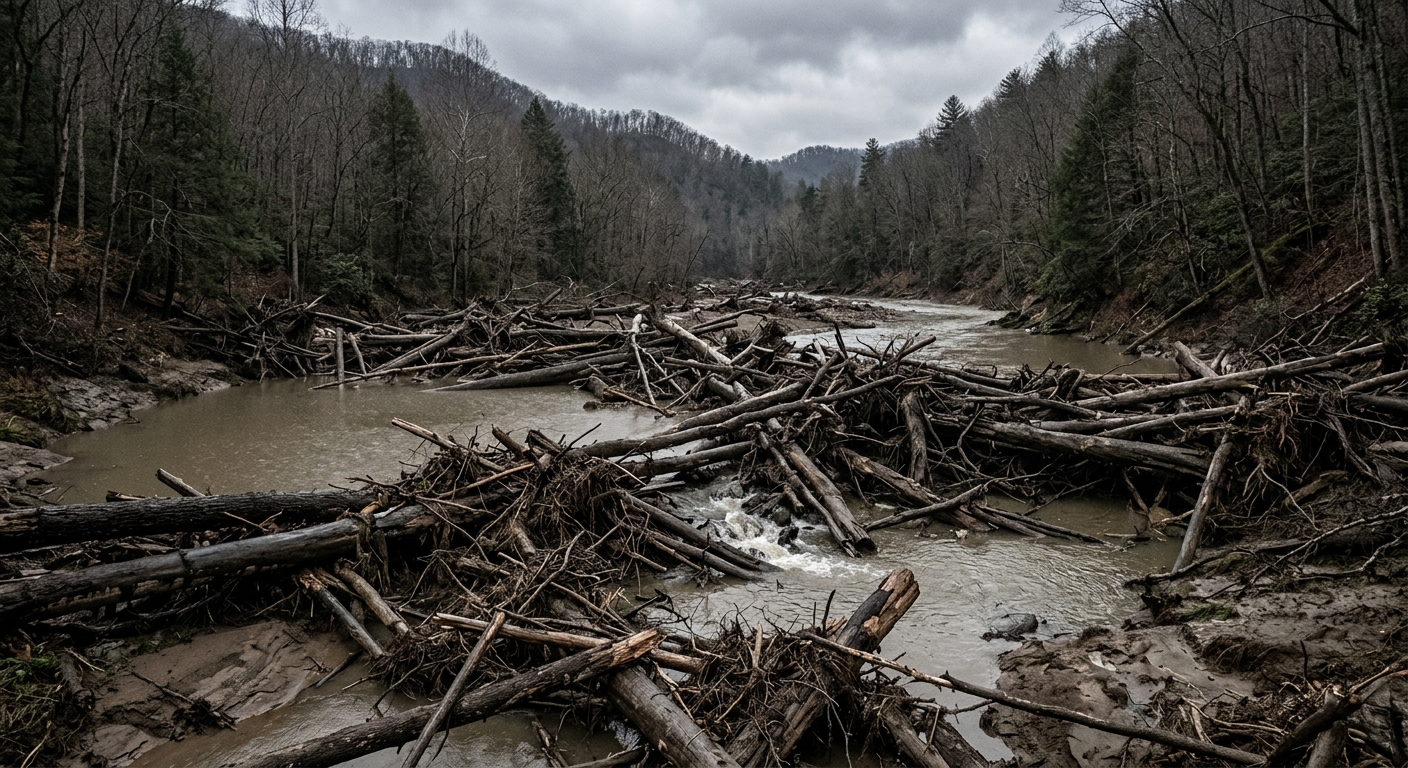
A tornado-battered creek in St. Clair County, Alabama is getting federal help to clear the debris that's been choking it, with the USDA awarding $162,031 to remove downed trees and wreckage from Wolf Creek near Roberts Mill Pond Road.
When tornadoes tear through the forested Appalachian foothills northeast of Birmingham, they don't just destroy buildings. They drop enormous volumes of timber and debris directly into stream channels. In steep, narrow creeks like Wolf Creek, that material piles up fast, backing water upstream and putting downstream road crossings, bridges, and any impoundment structures at risk of sudden, severe flooding. The reference to Roberts Mill Pond Road suggests a road crossing or pond is in the debris field's path.
The funding comes through the USDA's Natural Resources Conservation Service under the Emergency Watershed Protection (EWP) Program, a decades-old federal program specifically designed to address exactly this kind of post-disaster watershed damage. Under the program's standard cost-share structure, the federal government covers 75 percent of costs and a local sponsor, typically the county or a soil and water conservation district, covers the remaining 25 percent. That puts the total project cost at roughly $216,000.
St. Clair County sits in one of the most tornado-prone corridors in the country, the stretch between Birmingham and Gadsden that researchers increasingly describe as part of "Dixie Alley," a southeastern tornado corridor that has grown more active over the past two decades. Alabama saw 62 tornadoes in a single day during the April 2011 Super Outbreak, and the state has recorded significant tornado events nearly every year since. The county's terrain amplifies the problem: forested hillsides mean tornadoes generate timber debris at scale, and narrow valley streams have nowhere to push it.
Without intervention, debris jams in small creeks can deteriorate gradually or give way all at once, sending a surge of water and material downstream without warning. Rural areas like the Wolf Creek corridor have no municipal stormwater infrastructure to absorb that kind of event, making the natural channel the only flood management system available.
The EWP program has faced growing demand nationally as severe weather intensifies, with post-disaster funding requests sometimes outpacing available appropriations by hundreds of millions of dollars. For St. Clair County, a semi-rural county of about 91,000 people operating on a limited budget, the federal cost-share makes a project like this feasible where it otherwise might not be. The county will need to confirm its local match commitment before work can begin.