Federal flood-control grants to Iowa hit $14.29 million in the trailing 90 days, a 925% jump from the $1.39 million the state received in the same window a year ago. The entire gain traces to a single award, issued on a single day, to one suburban Des Moines neighborhood that has been filing flood insurance claims for years.
The money came from FEMA on April 24, 2026, through its Flood Mitigation Assistance program. Of the $14.29 million routed to the Iowa Homeland Security and Emergency Management Department, $13.1 million flows to the City of Clive for the acquisition and demolition of repetitive flood-damaged commercial structures along University Boulevard. Three years from now, those buildings are supposed to be gone. The grant period runs through April 2029.
The timing is the detail that doesn't fit the normal script. According to a FEMA press release, the $250 million-plus national announcement, covering more than 100 projects across 20 states, was issued 67 days into what FEMA itself called "the longest ever" lapse in federal appropriations. The agency was formally without a budget. DHS Secretary Markwayne Mullin had directed FEMA to clear a years-long backlog of pending mitigation applications, and the directive didn't pause for a new spending bill. Iowa's check cleared anyway.
Source: NationGraph.
That backlog context is load-bearing. The Clive project didn't materialize in April 2026 because the flooding got worse that month. It materialized because the application had been queued, reviewed, and approved, and Mullin's push finally moved it to the front. Iowa's prior-year flood-grant totals were modest and fragmented, running between roughly $550,000 and $1.4 million per month in small, scattered awards. The April spike is a discontinuity, not an acceleration.
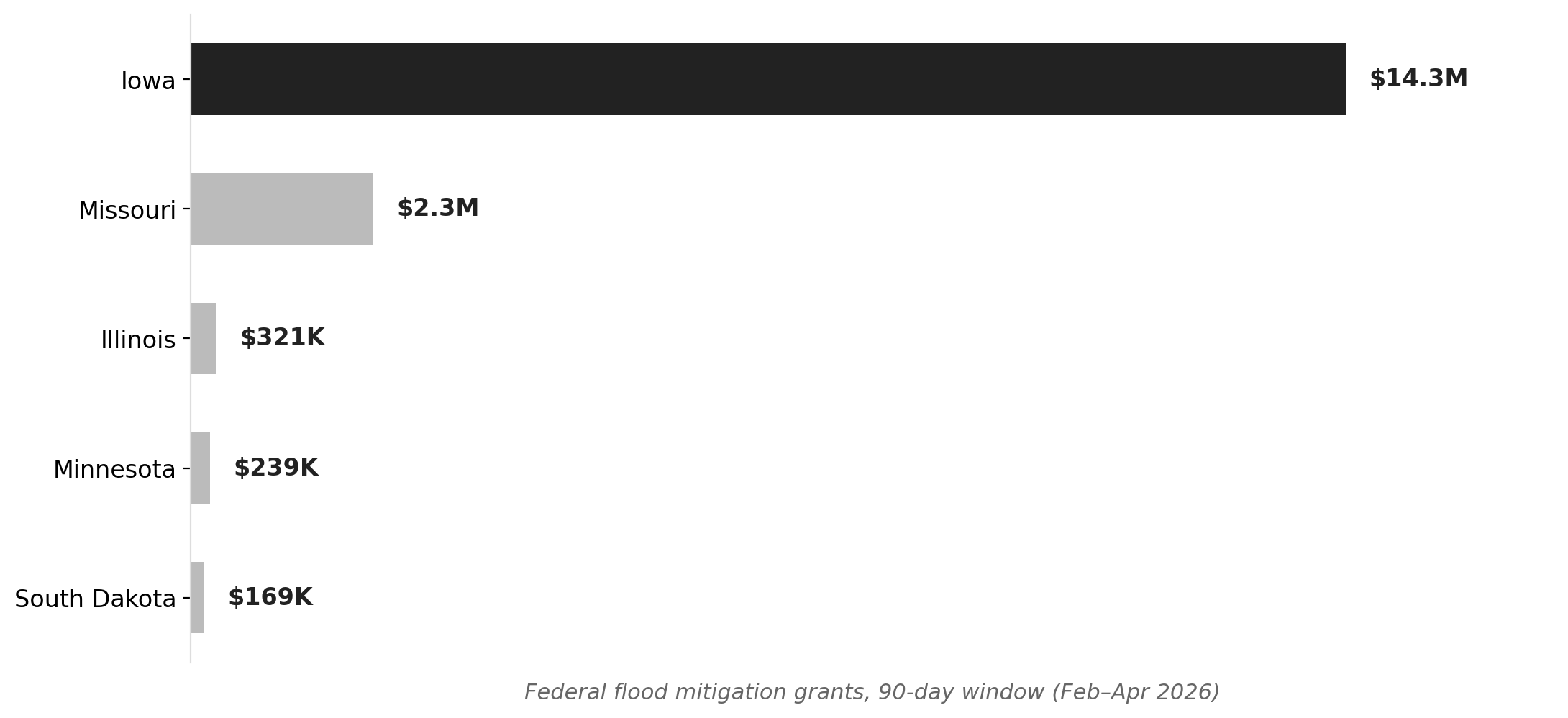
The scale is easier to grasp against the regional backdrop. In the same 90-day window, Missouri received $2.26 million across two grants. Illinois drew $321,000. Minnesota collected $239,000. South Dakota, $169,000. Iowa's $14.29 million is more than twice the combined total of all four neighboring states, and it is more than 10 times larger than any other flood-tagged federal grant Iowa has received in at least three years. By that measure, Iowa didn't inch ahead of its Midwest peers, it lapped them.
Clive sits in the western Des Moines metro, well inside the Missouri and Des Moines river drainage systems that have produced some of Iowa's worst flood years: 1993, 2008, 2019. Repetitive-loss properties, structures that have filed multiple National Flood Insurance Program claims, are the specific target of the FMA program, and FEMA's Flood Mitigation Assistance program is designed precisely for cases like University Boulevard: properties where the cumulative cost of repeated damage has long since exceeded the cost of simply buying the owner out and returning the land to floodplain. The acquisition-and-demolition model permanently removes the structure from the claims cycle. Clive has been in that cycle long enough to be on a first-name basis with it.
The $14.29 million is not the whole picture. A separate FMA award in the same announcement directs nearly $750,000 to Iowa for levee infrastructure risk assessment, a smaller but structurally different investment aimed at understanding what the state's existing flood defenses can actually handle. That work will take months to complete and may generate future mitigation applications of its own.
Elsewhere in Iowa, local governments are already trying to get in line for the next round. In Oelwein, roughly 100 miles northeast of Des Moines, the city council approved a $15,000 contract in April 2026 for BRIC grant-writing services, a signal that smaller communities are watching the Clive award and positioning themselves to compete when FEMA opens another application window. BRIC, the Building Resilient Infrastructure and Communities program, is the other major FEMA mitigation channel, and the Oelwein contract suggests the pipeline is widening beyond the single award that drove April's numbers.
For Iowans living near repetitive-loss areas, the Clive project is the most immediate indicator of what the backlog-clearing push can actually deliver: not a study, not a flood wall, but a buyout check and a demolition permit. The three-year performance window means work should begin well before the 2029 deadline, and FEMA's monitoring requirements will keep the project on public record.
The open question is whether April's surge is a one-time release of queued applications or the beginning of sustained elevated funding. FEMA has signaled continued prioritization of mitigation over post-disaster recovery spending, but the appropriations lapse that framed this announcement remains unresolved. The next application cycle and any future backlog announcements will show whether Iowa, and its neighbors, can count on this pace holding.