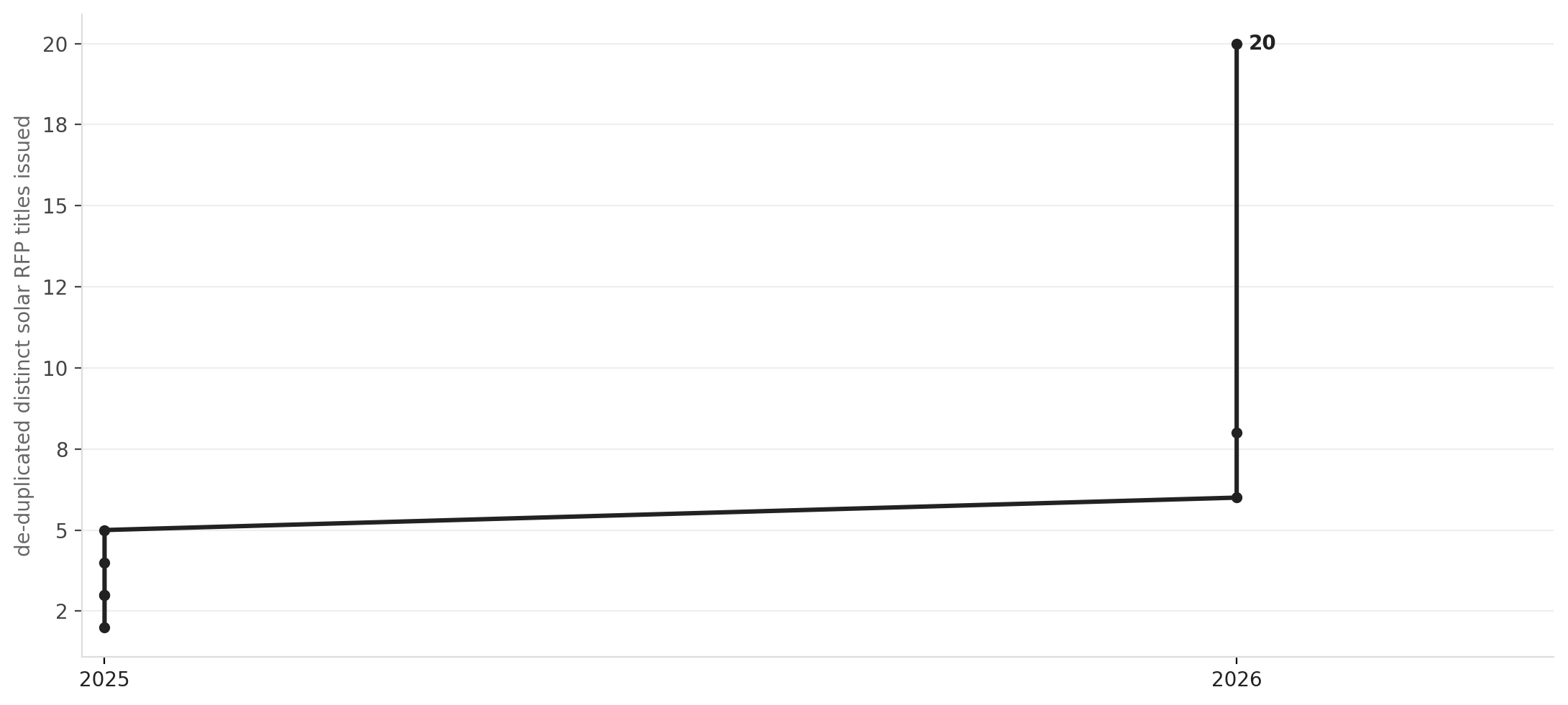
Twenty distinct solar procurement solicitations landed in Minnesota in February 2026 alone, up from two to five per month in the second half of 2025, and the engine behind them is not Washington. It is a pair of state statutes, a July deadline, and $14.55 million in Minnesota-appropriated grant money that local governments are racing to capture before the next application window closes.
The timing is striking. On the same weeks that the Trump EPA has been attempting to terminate Minnesota's $62.45 million Solar for All federal grant, awarded to the Minnesota Department of Commerce in September 2024, municipal procurement boards across the state have been posting solar RFPs at rates the state has never seen before. According to the Commerce Department, only about $96,000 of that federal award has been disbursed, and the state is fighting the termination through the Attorney General's office. The federal program barely touched the ground before it was threatened. The state programs never stopped.
The driver is a synchronized application-cycle effect. Minnesota's Solar for Schools program (Minn. Stat. § 216C.375) and Solar on Public Buildings program (Minn. Stat. § 216C.377) both opened new 2026 grant rounds this winter, and both carry hard deadlines. The Solar for Schools round has a full-application deadline of July 2, 2026. The program offers grants covering 70 to 90 percent of system cost, up to $675,000 per district, and to receive a grant, districts need a contractor quote, which means issuing an RFP. The Solar on Public Buildings program, refueled with $14.55 million from the State Competitiveness Fund in 2025, covers up to 70 percent of costs for counties, cities, townships, and Tribal Nations. When both deadlines fall within the same quarter, procurement activity clusters.
Source: NationGraph.
That clustering was visible in real time. On February 11, 2026, St. Cloud posted two solar RFPs simultaneously. Northfield, Little Canada, International Falls School District, Golden Valley, and the Lakes Country Service Cooperative all issued solicitations the same day, each explicitly citing the Commerce Department grant programs as the funding vehicle. April and May continued above baseline, with Golden Valley returning with a rooftop solar solicitation for its Brookview facility and North Mankato posting one for its public works campus. The pattern is not a dozen communities independently deciding solar is a good idea at the same moment. It is a grant architecture producing synchronized procurement pulses.
The architecture itself is a product of Minnesota's 2023 omnibus energy law, which transferred Solar for Schools from Xcel Energy to the Commerce Department, expanded eligibility statewide, and appropriated $16.1 million for the program in the 2024-25 biennium. The Legislature subsequently nearly doubled that funding after the program was oversubscribed in its first Commerce-administered rounds, according to Clean Energy Resource Teams. More than 150 Minnesota schools have received solar grants since the program began in 2021. The 2023 law also set Minnesota's Carbon-Free Standard: 100 percent carbon-free electricity by 2040, with a requirement that 10 percent of retail sales come from solar by 2030 for large utilities. Those mandates give municipalities a structural reason to move, not just a financial one.
What makes the current moment editorially significant is the degree to which state mechanics have insulated local governments from federal turbulence. Most states that built solar infrastructure programs in the early 2020s leaned heavily on federal IRA dollars and EPA grants. Minnesota did too, and the Solar for All termination fight is real and unresolved. But the programs producing February's procurement burst, Solar for Schools and Solar on Public Buildings, are funded through state appropriations and administered by state staff. A federal reversal does not stop a school district in International Falls from getting a Commerce Department check.
There is a human dimension worth noting. The 2023 law that expanded these programs was championed in the House by Speaker Melissa Hortman, who was assassinated in June 2025. A 2026 bill, HF3556, would rename the community solar garden program in her honor. The procurement surge happening right now is, in a real sense, running on the policy infrastructure she built.
The next signal to watch is the July 2 Solar for Schools deadline. If the pipeline of RFPs currently circulating converts to signed contracts and submitted grant applications at the rate suggested by February's activity, the 2026 round will likely be oversubscribed again, forcing the Legislature, when it reconvenes, to decide whether to fund a third round expansion. Separately, the outcome of Minnesota's legal challenge to the EPA's Solar for All termination could determine whether the $62 million eventually reaches the low-income communities it was designed to serve. The state-funded machine will keep running either way.