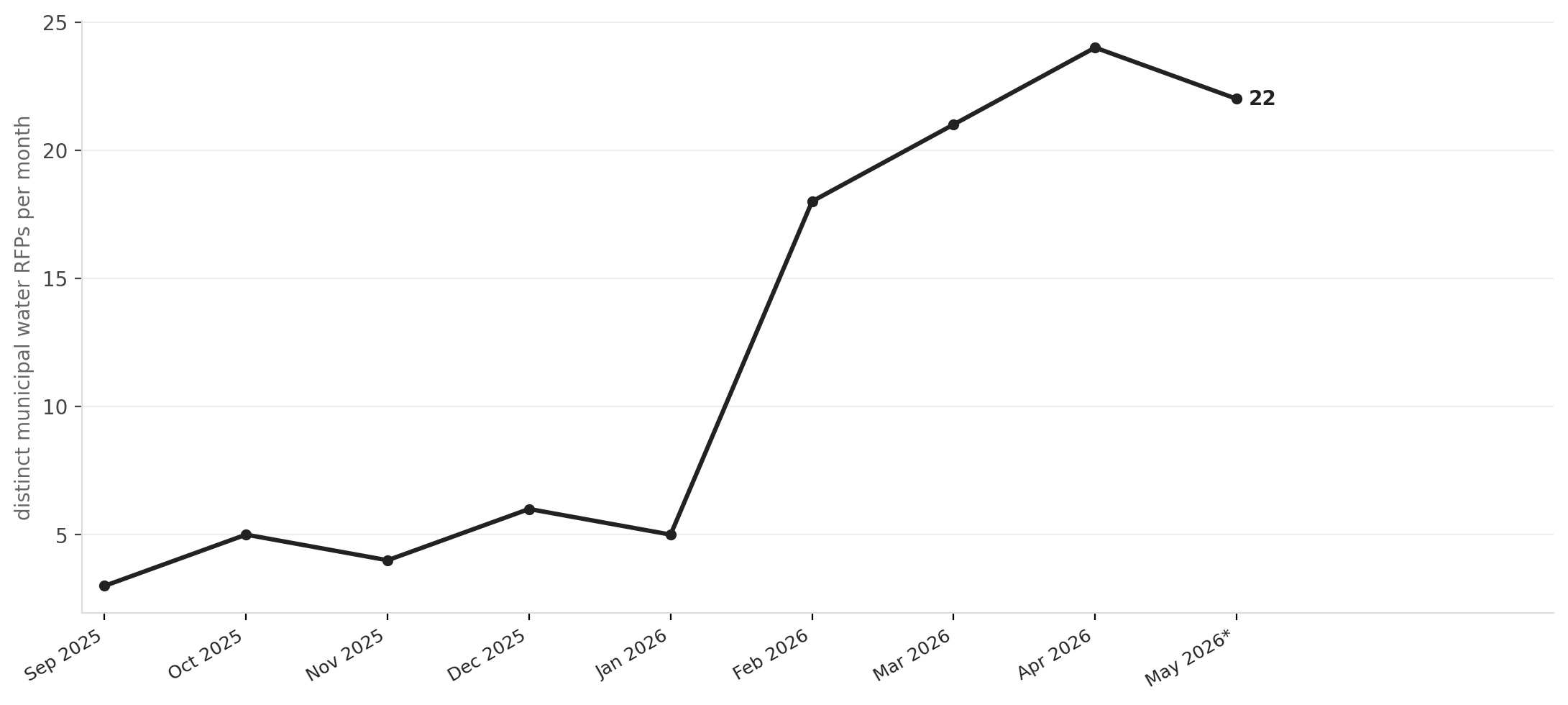
Texas water utilities posted 51 infrastructure RFPs in the last 30 days, against a 12-month monthly average of about 18, a 2.8x surge that began in February and has held for three straight months. The cause is not a pipe failure or a drought emergency. It is a calendar date: July 30, 2026, the application deadline for the Texas Water Development Board's new Water Supply and Infrastructure Grant program, which distributes $1.038 billion in 100%-grant funding with no local match required. Communities that cannot demonstrate they are engineering-ready by that date will miss the largest single water infrastructure payout in Texas history.
The grant program exists because of House Bill 500, passed by the 89th Texas Legislature in 2025 and signed by Governor Abbott. The bill drew from general revenue to seed the WSIG program, separate from but layered on top of Proposition 4, which Texas voters approved in November 2025 and which dedicates up to $20 billion in sales tax revenue to the Texas Water Fund over two decades. WSIG is explicitly a one-time program: once the $1.038 billion is committed, the window closes permanently. Governor Abbott made that urgency official on April 14, 2026, publicly urging eligible water entities to apply before the deadline. TWDB followed with implementation webinars on April 23 and May 13.
The procurement data captures exactly when cities heard the message. RFP volume in October and November 2025 ran at roughly three to six genuine municipal procurements per month. By February 2026, it jumped to the low twenties and stayed there. What cities are buying in these RFPs is not construction itself, it is the engineering plans, feasibility studies, and project documentation that a WSIG application requires. To get the grant, you first have to hire the consultant. That sequencing is what's showing up in the data now.
Source: NationGraph.
The geographic spread rules out a regional story. Procurements in the trailing 30 days come from Dallas, Austin, San Antonio, El Paso, Pasadena, College Station, and Forney, alongside smaller municipalities including Big Lake, Ellinger, Floresville, and Horizon City. The TWDB's WSIG program structure is designed for this range: smaller communities with populations at or below 150,000 can fund planning through construction in a single application, while larger cities are limited to construction-phase grants. Both tiers need engineering work done before they can apply, which is why the RFP acceleration is visible across the full urban-rural spectrum.
The underlying pressure is not manufactured. Sen. Charles Perry, author of companion SB 7, has warned that Texas will face a shortfall of roughly 6 million acre-feet of water, nearly half of current annual use, within 50 years. Texas Agriculture Commissioner Sid Miller has noted that large municipalities already lose an average of 30% of their water through aging distribution systems. A Texas 2036 analysis estimates the state needs close to $154 billion in water infrastructure investment by 2050, including $74 billion just to address leaking pipes. Texas is also adding roughly 500,000 residents per year while its aquifers deplete and nearly all surface water rights are already allocated.
Against that backdrop, the federal water infrastructure pipeline is substantial but slow. Texas's active EPA water infrastructure grant portfolio carries $1.35 billion in obligated funding, with only $217 million actually disbursed, a structural gap that WSIG grants are now filling from the state side. Some larger utilities are stacking both: Pflugerville received $176 million in federal WIFIA loans in late 2025 and is likely among the cities now seeking engineering support to position for WSIG on top of it.
For residents, the near-term consequence is a compressed procurement market. Engineering firms with water infrastructure specializations in Texas are absorbing an unusual volume of concurrent RFPs from clients at every scale, from major metros to rural co-ops. Cities that move slowly risk either missing the July 30 deadline outright or entering TWDB's review queue with incomplete documentation. The TWDB has signaled it will prioritize applications that demonstrate project readiness.
The next signal to watch is what happens after July 30. The WSIG program requires all funds to be committed by August 31, 2027, meaning TWDB will need to move through its review and award process quickly. Communities that filed complete applications will know within months whether they are among the limited number of grantees. Those that missed the window will face the same aging infrastructure, the same depleted aquifers, and the same population growth, without the one funding mechanism that required no local dollars at all.