Virginia localities issued 34 flood-control RFPs in the last 30 days, nearly five times the monthly baseline of seven, as jurisdictions from the Shenandoah Valley to Tidewater scramble to convert state grant awards into signed contracts before deadlines expire. The surge is the most concentrated procurement activity the state has seen since the Community Flood Preparedness Fund launched in 2021, and it is happening entirely by design.
The proximate cause is CFPF Round 6, the $99 million tranche announced January 15, 2026 by outgoing Governor Glenn Youngkin. It is the largest single round in the program's history and landed in the final days of one administration and the first days of another. Round 6 awardees must have a Department of Conservation and Recreation-approved resilience plan before drawing funds, a contractual condition that gives localities no runway for delay. Spend the money or forfeit it.
The timing accelerates a machine that has been building for years. Virginia's CFPF has distributed more than $350 million across six rounds since 2021, administered through the Virginia Resources Authority and DCR. The Georgetown Climate Center has described it as one of the most comprehensive state-level climate adaptation programs in the country. Round 6 drew 78 applications requesting $129 million against $99 million available, a 30 percent oversubscription that reflects just how much demand the earlier rounds created. The rounds have escalated sharply: $53.9 million in Round 4 (March 2024), $67.1 million in Round 5 (July 2025), $99 million in Round 6 (January 2026).
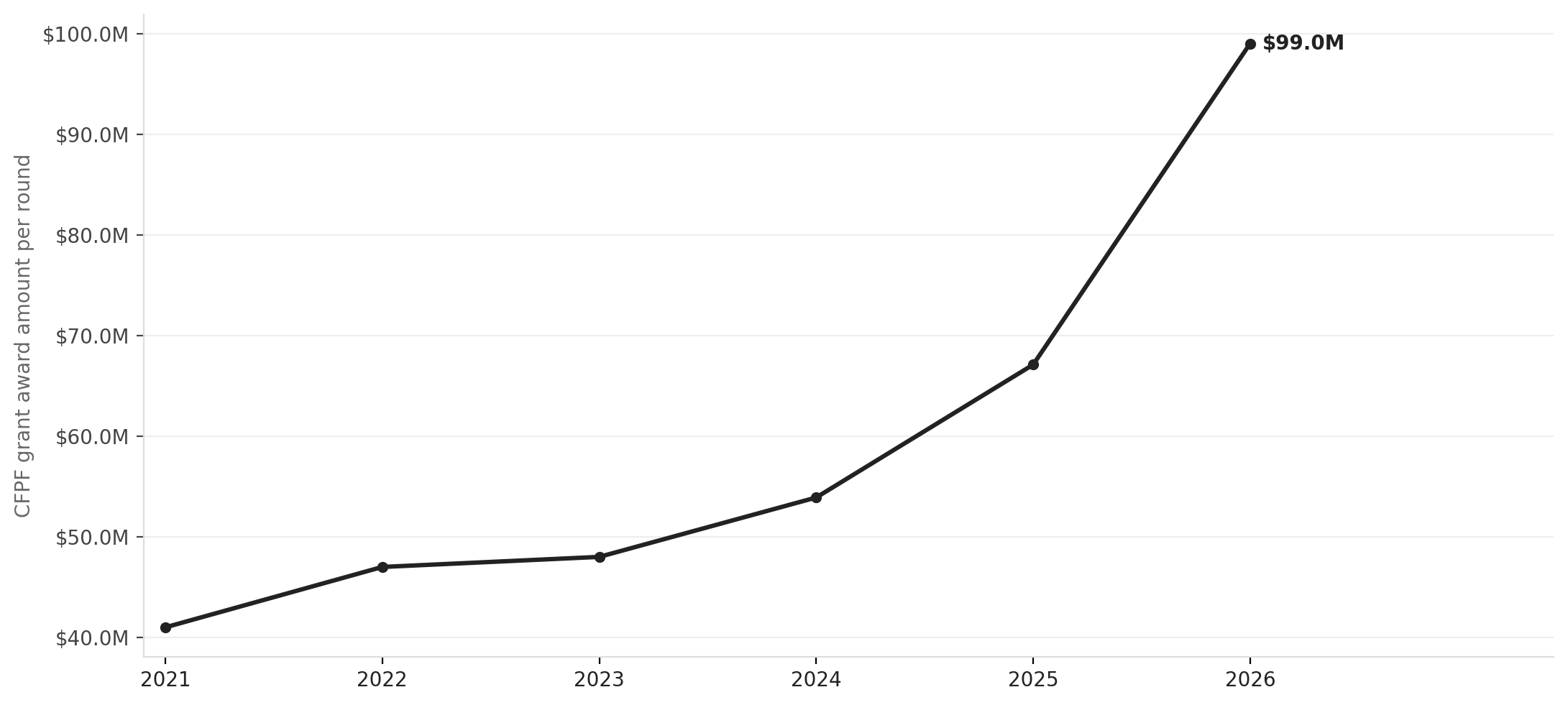
Source: NationGraph.
Hurricane Helene supplied the political rationale for that escalation. When Helene struck Southwest Virginia on September 27, 2024, the New River crested at 31 feet in some locations. Agricultural damage alone exceeded $125 million across 16 counties, according to Virginia Tech's College of Agriculture and Life Sciences. The storm triggered a federal major disaster declaration and, under Executive Directive 9, a dedicated Office of Hurricane Helene Recovery and Rebuilding. Youngkin explicitly cited Helene when announcing Round 5: "The devastation experienced in Southwest Virginia during Hurricane Helene underscores the importance of preparedness and flood resilience." Dickenson County, one of the hardest-hit localities, issued a CFPF program RFP in May 2026. That is what the pipeline looks like from catastrophe to contract: roughly 18 months.
The federal funding vacuum is making state dollars matter more than they were ever meant to. FEMA's Building Resilient Infrastructure and Communities program, a $4.5 billion national fund that served as the primary federal alternative for proactive mitigation, was cancelled in April 2025. Virginia localities that once balanced CFPF applications against BRIC applications now have one viable option. The effect shows in the RFP geography: coastal Poquoson is issuing engineering consultant RFPs for tidal flooding; Roanoke is procuring watershed modeling services; James City County is moving on its own CFPF-funded projects. Virginia leads every neighboring state in 30-day flood RFP volume, with 34 against North Carolina's 11, Kentucky's 6, Tennessee's 3, and Maryland's 1.
Roanoke's procurement illustrates the full arc. The city's October 2023 Flood Resilience Plan, itself funded by an earlier CFPF round, identified specific watershed projects and explicitly positioned the city to access future grants. The current RFP for "Watershed Modeling for Flood Resilience," due May 21, 2026, is that next step. It took roughly two and a half years from first grant to follow-on contract. That lag is now compressed for every Round 6 awardee facing the same sequence simultaneously.
A second statutory deadline is adding pressure statewide. Virginia's HB516/SB551, passed in 2022, requires a new Virginia Flood Protection Master Plan by December 31, 2026. DCR must have watershed studies and technical data in hand to meet that mandate, which means localities need to issue and execute modeling contracts in the months ahead. The RFP surge is serving two masters at once: CFPF grant drawdown timelines and the state master plan deadline.
The program's structural vulnerability, however, is real. Youngkin's 2023 withdrawal from the Regional Greenhouse Gas Initiative severed the CFPF's original dedicated revenue stream. The 2024-2026 state budget replaced it with a $100 million General Fund allocation, but that means future rounds depend entirely on biennial appropriations rather than a guaranteed funding mechanism. Governor Abigail Spanberger has inherited both the program's momentum and that structural gap.
The watch item for the next 90 days is whether Round 6 awardees execute contracts before DCR's drawdown deadlines and whether the Spanberger administration's first budget proposal includes a dedicated CFPF revenue source. If it does not, the procurement sprint visible right now may be the last one at this scale for some time.