Massachusetts municipalities have issued 66 stormwater RFPs in the past 30 days, 2.7 times the trailing 12-month average of roughly 24 per month, and the geography of that surge is the most telling part. The activity is not centered in Boston or any single city. It is spread across Needham (8 RFPs), Sandwich (7), Amherst (5), and Braintree (5), with more than 20 municipalities across Norfolk, Middlesex, Hampshire, Barnstable, Suffolk, and Worcester counties all moving at roughly the same moment. That diffusion is the signature of a regulatory deadline, not a capital plan.
The deadline in question is EPA Region 1's forthcoming reissuance of the Massachusetts MS4 General Permit, the first full overhaul of the state's stormwater rules since 2016. The 2024 Draft MS4 General Permit was published November 22, 2024, covering more than 260 urbanized municipalities. The public comment period closed May 21, 2025, after a 90-day extension, and a virtual public hearing was held May 7. Once EPA finalizes the permit, each covered municipality must submit a Notice of Intent within 90 days and begin updating its Stormwater Management Program. That window is now imminent, and towns are procuring ahead of it.
The new permit is substantively more demanding than the 2016 version. It introduces nature-based street design standards, requires integrated MS4 asset-tracking and maintenance systems, mandates catch basin upgrades, and expands post-construction stormwater controls on permittee-owned property. Municipalities discharging to the Mystic River watershed face an additional requirement: reduce phosphorus loads from hard surfaces by 20 percent within six years. For many mid-sized towns, those obligations represent engineering and contracting work they have never done at this scale.
Source: NationGraph.
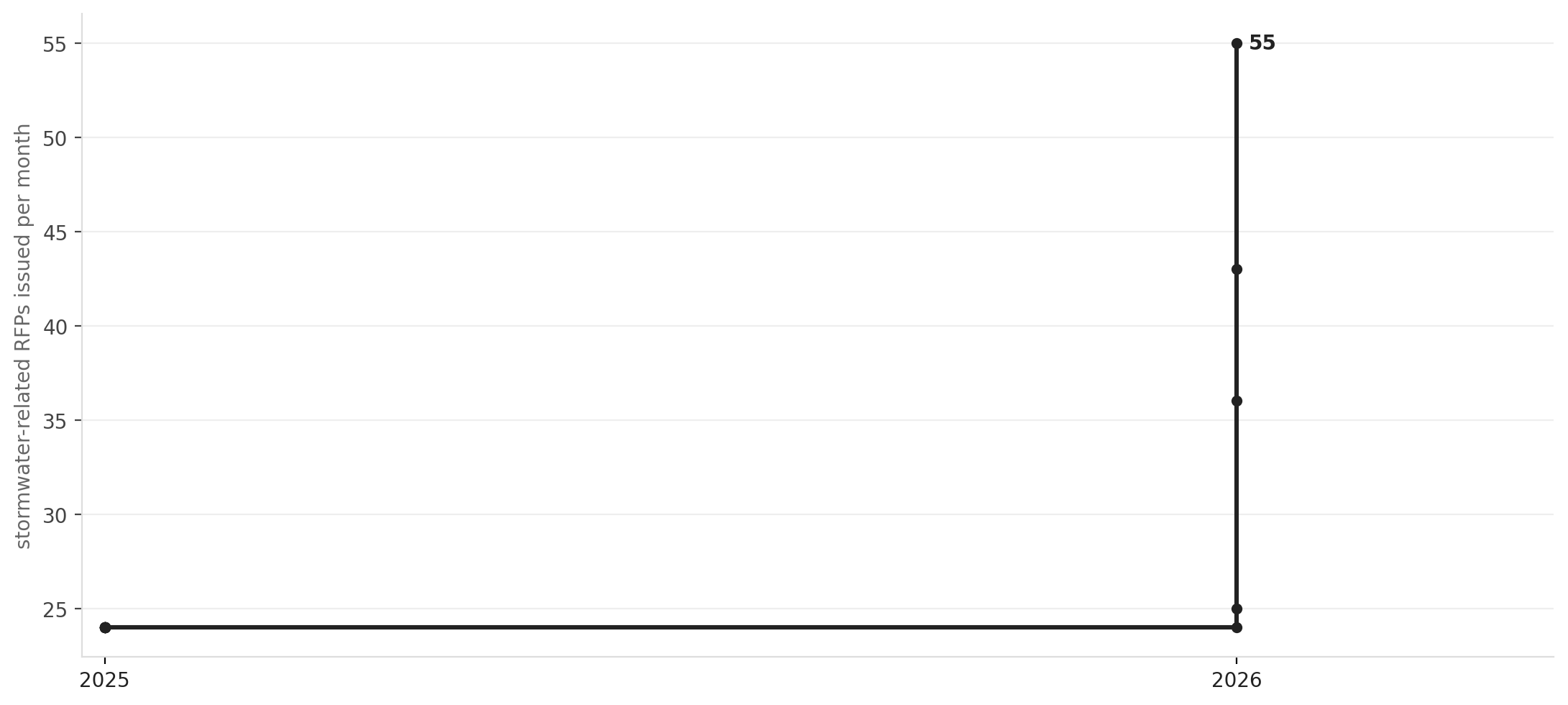
The monthly RFP time series makes the acceleration visible. Volume climbed to 43 in February 2026, dipped to 36 in March and 25 in April, then jumped to 55 in May, the highest single-month count in the 18-month window examined. The spring spike has a secondary cause beyond the permit: MS4 annual reports are due to EPA and MassDEP each May 1, creating a recurring procurement pulse that this year is amplified by the permit renewal pressure. Towns that have just filed their annual reports, and seen the gap between current infrastructure and incoming requirements laid out in writing, are moving directly to procurement.
The work categories being solicited reflect the full breadth of what the new permit demands. Active procurements cover stormwater BMP retrofits, pond maintenance contracts, sewer and stormwater rehabilitation, and peer-review engineering services for compliance planning. According to EPA's fact sheet on the draft permit, the new requirements were designed to address documented water quality failures in dozens of impaired watersheds, and the compliance burden falls most heavily on municipalities that have deferred infrastructure investment since the 2016 permit took effect.
Federal grant support is flowing in parallel, though unevenly. Somerville will receive a $2.5 million EPA Congressionally Mandated Project grant starting June 2026 for active stormwater work. The Massachusetts Clean Water Trust holds a $587,000 EPA Sewer Overflow and Stormwater Reuse Municipal Grant through 2029. The state's Clean Water State Revolving Loan Fund, which provides low-interest financing specifically for MS4 compliance, has lowered the cost barrier for mid-sized towns that would otherwise struggle to front capital for permit-driven projects. MassDEP separately runs an MS4 Municipal Assistance Grant program that allows groups of municipalities to pool compliance tool development.
Massachusetts is outpacing every other state in the Northeast on this metric right now: 66 RFPs in 30 days against Vermont's 48, Pennsylvania's 33, and New York's 29. That gap reflects how much the draft permit has concentrated urgency in a single state. Vermont and Pennsylvania have their own stormwater regulatory calendars; they are not facing the same simultaneous deadline across 260-plus jurisdictions.
For residents in the towns issuing these RFPs, the near-term signal to watch is contract awards, not just solicitations. A municipality that issues an RFP in May but cannot award a contract by late summer may find itself starting implementation work after the NOI clock has already begun. Engineering firms with MS4 compliance experience are already reporting high demand across the region, and capacity constraints could delay some projects. Towns that are early in procurement, Needham and Sandwich among the most active so far, are better positioned to lock in contractors before the backlog builds.
The next marker in this sequence is EPA Region 1's formal permit finalization, which has not yet been given a public date. Once that notice publishes, the 90-day NOI window opens simultaneously for all 260-plus municipalities, and the procurement race that is already underway will shift from preparation to execution.