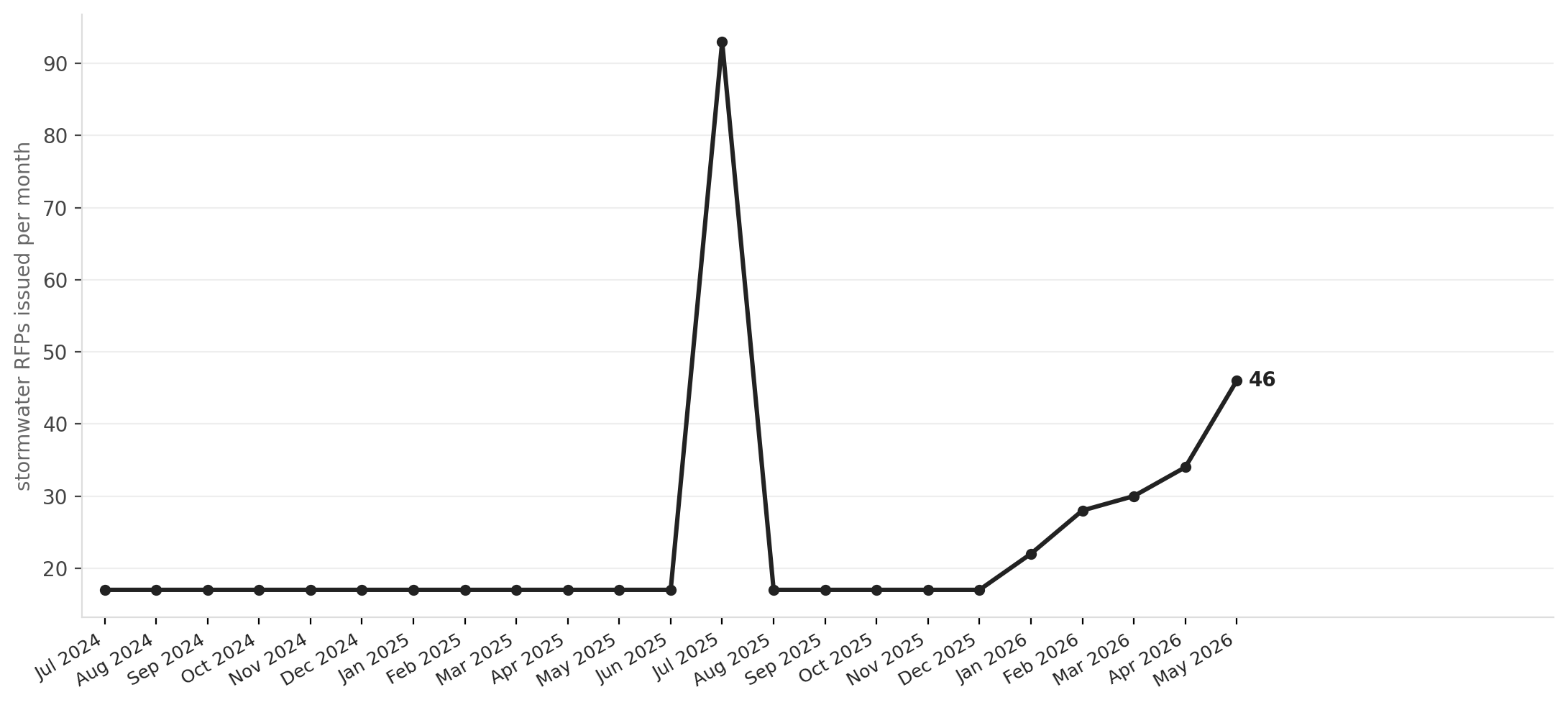
Vermont issued 46 stormwater management RFPs in the last 30 days, against a monthly average of roughly 17 over the past year. That 2.7x surge is not a planning exercise. It is the opening phase of a compliance race with a hard deadline and a finite pool of engineers to run it.
The forcing mechanism is Act 37 (H.481), signed by Governor Phil Scott on May 27, 2025 and effective July 1 of that year. The law restructured Vermont's three-acre impervious surface stormwater permitting program, extending the compliance deadline for Lake Champlain and Lake Memphremagog watershed properties to October 1, 2028, while directing a recommended $5 million from the Clean Water Fund to the Municipal Stormwater Implementation Grant Program in FY2027. The grant money is the carrot; the deadline is the clock. Municipalities that want access to that funding need to have permit applications submitted by October 1, 2027, giving most of them roughly 17 months from today.
The RFP time series shows two distinct pulses that map directly onto Act 37's implementation. The first came immediately: July 2025 logged 93 stormwater RFPs, the single highest month in the dataset, coinciding with the law's July 1 effective date. Then procurement settled into an elevated plateau, running 22 to 34 RFPs per month from January through May 2026. That second wave aligns with the reissuance of General Permit 3-9050, which took effect December 19, 2025, and formally established the October 2027 application submittal schedule for priority watersheds. Two regulatory triggers, two procurement spikes.
Source: NationGraph.
The geography of current activity is telling. The top issuers in the trailing 30 days are concentrated almost entirely in Chittenden County: Vermont's Department of Economic Development (17 RFPs), the Town of Essex (7), the City of Burlington (6), and the City of Winooski (6). Chittenden County sits squarely in the Lake Champlain watershed, where the tightest compliance obligations apply and where most of Vermont's urban impervious surface, roads, parking lots, and rooftops built before modern stormwater standards, was laid down decades ago.
What those RFPs are asking for reveals how far along the procurement pipeline has moved. The project types span the full retrofit spectrum simultaneously: stormwater pond maintenance, slip-lining of aging pipe, outfall-separation feasibility studies, bumpout bioretention construction, and at least one public-facing awareness campaign. Municipalities are not sequencing planning before design before construction. They are running all three phases at once, because the deadline does not allow for sequential procurement.
The capacity question is the one Vermont's own regulators are watching. Vermont DEC's Clean Water Initiative Program has publicly acknowledged a relatively sudden increase in federal and state funds and is actively investing in contractor capacity to address it. That acknowledgment is significant: the agency is signaling that the procurement surge is real and that the state's small engineering and construction market is a constraint, not just a backdrop. Vermont ranks second in New England for stormwater RFP volume in the trailing 30 days, behind only Massachusetts (67 RFPs), a state with roughly 11 times the population. On a per-capita basis, the procurement intensity here has no regional parallel.
The federal backstop underneath all of this is the EPA's Lake Champlain Basin Program TMDL, a phosphorus reduction mandate in place since 2016 that requires Vermont to demonstrate measurable progress on developed-lands stormwater at each five-year EPA review cycle. VT DEC currently holds an $11 million EPA Lake Champlain Basin Program grant active through 2030 and more than $44 million in total active EPA stormwater and clean water grants. Those federal dollars amplify the pressure on the October 2027 deadline: a municipality that misses the application window is not just out of compliance, it is leaving grant money on the table that the state has already secured.
Act 37 also gave municipalities a new financing tool that matters for the retrofit math: authority to levy special assessment fees on stormwater system users when they assume legal responsibility for systems. For towns like Winooski and Essex that lack the tax base to front large capital projects, that fee authority may be what makes a retrofit financeable at all. The policy design, deadline plus grant plus revenue tool, is structured to push procurement, but it works only if engineers are available to be hired.
For property owners and municipal officials in the Lake Champlain and Lake Memphremagog watersheds, the immediate signal to watch is contractor availability. Engineering firms that specialize in stormwater permitting and retrofit design are already receiving simultaneous inquiries from dozens of municipalities on the same timeline. The towns that move first on RFP issuance and award are most likely to secure capacity before the market tightens further. The October 2027 application deadline is 17 months out. The window to lock in an engineer is considerably shorter.