Ninety-nine California institutions issued a housing-related RFP in the last 30 days after going silent for at least a year, and the cities behind that number are not the state's housing champions. They are the ones that stalled longest, and they are moving now because the cost of waiting finally became unacceptable.
The procurement signal is unusually clean. Monthly housing RFP volume across California troughed at just 40 institutions in January 2026, the lowest point in more than a year. Then it nearly tripled: 107 in February, 108 in March, and the volume has held since. The inflection point lines up precisely with Governor Newsom's escalating enforcement actions, which culminated on March 25, 2026, when his administration issued formal Notices of Violation to 15 jurisdictions, including Half Moon Bay, Turlock, Merced County, and Hanford, warning that HCD would refer noncompliant cases to the Attorney General within 30 days. "If any of the cities and counties on track to complete the steps necessary for compliance fail to do so within the next 60 days," Newsom said at the time, "they, too, will receive a Notice of Violation."
The threat is not rhetorical. Cities without a certified 6th-cycle Housing Element lose eligibility for state grant funding, including a share of the $500 million in homelessness assistance budgeted for 2026-27 under HHAP. More consequentially, they become subject to the Builder's Remedy: a provision that strips local zoning authority entirely, allowing developers to build at essentially unlimited density on any project that includes 20 percent affordable units, with no city approval required. For a mid-sized city, a single large Builder's Remedy project can reshape a neighborhood in ways no elected official can stop.
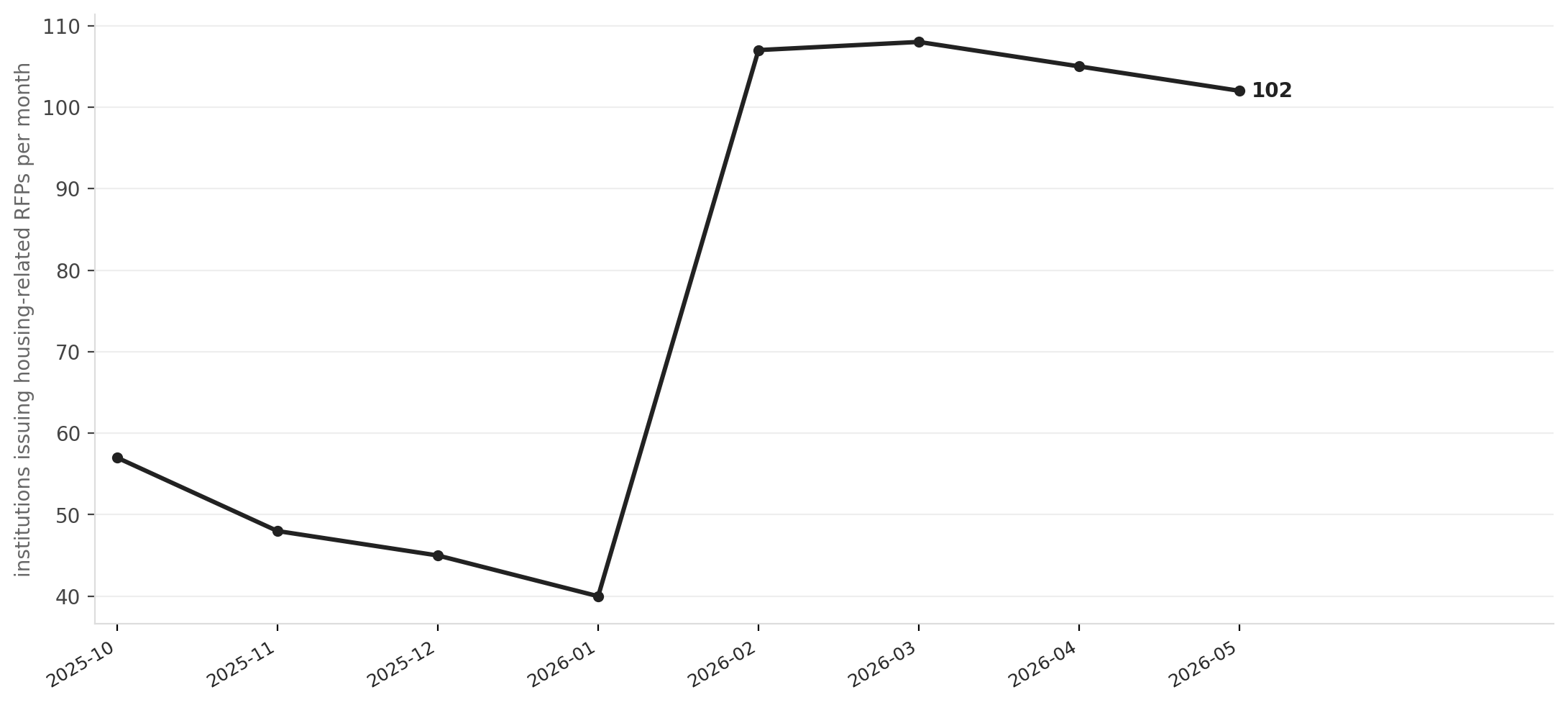
Source: NationGraph.
The RFPs now flooding the market are the procurement fingerprint of the cities trying to avoid that outcome. Fontana (pop. 233,000), Inglewood (108,000), and Alhambra (80,000) are among the larger jurisdictions issuing Housing Element update or affordable housing program RFPs for the first time in over a year. So are Dublin, Lodi, Gilroy, Rancho Palos Verdes, Sanger, Eureka, Arcata, and Truckee, a spread that runs from the Central Valley to the North Coast, from the Inland Empire to the Bay Area suburbs. The geographic range matters: this is not a regional compliance gap. It is a statewide one.
The legislative calendar has compounded the pressure. California's 2025 housing session produced three laws that simultaneously created new tools and started new clocks. AB 130 established a sweeping infill CEQA exemption. AB 1007 cut permit-review timelines from 90 days to 45. And SB 79, authored by Senator Scott Wiener, mandated that cities adopt transit-oriented density zoning by July 1, 2026, a deadline now less than two months away. SB 79's Housing Accountability Act penalty provisions activate January 1, 2027, giving cities a narrow window to adopt compliant ordinances before that enforcement layer compounds the existing one.
HCD has confirmed that 480 of California's roughly 520 incorporated jurisdictions, about 92 percent, have a certified 6th-cycle Housing Element. The current RFP surge is the procurement fingerprint of the remaining 8 percent. That sounds like a small share, but in a state with 520 jurisdictions it still means roughly 40 cities and counties whose land-use plans remain out of compliance more than four years into an eight-year cycle.
For residents in the cities now rushing to hire consultants, the practical effects are still months away. An RFP is a solicitation, not a plan. A Housing Element update typically takes six to eighteen months to draft, circulate for public comment, negotiate with HCD, and certify. Cities issuing RFPs this spring are on a timeline that, if everything goes smoothly, puts them in front of the Attorney General's office before they reach the finish line. The question is whether HCD treats demonstrated forward motion, an active procurement, a signed contract, a draft in progress, as sufficient to pause enforcement referrals.
The next signal to watch is HCD's response to the 15 Noticed jurisdictions in the weeks after the 30-day window closed in late April. If any of those cities received extensions based on procurement activity alone, it would confirm that filing an RFP is itself a compliance gesture. If the AG referrals proceeded regardless, the urgency for the cities still drafting their solicitations will be considerably sharper.
Either way, 99 housing RFPs in 30 days from institutions that had gone quiet for a year is not organic demand. It is the sound of a penalty becoming real.