Texas schools and libraries are receiving $2.16 million in federal broadband funding to help keep students and library patrons connected to high-speed internet, a fresh disbursement from a program that has quietly underpinned classroom connectivity for nearly three decades, and that now faces an uncertain future.
The funding comes through the E-Rate program, run by the Federal Communications Commission as part of its Universal Service Fund. Since 1998, E-Rate has provided schools and libraries discounts of 20% to 90% on internet and telecommunications services, with the steepest subsidies going to institutions in low-income and rural areas. Texas, with roughly 1,200 school districts and more than 550 public library systems spread across a state bigger than most countries, is a heavy beneficiary. Hundreds of thousands of households in rural West Texas and along the Rio Grande Valley still lack broadband meeting minimum speed standards, and the state's child poverty rate of around 19% means many districts qualify for the program's deepest discounts.
The stakes of the program are hard to overstate. When E-Rate launched, only 14% of K-12 classrooms in the United States had internet access. Today, that figure is effectively universal, a transformation largely credited to the program. Similar recent awards have reached New York and Wisconsin, reflecting the program's nationwide reach.
Source: NationGraph.
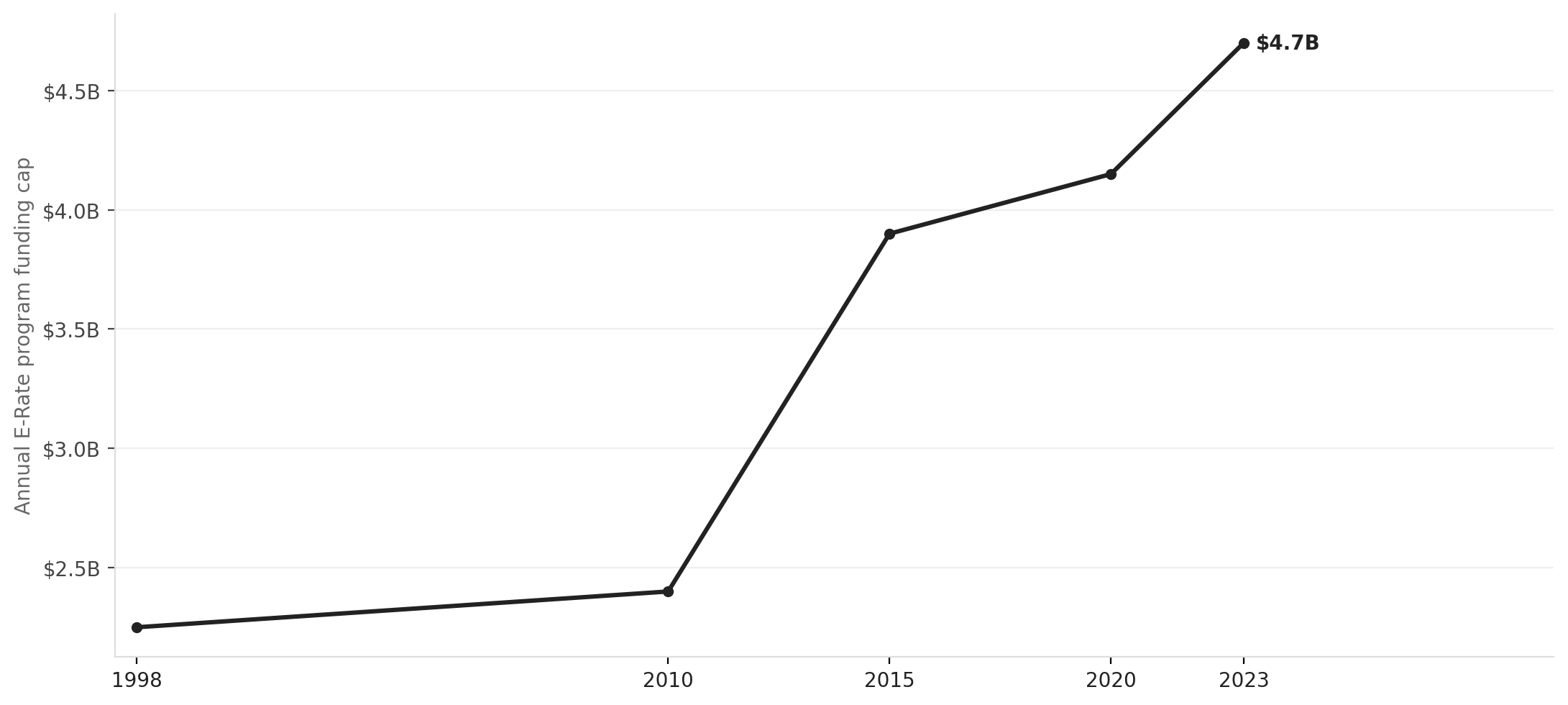
But the program is facing the most serious threat in its history. In 2024, the Fifth Circuit Court of Appeals ruled in Consumers' Research v. FCC that the way E-Rate and other Universal Service Fund programs are financed, through fees assessed on phone and internet carriers, which pass them on to consumers, amounts to an unconstitutional delegation of taxing authority. The Supreme Court heard oral arguments in the case in 2025, and a ruling has not yet been issued. If the court sides with the challengers, the funding mechanism for the entire $4.7 billion annual program could collapse.
There is an added layer of irony for Texas: the Fifth Circuit, the court that first struck down the funding structure, is the federal appeals court whose jurisdiction covers the very Texas schools and libraries that depend on these dollars.
For now, disbursements continue. This latest award reflects an application from the 2023 or 2024 funding cycle, E-Rate payments routinely lag applications by one to two years as the Universal Service Administrative Company, the nonprofit that manages the fund, reviews and approves requests. The money is already committed. What happens to next year's applications, and the year after, depends on what the Supreme Court decides.