Boston is moving to bring in outside help to fix a pre-K special education referral system that has struggled to identify young children with disabilities quickly and equitably, a challenge that has grown more acute as the city rapidly expands access to public preschool.
Boston Public Schools, which serves roughly 49,000 students in Massachusetts's largest district, posted a request for proposals in June 2026 seeking a contractor to support its consultation and referral system for preschool-age children, those ages 3 to 5 covered under federal special education law. The move signals that the district's internal capacity has not kept pace with the growing number of young children entering BPS-connected settings through Mayor Wu's Universal Pre-K initiative, which aims to offer free preschool to every 4-year-old in Boston and is now expanding to 3-year-olds.
The problem runs deeper than staffing. BPS has faced years of scrutiny over special education access, including a 2022 Boston Globe investigation that found families waiting months beyond the federally required 30-school-day timeline for initial disability evaluations, ultimately leading the district to enter a corrective action plan with the Massachusetts Department of Elementary and Secondary Education. Advocates and the Boston Special Education Parent Advisory Council have repeatedly raised concerns about chronic shortages of school psychologists, speech-language pathologists, and early childhood special educators.
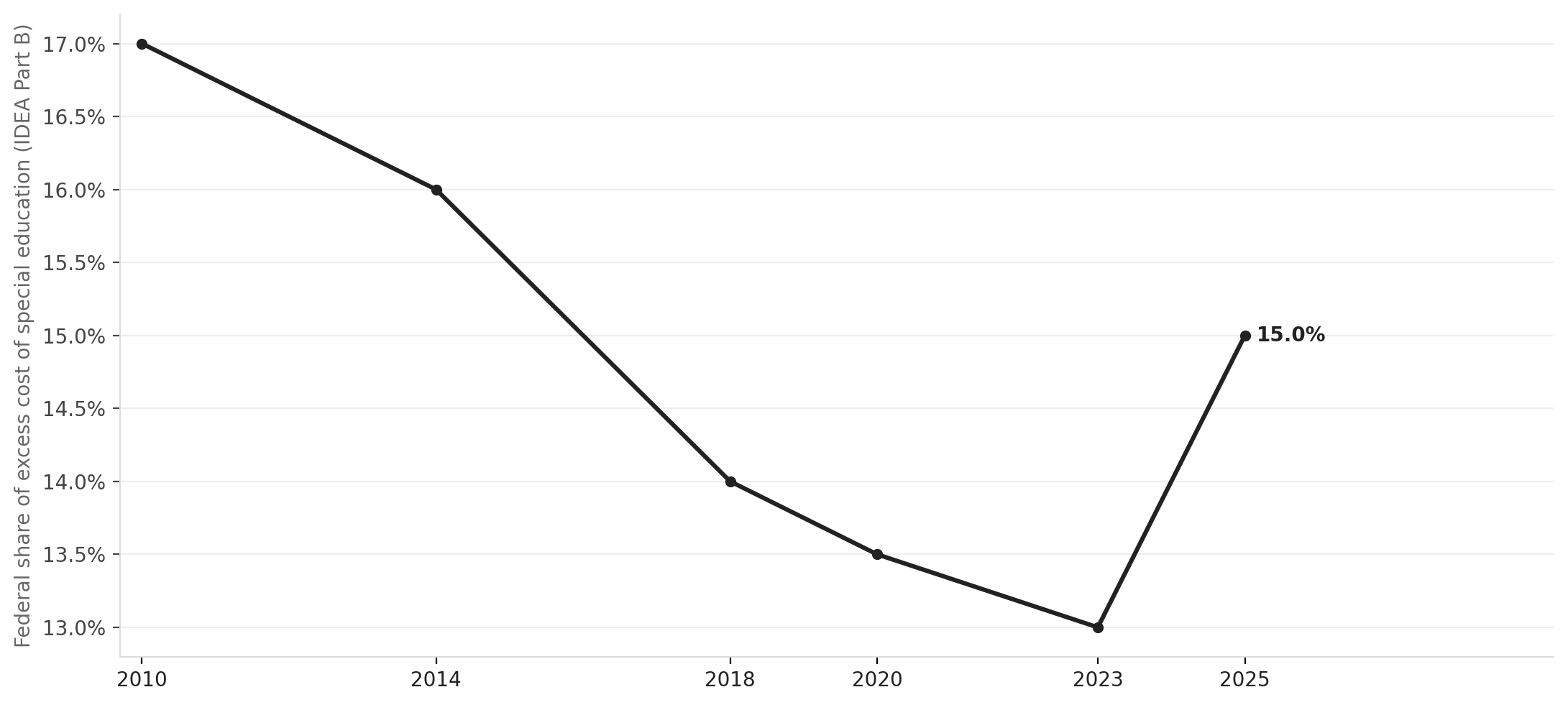
Source: NationGraph.
The district's demographic profile makes the challenge especially complex. BPS is roughly 45 percent Latino and 30 percent Black, with more than 30 percent of students classified as English Language Learners. Research has consistently shown that Black and Latino children and those learning English are both over-identified for some disability categories and under-identified for others at the preschool level, a disparity that advocates say has been persistent in Boston.
The COVID-19 pandemic compounded the backlog. Pediatric screenings were delayed and preschool programs shuttered during 2020 and 2021, causing referral rates to drop sharply across the country. Districts nationwide have since seen a surge of older children arriving in kindergarten with unidentified disabilities who should have been caught years earlier. Federal funding has not closed the gap: Congress has chronically funded only about 13 to 15 percent of special education's excess costs, well below the 40 percent originally promised when the Individuals with Disabilities Education Act was passed in 1975.
One of the most vulnerable moments in the system is the transition a child makes around age 3, when early intervention services end and preschool special education begins. Children frequently fall through the cracks during that handoff, and advocates say BPS has historically struggled to catch them.
The contract Boston is pursuing would cover both consultation and referral functions, meaning the vendor would support the process from initial screening through the pipeline into formal evaluation. Whether that outside investment translates to faster, more equitable identification for the city's youngest children with disabilities is an open question, and one that parent advocates and district watchdogs will be watching closely as the 2026-2027 school year approaches.