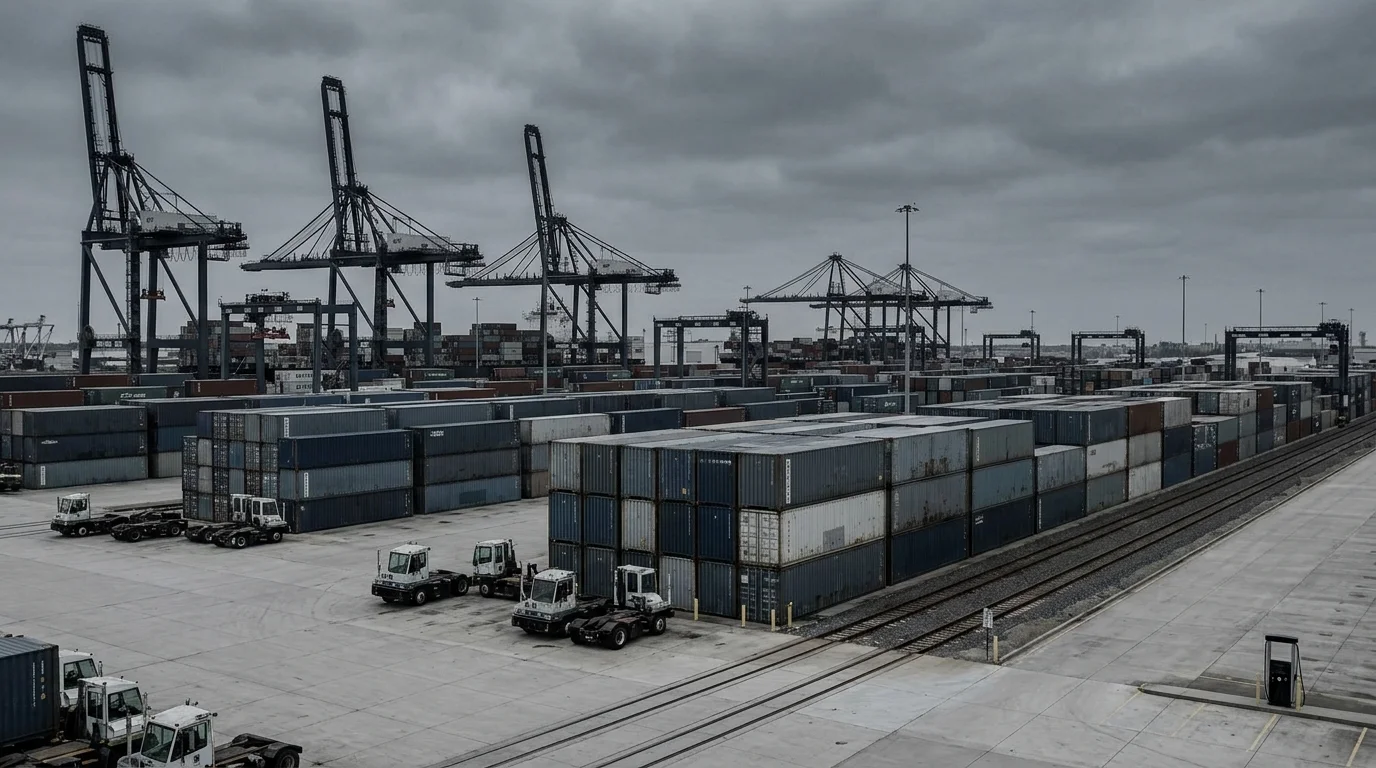
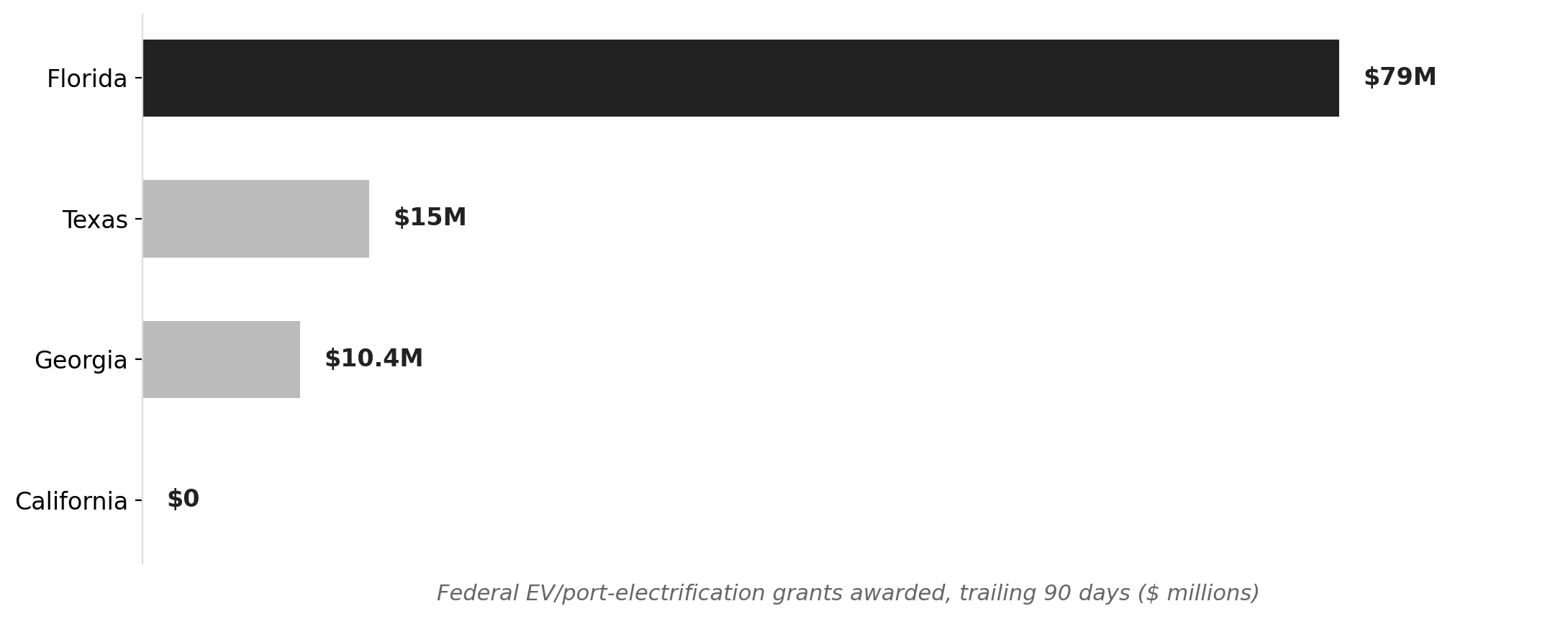
Florida has absorbed $79 million in federal electric vehicle grants over the past 90 days, a 94 percent increase over the same window last year, and virtually none of it will build a single public charging station. The money is going to two of the state's largest freight ports, electrifying the cargo terminals that move goods into the country rather than the highways that move residents around it.
The surge traces almost entirely to two awards. In March 2026, Miami-Dade County received a $25.7 million INFRA grant for PortMiami, covering roughly 47 electric terminal tractors, three hybrid rubber-tired gantry cranes, 76 hybrid trucks, and 42 dual charging stations across two cargo terminals. Two months later, Broward County landed a $53.4 million MARAD Port Infrastructure Development Program grant for Port Everglades, funding hybrid and electric cargo vehicles, a comprehensive electrification master plan, and charging infrastructure that runs through November 2031. Together, the two awards account for nearly 12 percent of MARAD's $450 million national PIDP allocation for FY 2026, which the agency has identified as the final IIJA-funded year for the program.
No other large state is close in the same 90-day window. Texas received $15 million across six grants. Georgia took in $10.4 million across two. California received nothing. Florida's freight port ecosystem, anchored by two of the busiest container and cruise facilities in the Western Hemisphere, has made the state the dominant beneficiary of the IIJA's port-electrification push precisely as that push reaches its funding ceiling.
Source: NationGraph.
The driver is deadline math. Both MARAD's PIDP and DOT's INFRA programs are drawing down their Bipartisan Infrastructure Law authorizations in the current fiscal year, pushing grant officers toward large, shovel-ready projects that can demonstrate obligated funds before the IIJA clock expires. Port Everglades and PortMiami qualified on both counts: established infrastructure, documented emissions-reduction plans, and the logistical capacity to absorb nine-figure commitments. Florida's total active federal EV grant portfolio through DOT alone now exceeds $180 million obligated, with $45.5 million already outlayed.
The split becomes sharper when you look at what the same IIJA session has not delivered. Florida holds a $198 million five-year allocation under the NEVI formula program, the federal effort to build out a national public highway charging network. That allocation was frozen in February 2025 when FHWA suspended the program for executive-order compliance review. A federal court order in June 2025 forced the release of frozen funds, and FHWA issued new interim guidance in August 2025 restoring state access. Florida has since submitted its FY26 NEVI plan, but as the Electrification Coalition notes in its state tracker, the state has still not obligated any NEVI funds for public charging stations. The federal money to electrify Florida's highways exists. The chargers do not.
There is other EV activity in the state that points toward a future public fleet, even if not public charging. The Pinellas Suncoast Transit Authority secured a $27.8 million Low-No emissions bus grant in May 2025, with $16.5 million already outlayed. The City of Tallahassee received a $20.4 million Low-No award in July 2025 toward a fully battery-electric bus fleet by 2035. Miami-Dade's school district received $8.8 million through EPA's Clean School Bus Program, pushing its electric bus count toward 125 vehicles by 2026. These grants represent a parallel electrification track moving through transit agencies, not highway corridors.
For a state with 21 million residents and more than 100 million annual tourists, the gap between freight-port electrification and consumer charging infrastructure carries real commercial weight. Florida ranks among the top five states for EV registrations, and its tourism economy depends heavily on rental car fleets that are increasingly electric. The absence of a reliable NEVI network along I-95 and I-75 is a constraint that port electrification, however substantial, does not address.
What happens next depends on two separate timelines. On the port side, Broward and Miami-Dade will begin equipment procurement and infrastructure construction under their respective grant agreements, with performance benchmarks stretching to 2029 and 2031. On the charging side, Florida's FY26 NEVI plan is now before FHWA for approval. The plan's acceptance, followed by the state's first obligated charging-station funds, would mark the first concrete step toward closing the gap. Whether that step comes before the next round of IIJA port grants is awarded, likely in late 2026, will determine whether Florida's EV story stays a port story or becomes something residents can actually plug into.