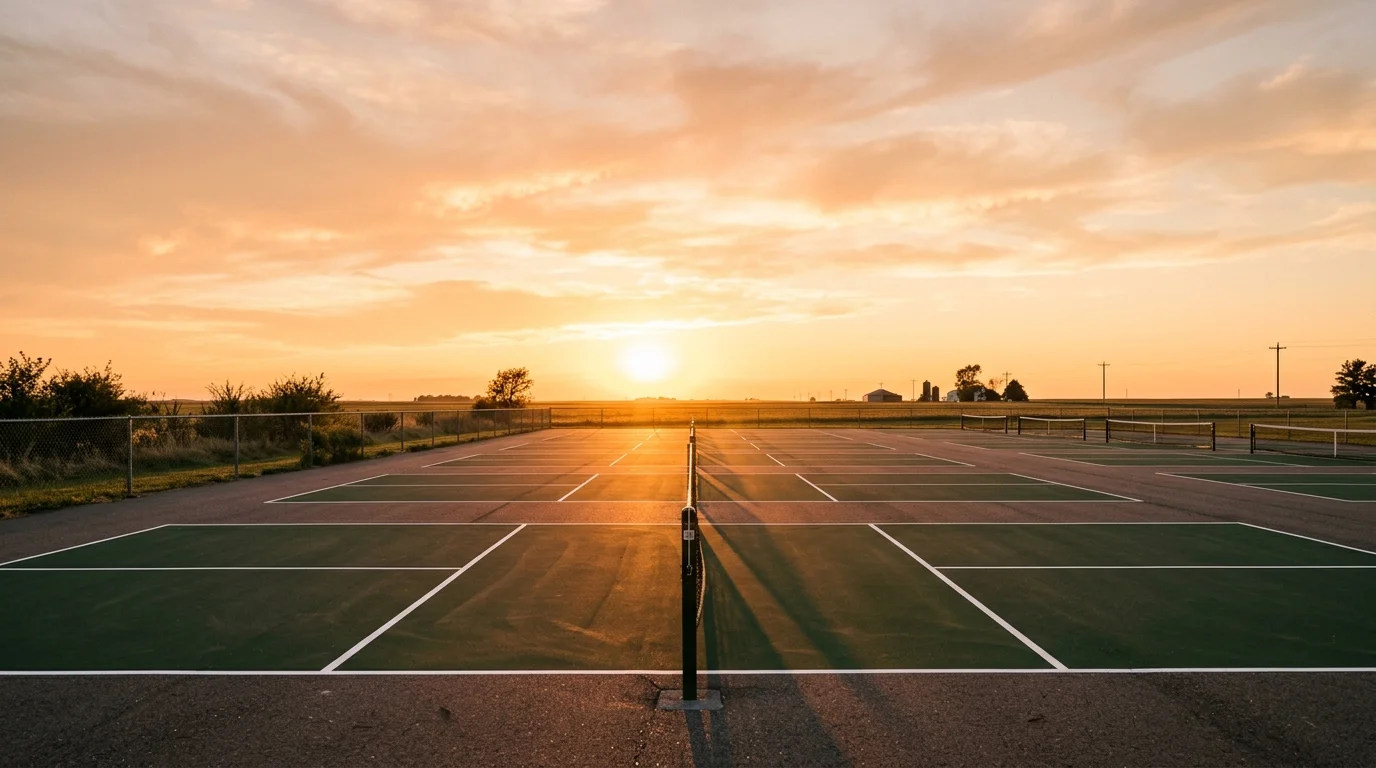
Bonner Springs, Kansas, population 7,554, is soliciting bids to build pickleball courts in North Park. That fact is unremarkable on its own. What makes it a signal is the company it's keeping: Kansas has logged 8 pickleball facility RFPs in the past 30 days against a 12-month monthly average of roughly 0.75, a nearly 10-fold spike. The three distinct procurement projects behind that number, in Bonner Springs, Liberal (pop. 18,753), and Hays (pop. 20,870), are all small cities well outside Johnson County. The model is spreading.
The force behind the diffusion is not a sudden conversion to paddle sports. It is a replicable economic-development template that Overland Park assembled over four years and that a national pro tour just publicly validated. In August 2025, Visit Overland Park and the Association of Pickleball Players announced a five-year APP Tour partnership, placing the inaugural APP Overland Park Open at the AdventHealth Sports Park at Bluhawk on September 16-20, 2026. The event is expected to draw roughly 200 professional athletes and 1,000 amateur participants. APP Chief Revenue Officer Ryan McSpadden publicly branded Overland Park as "the most pickleball-obsessed community in the country." For a park director in Liberal or Hays, that branding is an instruction manual.
The financial architecture underpinning this is Kansas's STAR bond program, administered by the Kansas Department of Commerce and designed specifically for major entertainment and tourism destinations. The AdventHealth Sports Park at Bluhawk, a $1 billion complex that opened in fall 2024, was built on STAR bond financing and includes eight pickleball courts in its first phase. Developer Bart Lowen said explicitly that the APP Tour's selection of the venue demonstrated "how the STAR bond program successfully drives new-to-state economic activity." Phase 2 of Bluhawk is now requesting an additional $16 million in STAR bonds, with a public hearing scheduled for the June 1, 2026 Overland Park City Council meeting, adding still more pickleball courts before the first pro tournament has been played.
Source: NationGraph.
Smaller cities cannot replicate a $1 billion complex. What they can replicate is the logic: pickleball courts are cheap to build, easy to permit, and draw participants who travel and spend. Overland Park Mayor Curt Skoog and Visit Overland Park CEO Warren Wilkinson have made that case publicly, and the APP tour stop gave it a quantifiable payoff. For cities like Bonner Springs, Liberal, and Hays, the co-financing vehicle is more modest: the Kansas Department of Wildlife and Parks holds approximately $3 million in active Department of the Interior Outdoor Recreation Acquisition and Development grants, the likely funding mechanism for court projects at this scale. A few hundred thousand dollars in court construction is a manageable line item for a small-city parks department; the Overland Park proof of concept reduces the political risk of asking for it.
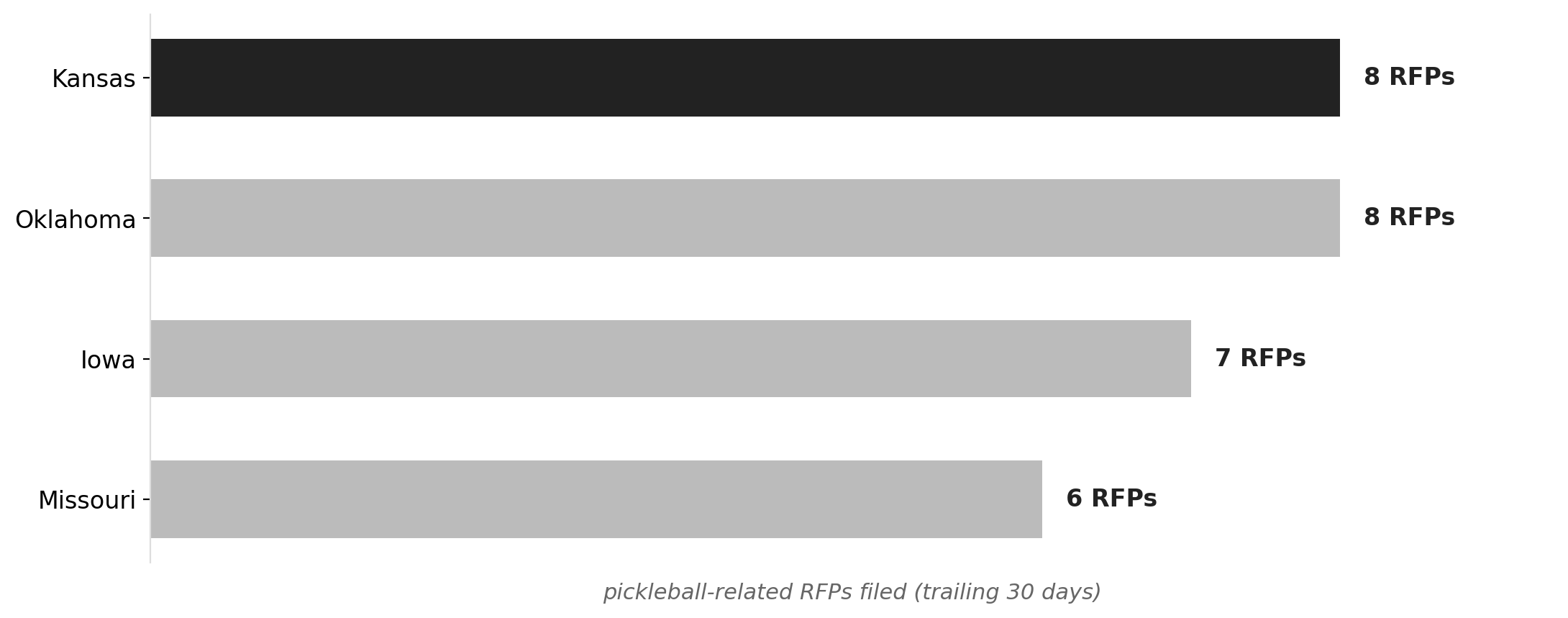
The geographic spread of the current procurement activity is the editorial point. Across the past 18 months, seven Kansas cities have issued pickleball-related RFPs: Bonner Springs, Derby, Great Bend, Hays, Liberal, Overland Park, and Wichita. That range runs from the Kansas City suburbs to the southwest corner of the state. In the trailing 30-day window, Kansas ties Oklahoma for the most pickleball RFPs among Midwest states, with Iowa at seven and Missouri at six trailing behind. But Kansas's activity is concentrated in smaller municipalities, which makes its per-capita intensity notable and suggests the diffusion is coming from a specific state-level signal rather than a general national surge in pickleball investment.
Kansas has no mountains and no coastline. Overland Park officials have acknowledged this publicly. Sports infrastructure is one of the state's primary levers for attracting out-of-state visitors, and the STAR bond program exists precisely to fund destination-grade facilities that would not otherwise pencil out for private developers alone. The pickleball strategy fits that framework cleanly: it requires relatively little land, generates tournament traffic that fills hotel rooms, and produces an asset that serves local residents year-round between events.
The next concrete moment to watch is June 1, when the Overland Park City Council takes up the Phase 2 STAR bond request. If the additional $16 million is approved, it will confirm that the state's anchor city is expanding the template even as smaller cities are still copying version one. The APP Overland Park Open in September 2026 will then provide the first real attendance and economic-impact numbers. Those figures will either accelerate the next round of small-city RFPs across Kansas, or give park directors a reason to pause. Either way, Bonner Springs is already building.