Washington state issued 145 stormwater-related RFPs in the last 30 days, more than double its trailing 12-month monthly average of roughly 70 and more than triple the volume recorded in any single month between August and January. In the same window, California issued 62 stormwater RFPs, Oregon issued 47, and Colorado, Montana, and Idaho combined for fewer than 50. Washington, by itself, out-procured the entire Pacific coast.
The explanation is not a budget cycle or a funding windfall. It is a date: July 1, 2026.
Two interlocking regulatory deadlines are hitting simultaneously, and together they have turned a normal spring contracting season into one of the most concentrated public procurement bursts the state has seen in years. First, Washington's Department of Ecology issued a new 2026 Construction Stormwater General Permit that took effect January 1, 2026, adding mandatory Certified Erosion and Sediment Control Leads on every construction site, new turbidity sampling requirements, and expanded definitions of what counts as regulated activity. Second, stormwater permits issued before July 1, 2021 expire on that same July 1, 2026 date under Clark County Code §40.386.010, and Clark County must finalize an entirely new Stormwater Code and Manual by the same deadline. The Western Washington Phase II Municipal Stormwater Permit, covering more than 80 cities and portions of six counties, became effective August 1, 2024, and embeds Stormwater Management Action Plan deadlines that are now coming due.
Source: NationGraph.
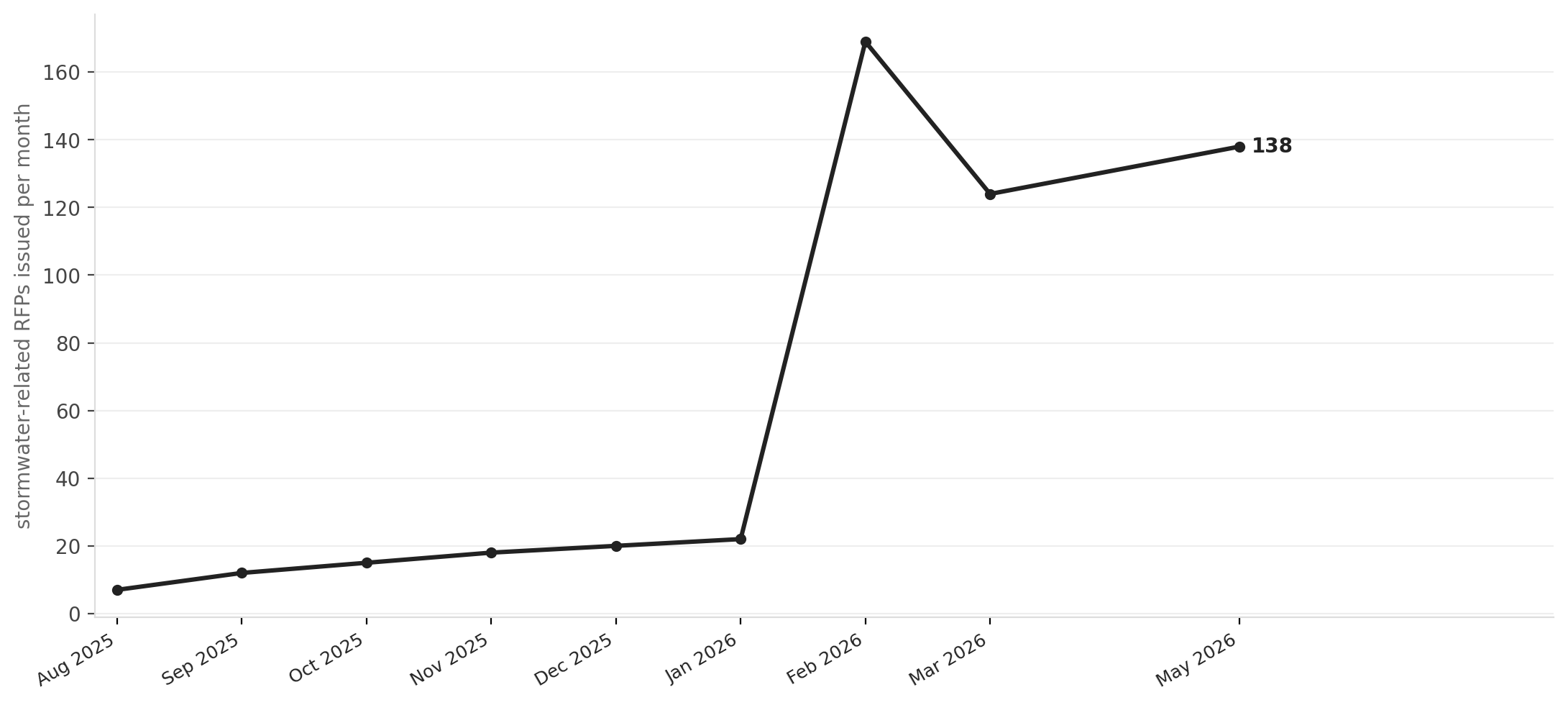
The procurement signal appeared almost the moment the new permit took effect. Monthly RFP volume ran between 7 and 22 from August through January. Then it jumped to 169 in February, settled at 124 in March, and has stayed above 130 through May. The surge is not concentrated in one corner of the state. Since February, King County has issued 72 stormwater RFPs, Whatcom County 66, Snohomish County 51, Thurston and Clallam counties 35 each, and Pierce and Spokane counties in the low 30s. Clark County, which faces the most explicit code-rewrite deadline, has issued more than 30. In the most recent 30-day window, the city of Port Angeles leads all jurisdictions with 12 RFPs, followed by Whatcom County at 9 and Everett and Mill Creek at 6 each.
What explains the concentration in Washington specifically is the structure of its regulatory program. Ecology administers its own EPA-delegated NPDES program and has historically written some of the country's most stringent stormwater rules. The state runs overlapping Phase I permits covering large counties such as King, Snohomish, Pierce, and Clark, and Phase II permits for the 80-plus smaller cities of Western Washington, meaning virtually every local government in the region faces compliance obligations within the same 12-month window. Puget Sound's salmon habitat adds a further backstop: turbidity and runoff standards tied to ESA-listed species mean that non-compliance carries litigation risk that most other states do not face.
The 2026 Construction Stormwater General Permit is also Ecology's first attempt to adapt to the U.S. Supreme Court's 2025 ruling in City of San Francisco v. EPA (145 S.Ct. 704), which restricted how agencies can write open-ended "end-result" narrative permit provisions under the Clean Water Act. The ruling forced Ecology to restructure permit language it had used for years, adding compliance uncertainty that pushed some jurisdictions to seek outside engineering and legal help earlier than they otherwise would have.
Federal dollars are helping carry the cost. Washington's active federal stormwater and coastal resilience grant portfolio totals roughly $188 million, anchored by a $73.6 million NOAA Office for Coastal Management award to the State of Washington active through 2029 and $24.8 million to WSDOT under the same program. The EPA's Sewer Overflow and Stormwater Reuse Municipal Grant Program awarded Washington $764,000 in FY2025. Those grants fund design and infrastructure, but they do not write the procurement documents or hire the engineers, which is where the RFP surge shows up.
Clark County's public deliberations capture the scale of what local governments are actually trying to do. May 2026 meeting minutes show county officials working through proposed low-impact development priority requirements, bioretention design standards, and long-term maintenance cost allocations for stormwater facilities, all of which must be codified before July 1. Seattle published a second public draft of its own Stormwater Code and Manual revision in January 2026. These are not routine maintenance contracts; they are foundational documents that will govern how each jurisdiction manages runoff for the next five-year permit cycle.
The next signal to watch is whether the July 1 deadline produces a hard cliff or a negotiated extension. Ecology has the authority to issue compliance schedules for permittees that can demonstrate good-faith progress but cannot meet the deadline outright. The volume and timing of RFPs suggests most jurisdictions are trying to avoid that conversation. Whether contractors can absorb 145 simultaneous bids in a single state, in a single month, without the kind of capacity crunch that delays the projects those bids are meant to fund, is the open question heading into summer.