Procurement filings for flood control in North Dakota have surged sevenfold in the past 30 days compared to the monthly average, a spike that reflects something more fundamental than a busy spring construction season: the state is simultaneously deep into the two largest flood-infrastructure projects in its history, and both are burning through money at the same time.
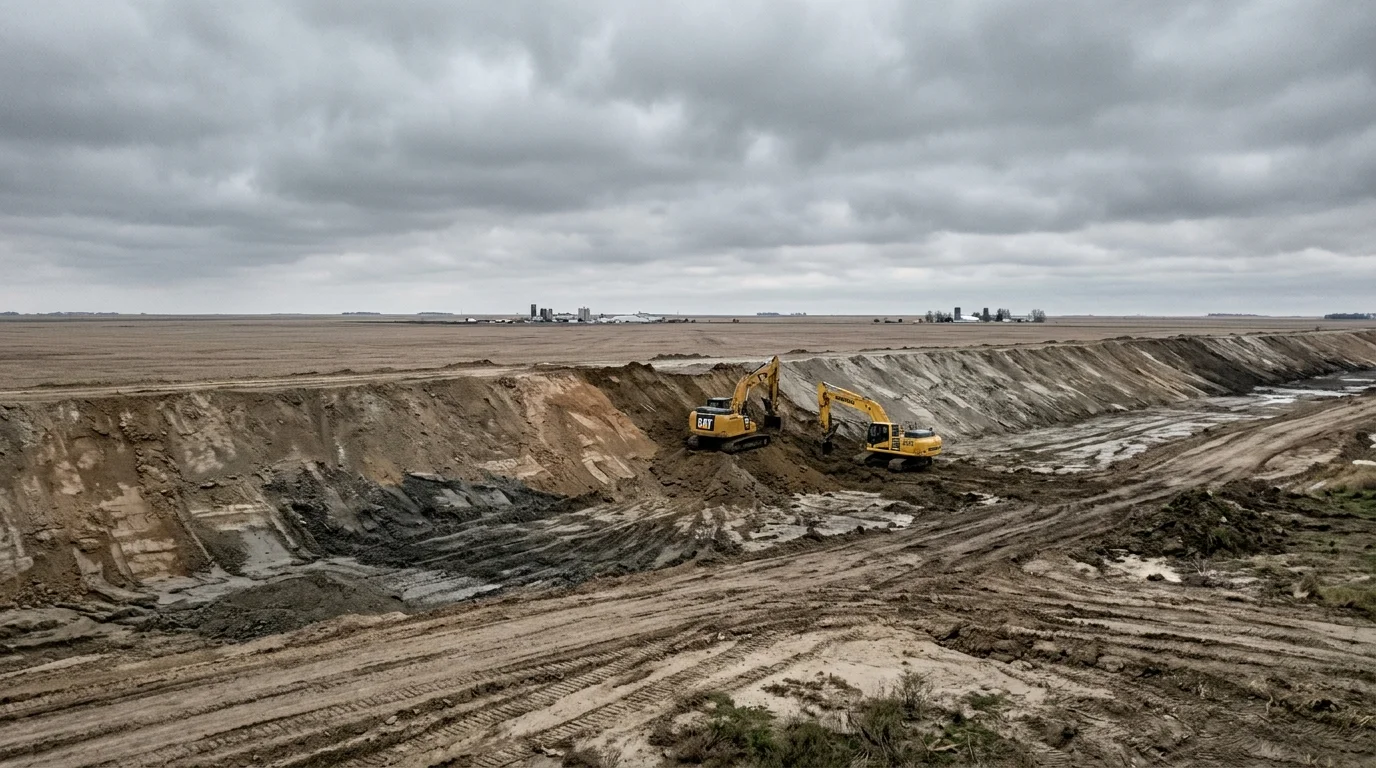
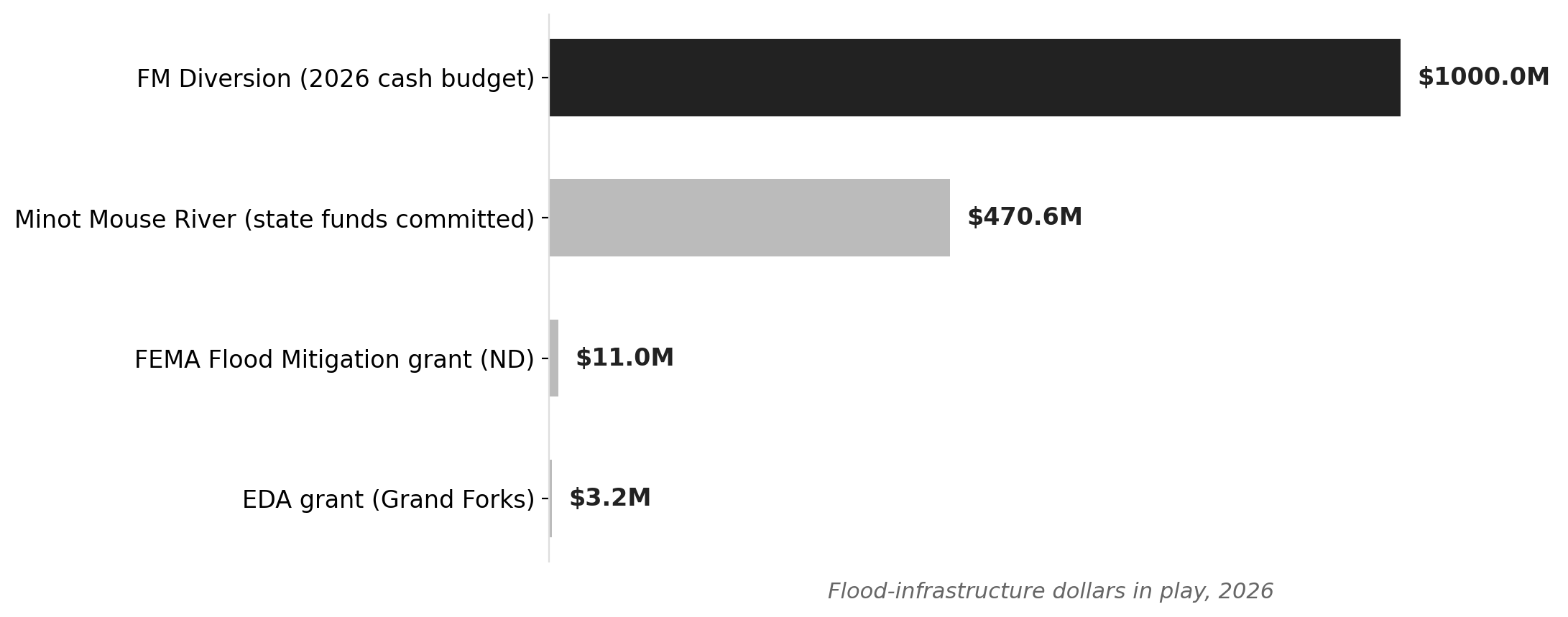
The Fargo-Moorhead Area Diversion carries a $3.2 billion price tag and a 2026 cash budget of $1 billion, or roughly $2.8 million every day, as approved by the Diversion Board last December. The project is targeting substantial completion this fall and its first operational use in the spring 2027 flood season. In Minot, the Mouse River Enhanced Flood Protection Project has accumulated roughly $1.8 billion in total estimated costs, and the State Water Commission released $81.1 million in new biennium funds for it in February 2026, on top of $389.5 million previously committed. A state of 780,000 people is carrying both tabs at once.
The driver behind this compression is straightforward: two disasters, two decades apart, produced two projects that were designed, fought over, and funded on separate timelines, then arrived at peak spending in the same calendar year. Fargo sits on the Red River of the North, which has produced eight of its ten largest floods since 1989. Minot has been rebuilding since the 2011 Souris River flood that damaged an estimated 4,700 structures. Both projects took more than a decade to reach shovels in the ground. They converged here.
Source: NationGraph.
Federal money has been the load-bearing beam for both. The FM Diversion captured $750 million in federal funds, including $437 million from the Infrastructure Investment and Jobs Act, plus a $569 million WIFIA low-interest loan, giving it a P3 structure with milestone-tied payments that insulates the project from year-to-year legislative variance. The Minot project has no such insulation. Its funding runs through the state's oil-and-gas trust fund appropriations and Army Corps authorizations, making it structurally exposed to commodity price swings. The Maple Diversion, the critical MI-4 segment that would remove 60 percent of Minot residents from the floodplain entirely, carries a roughly $100 million price tag with $60.5 million in federal Army Corps funding committed and construction expected to begin late 2026 over a five-season build.
Governor Kelly Armstrong toured Minot's active construction sites on May 1 and offered language that sounded less like a ribbon-cutting and more like a warning. He told reporters that "a partially funded flood project is a real problem because it's not actually flood protection," a direct acknowledgment that incomplete work provides no protection at all and that the state cannot treat either project as a place to find budget savings. The governor's framing also signals what the 2027 legislative session will face: a reckoning over whether oil revenues can sustain the Minot pace while the FM Diversion completes its final construction year.
The urgency is not hypothetical. North Dakota received two presidential major disaster declarations in 2025, FEMA-4888-DR for June storms that killed four people and triggered emergency loan access across 19 counties, and FEMA-4895-DR for August flooding. FEMA announced $846,000 in new public assistance for communities hit by the June storms as recently as May 19 of this year. Grand Forks is simultaneously issuing RFQs for 2026 flood fight assistance, filled sandbags, and crushed concrete, the kind of seasonal procurement that runs in parallel with long-term permanent infrastructure work. Valley City is advancing Phase 4 of its own permanent flood protection program. The flood threat is active while the permanent solutions are still under construction.
Minot's Public Works Department managed $153.6 million in total projects in 2025, of which $142.1 million, more than 92 percent, was flood control. That figure alone describes a city that has effectively reorganized its municipal capital program around one existential project for the better part of fifteen years.
For residents in Fargo and Moorhead, the spring 2027 flood season is the first concrete milestone to watch: it is the earliest point at which the diversion could be called into service, and the Diversion Authority has staked its construction schedule to that date. For Minot residents, the Maple Diversion groundbreaking, expected before the end of 2026, will mark whether the most protective segment of the project stays on its timeline or slips into the next budget cycle. The 2027 North Dakota legislative session, which will set appropriations for the next biennium, is where both timelines will either be confirmed or renegotiated.