Pennsylvania transit agencies issued 51 procurement solicitations in the last 30 days, more than double the 12-month monthly average of roughly 21.5, and the surge tells a story that looks nothing like a system flush with cash.
Pittsburgh Regional Transit alone accounts for 25 of those solicitations, a bulk release on May 20 covering engine parts, track components, light-rail vehicle bearings, modems, and fuel contracts. These are not aspirational purchases. They are the minimum required to keep a fleet moving, and many carry due dates in May and June 2026. South Central Transit Authority in Lancaster added three genuine fresh RFPs on top of that. The procurement calendar is busy. The balance sheet is not.
The reason agencies are buying at this pace while facing structural insolvency is a collision of two hard constraints. Federal grants come with use-it-or-lose-it obligations: SEPTA holds $317 million and $97 million in active State of Good Repair grants from the U.S. Department of Transportation running through 2034, and PRT holds $58 million in Formula Grants through 2028. Agencies that fail to issue matching procurements risk clawback. At the same time, basic fleet survival sets a floor on what can be deferred. You cannot skip the bearing replacement on a light-rail vehicle any more than you can skip an oil change and expect the car to start.
Source: NationGraph.
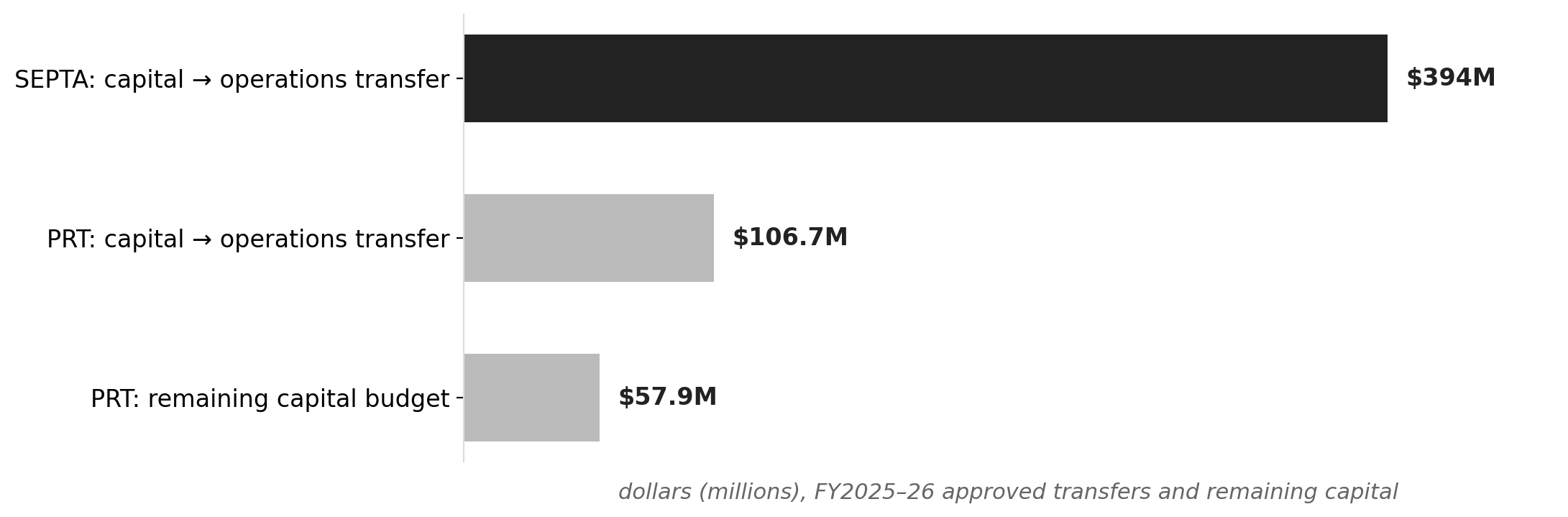
What makes this moment different is where the money to pay for those parts is coming from. Act 89, the 2013 law that routed Pennsylvania Turnpike toll revenue into $450 million a year in transit funding, expired without a legislative replacement. The gap it left has grown into a projected $100 million deficit at PRT for FY2026, growing annually. To plug it, Gov. Shapiro's administration approved SEPTA's transfer of $394 million in capital funds to operations in September 2025, and cleared PRT's use of $106.7 million on the same basis 8 days later. The capital accounts that were supposed to fund track work and vehicle overhauls are now covering payroll and fuel.
PRT CEO Katharine Kelleman put it plainly: the arrangement is like covering your mortgage with your car payment. The agency responded by slashing its infrastructure budget by two-thirds, to $57.9 million, in order to preserve 40 bus routes from elimination. The Panhandle Bridge rehabilitation and other capital projects have been pushed back or scaled down. The procurement RFPs going out now are largely the irreducible minimum: the parts and service contracts where delay means a bus or train does not run tomorrow.
The politics of a fix are stuck. Shapiro's FY2026-27 budget proposes raising the share of state sales tax revenue earmarked for transit from 4.4 percent to 6.1 percent, which would generate roughly $319 million a year, but the earliest that money could flow is July 2027, and it requires legislative approval from a Republican-controlled Senate that has shown no appetite for new revenue. Senate Republicans countered with HB 257, offering $292.5 million from the Public Transportation Trust Fund without tax increases, conditioned on inflation-indexed fare increases. Democrats rejected it. The June 30, 2026 budget deadline is approaching with no structural deal in sight.
The trust fund itself, which holds $2.4 billion even after the capital-to-operations transfers, according to PennDOT Secretary Mike Carroll's March 2026 Senate testimony, has become a Republican talking point: if the money is there, why are agencies crying poor? Carroll's answer is that hundreds of millions in allocated capital dollars remain unspent, a claim agencies attribute to the same procurement and labor constraints that make capital projects slow in any large public system.
The asymmetry cuts hardest outside Pittsburgh and Philadelphia. The capital-flex workaround is legally available only to PRT and SEPTA. The 33 smaller systems that did not receive that relief include agencies serving communities in Republican legislative districts, a fact that has not yet broken the legislative deadlock but complicates any narrative that frames this as a purely urban problem. LANTA, serving Lehigh and Northampton counties, already cut service 5 percent in February 2026 without the capital-flex cushion the big agencies have.
For riders, the immediate signal to watch is not the RFP count but the budget vote. If Harrisburg reaches June 30 without a transit funding agreement, PRT and SEPTA will have exhausted the two-year runway the capital transfers bought them, and the service cuts that were averted in 2025 come back to the table. The procurement activity visible right now is agencies racing to meet federal obligations and keep fleets operational while that clock runs out.