Most American high school students will never take a class on artificial intelligence, not because schools lack interest, but because their teachers have nowhere to learn how to teach it. A new federally funded initiative based in Florida is trying to change that.
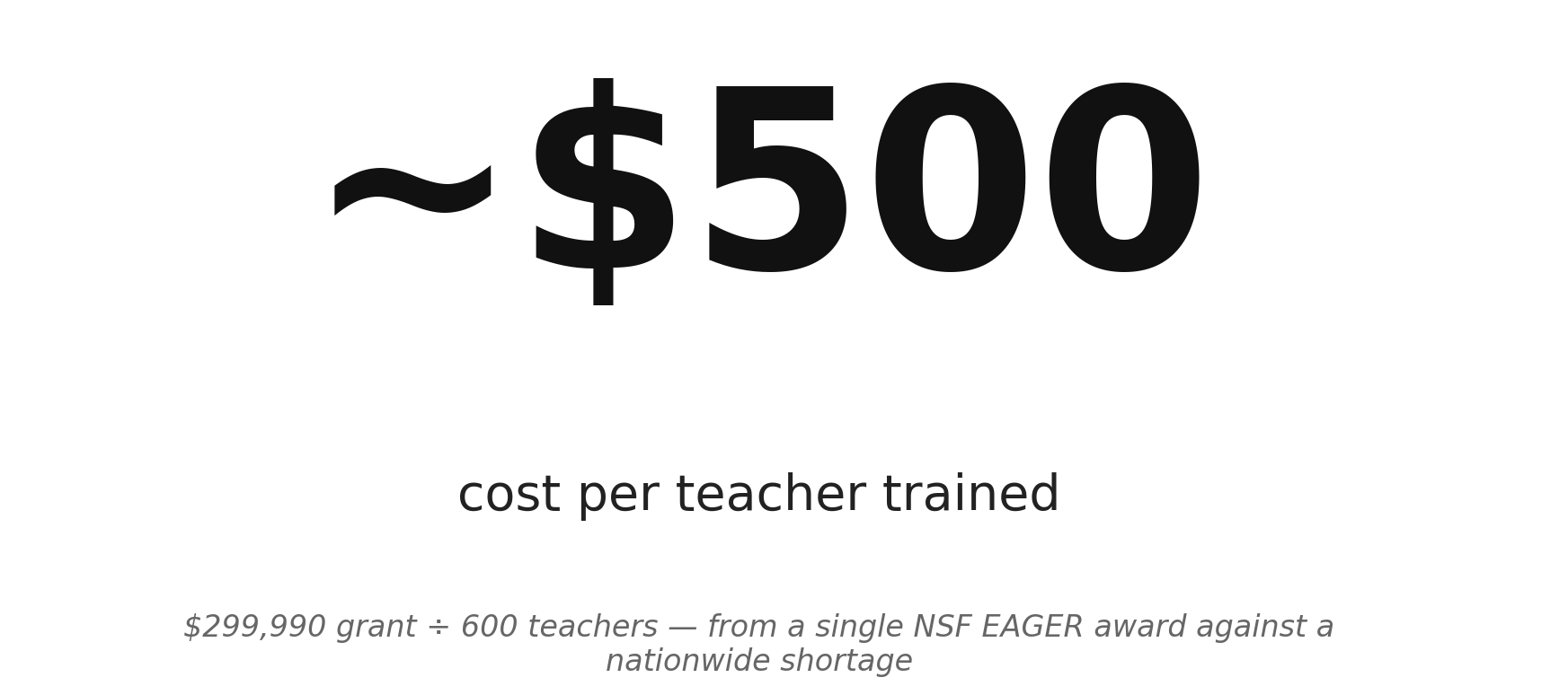
The National Science Foundation has awarded $299,990 to a Florida institution to build what it calls the National AI Entry Pathways Initiative, a year-long virtual academy targeting at least 600 credentialed high school teachers across the country. The program focuses on computer science and Career and Technical Education teachers, the two groups most likely to introduce AI content into classrooms for students in both college-prep and vocational tracks.
The scale of the underlying problem is significant. There are roughly 3.7 million high school teachers in the United States, and the vast majority have no formal AI training. Even among the approximately 75,000 computer science teachers, few have subject-specific AI expertise. Meanwhile, generative AI has moved from research labs to everyday use, states including California and Virginia have begun requiring or incentivizing AI coursework, and industry demand for AI-skilled workers continues to climb.
Source: NationGraph.
The grant comes in at essentially the ceiling for NSF's EAGER mechanism, a program designed for exploratory, time-sensitive research that can move faster than the agency's standard multi-year review process. The framing is deliberate: NSF is testing whether this training model works before potentially committing larger funds. The initiative responds to a 2025 NSF directive explicitly calling on researchers to advance AI education for American youth.
Teachers who complete the academy will pursue industry-recognized AI credentials and gain access to a curated, freely available online repository of classroom-ready instructional materials. A national community of practice, sustained through regular gatherings and a monthly newsletter, is intended to keep educators connected after the formal training ends.
Florida's role as the operational hub is a natural fit. The state has one of the largest CTE enrollments in the country, mandated computer science course offerings in all school districts by 2023, and hosts several NSF AI Research Institutes with ties to industry partners who are helping shape the credential framework.
The program runs centrally from Florida without distributing funds to regional partners, relying instead on virtual delivery and an existing network of academic and industry collaborators. Whether that model can meaningfully reach teachers in rural or underserved communities, and whether 600 trained educators can seed broader change in a country with tens of thousands of high schools, will be the central question when NSF evaluates whether to scale the effort.