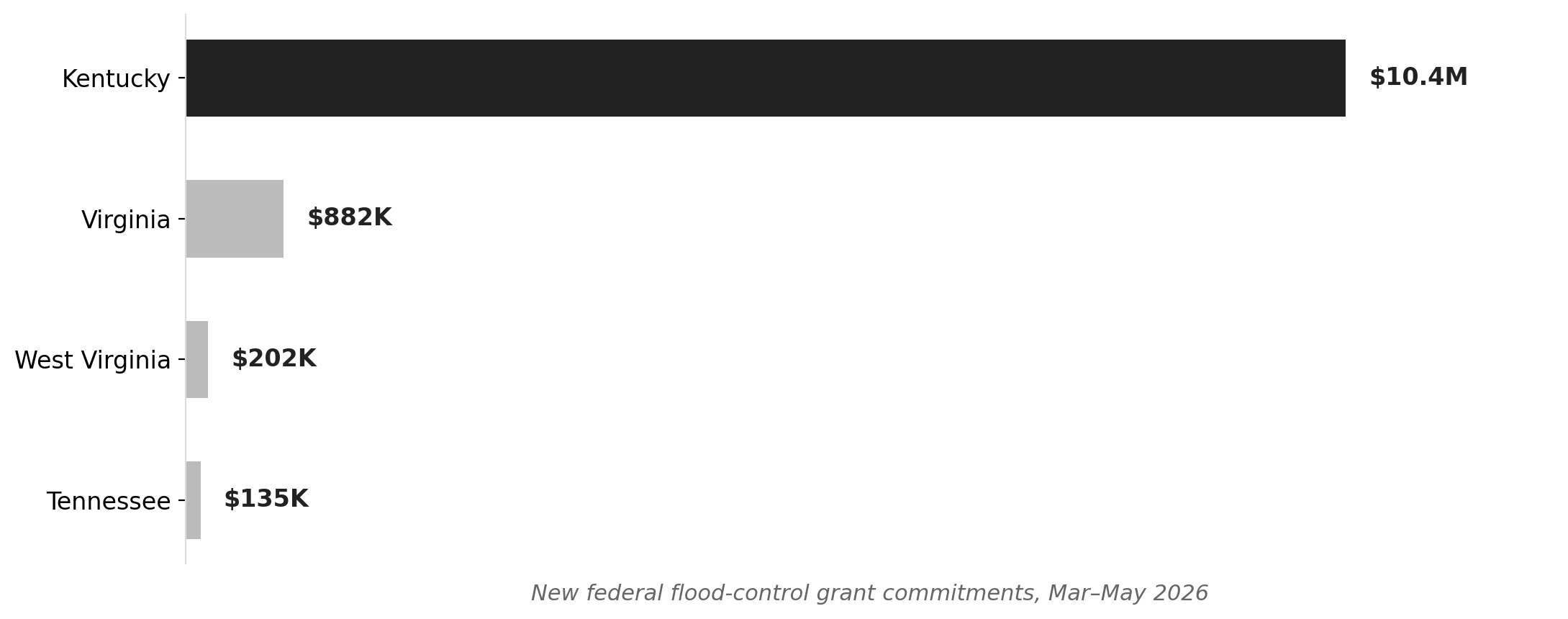
Federal flood-control grants to Kentucky have hit $10.45 million in the last 90 days, twelve times the $820,000 committed in the same window a year ago, and the counties holding most of that money now face a hard October 2026 deadline to turn it into dams, streambank stabilizations, and elevated structures in some of the most logistically difficult terrain in the country.
All five new awards flow through just two programs: the USDA's Emergency Watershed Protection (EWP) Program, which delivered $9.69 million to Pike County Fiscal Court ($5.24M), Big Muddy Creek Watershed Conservancy ($3.0M), and Perry County Fiscal Court ($1.45M), and FEMA's Flood Mitigation Assistance program, which added $757,000 to the Kentucky Department of Military Affairs. Those new commitments land on top of an already-massive active EWP portfolio: 13 USDA grants totaling $68.9 million, with the largest awards parked in Knott County ($17.5M) and Letcher County ($16.4M). Every one of those grants expires by October 2026.
The driver is a specific sequence of federal actions, not a general uptick in generosity. FEMA Major Disaster Declaration DR-4860, signed February 24, 2025, covered more than 60 Kentucky counties for severe storms, flooding, landslides, and mudslides from a storm system that moved through on February 14 and 15. Governor Andy Beshear traveled to Washington to lobby President Trump for an expedited declaration, and the authorization that followed unlocked Hazard Mitigation Grant Program funding alongside Public Assistance and Individual Assistance. A second declaration, approved April 24, 2025 for a separate storm system, extended coverage to Woodford County and parts of central and western Kentucky, explaining the $9.4 million EWP grant now sitting with a Woodford conservancy district.
Source: NationGraph.
The USDA's EWP program is built for exactly this situation: rapid post-disaster deployment for debris removal, streambank repair, and floodwall reconstruction. Grants typically close 12 to 15 months after the triggering event, which is why the volume is cresting now in spring 2026. The Kentucky Association of Counties noted that the expedited declaration was unusually fast by federal standards, a reflection of the political pressure Beshear applied and the well-documented history of repeat flooding in the same communities.
That history is what makes Eastern Kentucky's situation structurally different from a typical post-disaster recovery. The 11 counties designated for individual assistance under DR-4860, Breathitt, Clay, Floyd, Harlan, Knott, Lee, Letcher, Martin, Owsley, Perry, and Pike, are nearly identical to the counties devastated by the catastrophic July 2022 floods. Those 2022 floods generated their own federal pipeline: roughly $298 million in Community Development Block Grant Disaster Recovery (CDBG-DR) funds, now being administered by the Kentucky Department for Local Government across 20 Eastern Kentucky jurisdictions. Several county governments are now simultaneously managing CDBG-DR drawdowns from 2022, EWP construction from the February 2025 event, and new grant applications from the April 2025 storms. No comparable overlap exists in neighboring states: Virginia received $882,000 in new flood grants over the same 90-day window, West Virginia $202,000, and Tennessee $135,000, Kentucky's intake exceeds the three-state combined total by more than eight times.
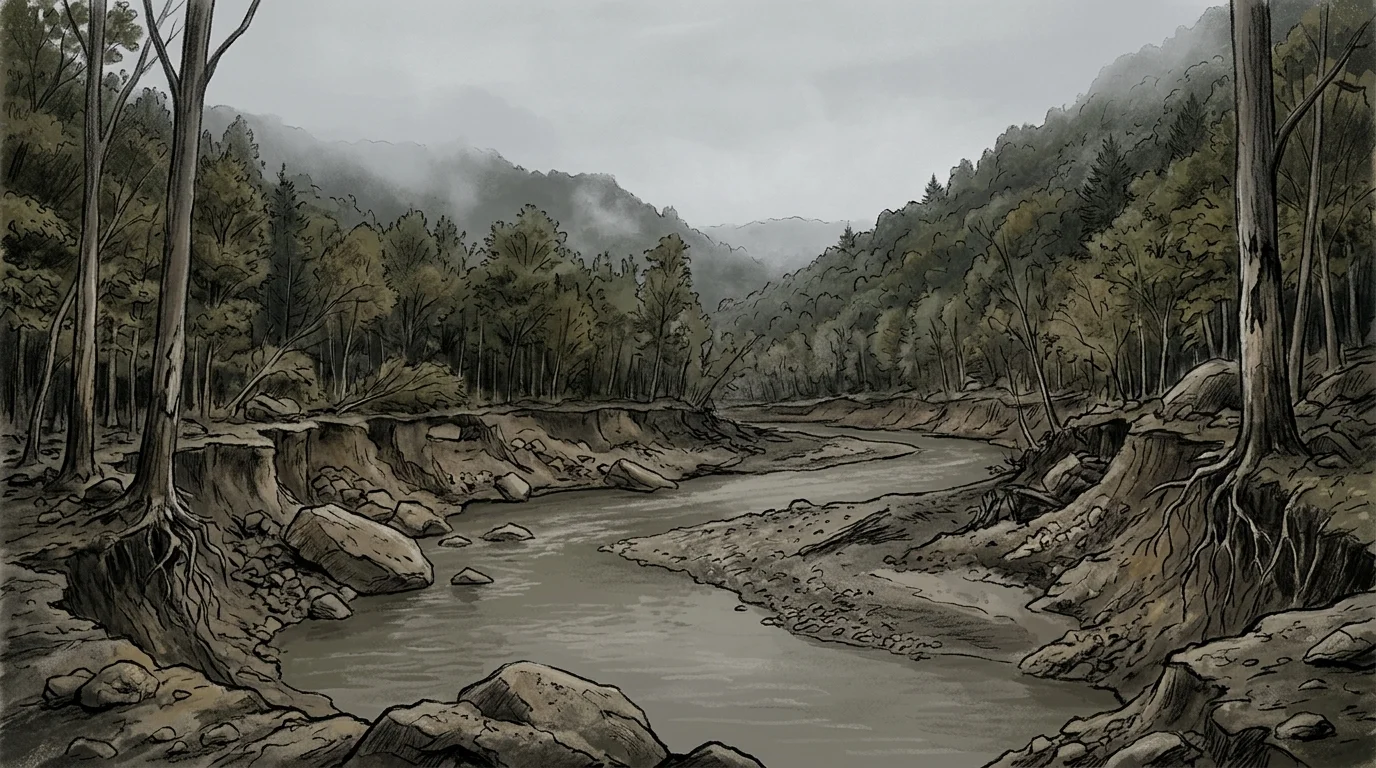
The capacity question is real. Fiscal courts in Pike, Perry, Knott, and Letcher counties are rural governments with small procurement staffs, and EWP projects require environmental reviews, contractor bids, and construction timelines that don't compress easily. Streambank stabilization and floodwall repair in narrow Appalachian hollows, where access roads wash out and heavy equipment must be barged or helicoptered, runs over schedule even under normal conditions. The October 2026 performance deadlines are not suggestions; unspent EWP funds revert to USDA.
For residents of Eastern Kentucky's core flood counties, the practical meaning of this surge is that physical mitigation work, the kind that keeps the next flood from destroying the same house twice, should be visibly underway this summer and fall. Whether it arrives in time, and whether local governments can absorb the administrative load, is the open question that will define whether this historic influx of federal dollars translates into lasting protection or ends in partial returns and deferred construction.
The next signal to watch is the October 2026 EWP expiration clock. If Knott and Letcher counties, which together hold $33.9 million in active USDA grants, cannot document substantial completion by then, the unspent balance disappears, and the next flood, in a region that has seen major events in 2021, 2022, and 2025, will find the same hollows unprotected.