Virginia spent two years and more than $276 million in active federal mental health funding preparing its public behavioral health system for the most significant overhaul in a generation. Then, weeks before the July 1, 2026 go-live date, the General Assembly hit pause, and no new date is confirmed.
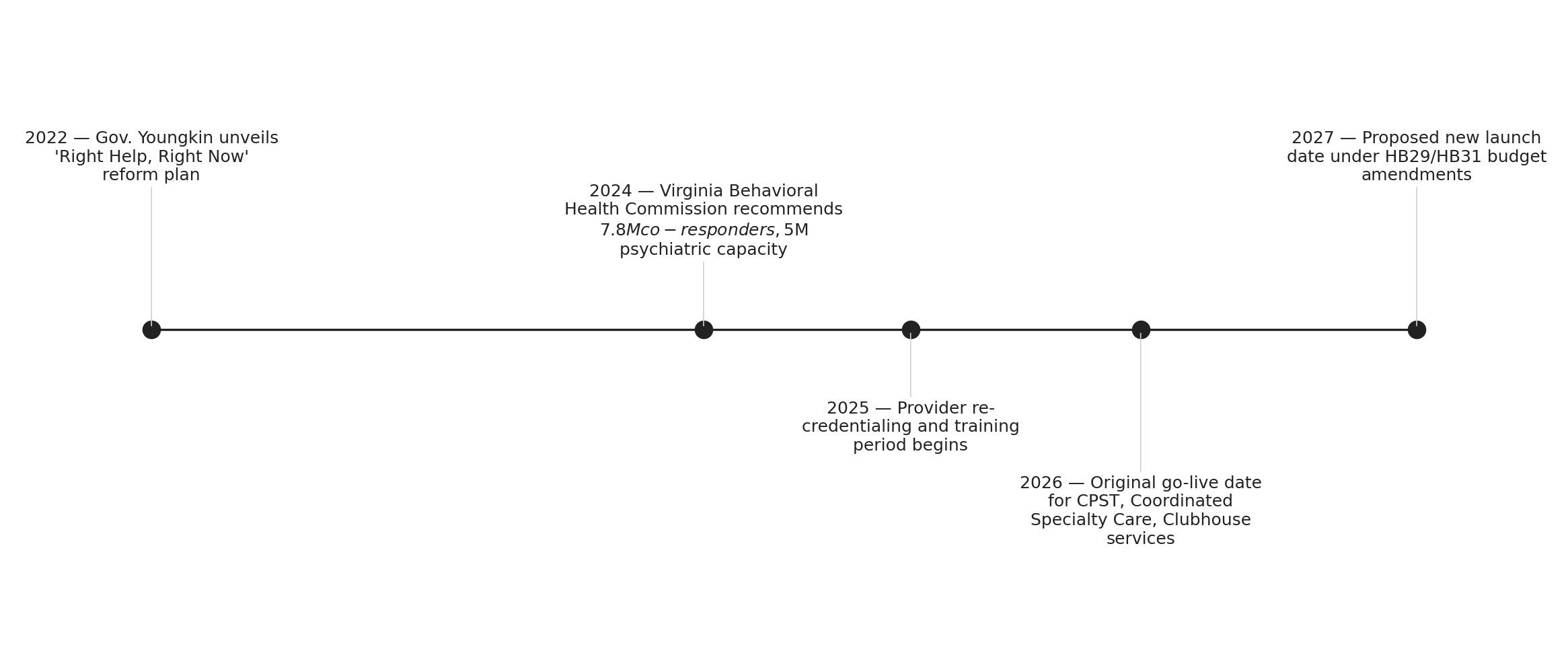
The delay, acknowledged by DMAS in May 2026, affects the full Medicaid Behavioral Health Services Redesign, a project authorized under Item 288 of the 2024-2026 biennium budget. The redesign was set to retire five legacy Community Mental Health Rehabilitative Services lines, including Intensive In-Home services, Therapeutic Day Treatment, and Psychosocial Rehabilitation, and replace them with evidence-based alternatives including Community Psychiatric Support and Treatment (CPST) and Coordinated Specialty Care. Competing budget amendments in the General Assembly now propose pushing the launch to either January 2027 or July 2027, but neither proposal has resolved.
The federal money is already moving. HHS currently holds 121 active mental health grants to Virginia totaling $276.5 million obligated, with $112.4 million already outlayed. The backbone of that portfolio is a $24.5 million Community Mental Health Services Block Grant running to DBHDS through September 2026, with a new $7.9 million tranche already authorized through September 2027. That funding was never contingent on the redesign launching on schedule, but much of the training and provider infrastructure it supports was built around the July deadline.
Source: NationGraph.
The disruption falls hardest on Virginia's roughly 40 Community Services Boards, the local agencies that serve as the primary delivery point for public mental health care across the state. Virginia's CSB structure is unusual among states: each board operates as an independent local government entity, which means that a statewide Medicaid service redesign requires each of them to separately re-contract, re-credential, and reprogram billing systems under new service definitions. Providers have been in training and re-credentialing mode since September 2025, with DMAS running Provider Office Hours through July 2026. That preparation now has no confirmed finish line.
The political roots of this overhaul run deep. Governor Youngkin launched the 'Right Help, Right Now' six-pillar behavioral health plan in December 2022, and the reform gained urgency after the March 2023 death of Irvo Otieno, a Black man with mental illness who died in the custody of state psychiatric hospital staff. The subsequent passage of Irvo's Law tightened oversight of state facilities and sharpened legislative scrutiny of DBHDS's broader system, creating pressure for the Medicaid redesign to move faster, not slower. The delay is a reversal of that momentum.
Separate from the redesign timeline, the Virginia Behavioral Health Commission issued recommendations in December 2024 that add further fiscal complexity. Those recommendations included $7.8 million for law enforcement co-responder programs, $5 million to expand private psychiatric hospital capacity, and $7.5 million to restore the School-Based Mental Health Integration program in FY2026. How those line items survive the current budget negotiations is an open question, but the Virginia Association of Counties has been tracking amendments tied directly to the Commission's proposals.
For patients, the operational consequences of delay are less visible than the political ones but more immediate. The five legacy service lines scheduled for retirement are still active for now, which prevents a hard coverage cliff. But providers who restructured staffing models, obtained new CPST credentials, or signed contracts premised on a July 2026 transition are now carrying costs for services that aren't yet billable under the new framework.
The next signal to watch is the resolution of HB29 and HB30 budget negotiations in the General Assembly. Until those pass, DMAS cannot set a new implementation date. If the launch moves to July 2027, Virginia will have run a three-year preparation process for a reform that took four years from authorization to execution, and the federal block grant funding that anchored the infrastructure will have cycled through a full renewal before a single patient is served under the new service model.