Nashville, Tennessee draws more than 14 million visitors a year to its honky-tonks and convention halls, but until now, virtually none of that tourist foot traffic has had a public recycling bin to use. The city is about to change that, and in doing so, close a gap that has long separated it from peer cities across the South and beyond.
The Metropolitan Government of Nashville-Davidson County has received a $2.44 million EPA grant to build its first city-owned materials recovery facility, a place where mixed recyclables are sorted into usable commodity streams, and to install AI-powered smart waste stations in downtown Nashville and along Jefferson Street. The funding comes from the EPA's Solid Waste Infrastructure for Recycling program, created under the 2021 Bipartisan Infrastructure Law as part of the largest federal investment in recycling in decades.
Unlike Austin, Charlotte, or Denver, Nashville has never owned its own processing plant. Instead, the county has relied on private contractors and a network of 11 drop-off sites, an arrangement that left the city exposed when China's 2018 ban on imported recyclables crashed commodity prices worldwide and made recycling economically unworkable for many U.S. cities. Nashville, with no processing capacity of its own, had little leverage.
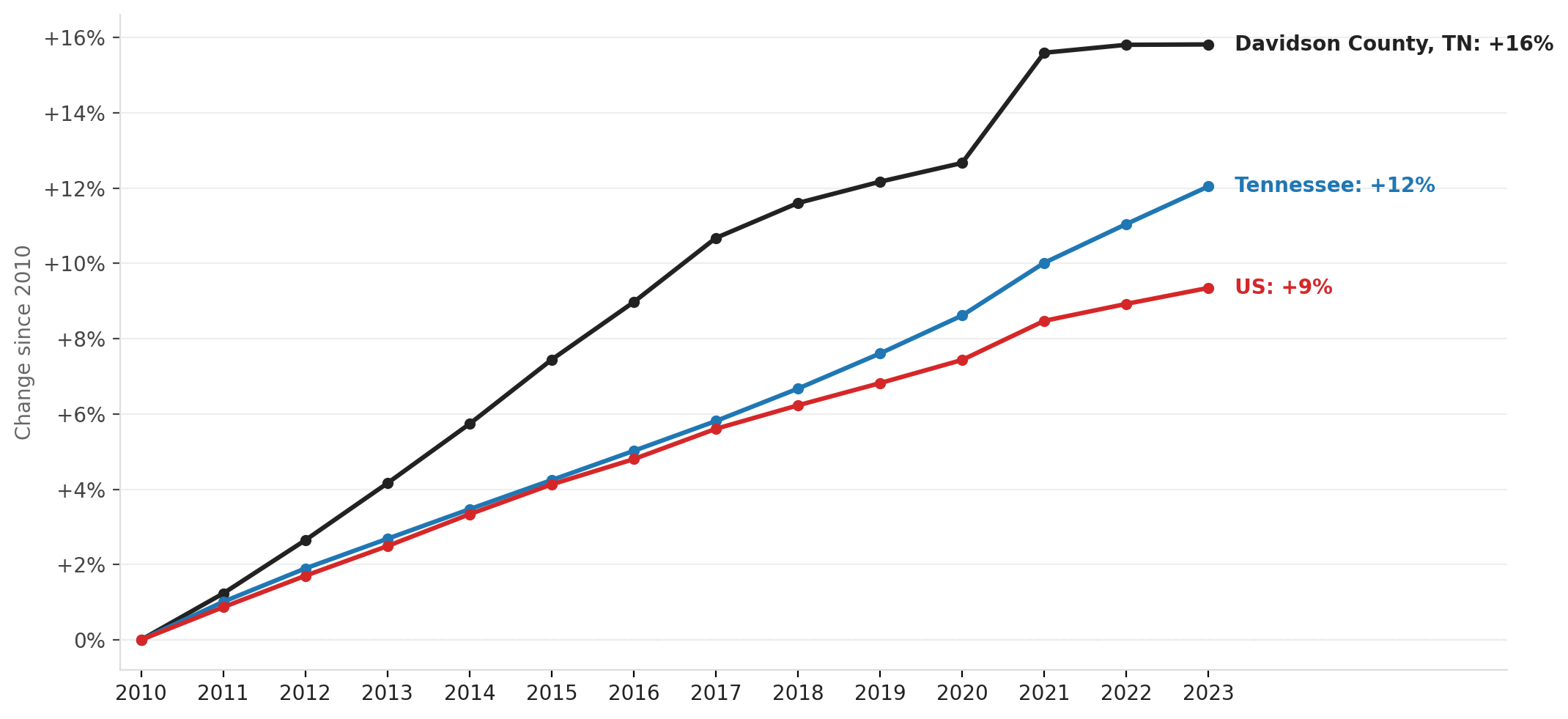
Source: U.S. Census Bureau, American Community Survey.
The new facility, a smaller-scale "mini-MRF" designed as a practical first step before a full regional plant, will process material from curbside pickup, the existing drop-off sites, and the new downtown collection points. The city expects to divert roughly 2,500 tons of recyclable material from landfills, including plastics, cardboard, paper, glass, and cartons, and plans to sell sorted commodities as a revenue stream to fund future expansion. At least five permanent jobs are expected at the facility.
The smart bins headed for downtown and Jefferson Street represent an emerging approach to one of recycling's biggest problems: contamination. The AI-equipped stations use cameras and machine learning to identify what a person is trying to throw away and steer it to the right receptacle, with some manufacturers reporting contamination rates dropping from over 40 percent down to single digits. Downtown Nashville, transformed over the past decade into one of the country's busiest entertainment districts, currently has no public recycling infrastructure on its streets.
The inclusion of Jefferson Street carries particular significance. The historically Black corridor, home to Fisk University, Tennessee State University, and Meharry Medical College, was severed by Interstate 40 construction in the 1960s and has long been the focus of both revitalization efforts and concerns about disinvestment. Placing new infrastructure there alongside the tourist-heavy downtown reflects a deliberate equity dimension in where the city is directing resources.
City and county officials are explicit that the mini-MRF is a foundation, not a finish line. The grant is designed to lay groundwork for a future full-scale regional facility that could eventually serve surrounding fast-growing counties including Williamson, Rutherford, and Wilson. Those counties face the same recycling infrastructure gaps as Davidson but have fewer resources to address them on their own.
Tennessee has no statewide recycling mandate and no bottle deposit program, leaving cities like Nashville to build systems largely without state support. Whether Nashville can use this federally funded foothold to make the case for a broader regional recycling network is the open question the project is designed to answer.