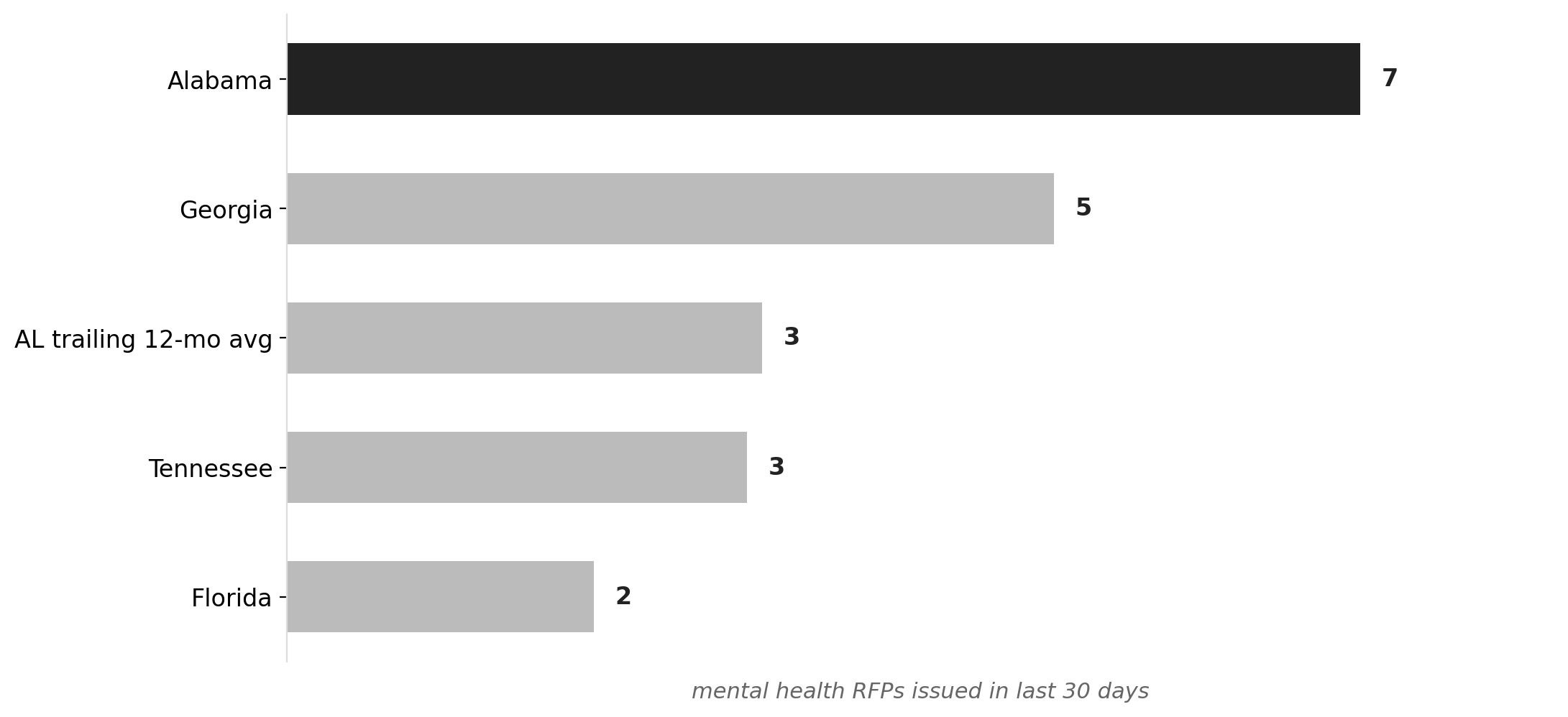
Alabama's Department of Mental Health issued 7 procurement notices in the last 30 days, more than double its trailing monthly average of 3.1, and the most consequential one is not a contract for services. It is a contract to figure out what the system should look like before the money runs out.
The System Transformation Consulting RFP, currently open, calls for up to 2,750 consultant hours to redesign ADMH's housing resources, its supportive housing strategy, and its crisis care infrastructure. When a state agency hires outside consultants to rebuild its own architecture from scratch, that is not routine planning. It is triage with a deadline.
The deadline is real. The One Big Beautiful Bill Act, signed by President Trump on July 4, 2025, did two things simultaneously: it enacted deep, permanent cuts to federal Medicaid matching funds, and it created a temporary $50 billion Rural Health Transformation Program meant to cushion the blow. Alabama secured $203.4 million in Year 1 RHTP funding, with mental health explicitly listed among the program's 11 funded initiatives. But according to analysis from KFF, that fund offsets only 37% of projected rural Medicaid cuts over ten years, and it expires entirely after FY2030. The Medicaid cuts do not.
Source: NationGraph.
Commissioner Kimberly Boswell has said publicly that the temporary nature of the RHTP is a sustainability concern. Her department's budget request for FY2026 made the math plain: ADMH asked for $389.6 million, a 23% increase it described as necessary to meet existing demand. The legislature approved $244 million, leaving a gap of more than $145 million between what the department said it needed and what it received. The procurement surge is, in part, an attempt to stretch the available federal dollars as far as possible before they phase out.
The supporting RFPs confirm where the pressure is showing up operationally. ADMH has also issued solicitations for temporary nursing personnel and for Visual Gestural/Deaf specialty staff, both signs of staffing strain at inpatient facilities. Alabama's inpatient psychiatric capacity is concentrated at three adult state facilities: Bryce Hospital, Mary Starke Harper Geriatric Psychiatry Center, and Taylor Hardin Secure Medical Facility. There is not much slack in that system.
On the community side, the gaps are equally visible. Alabama currently operates crisis diversion centers in six locations: Mobile, Huntsville, Montgomery, Birmingham, Tuscaloosa, and Dothan, the last of which opened in February 2025. Commissioner Boswell has stated the state needs 11 centers to adequately serve all 67 counties. Only 20 of those counties currently have any crisis infrastructure at all. The Alabama Reflector's reporting on the $203 million grant makes clear that rural workforce development is a central goal of the RHTP spending plan, but building out five additional crisis centers in the time the funding lasts is an aggressive target.
A separate procurement layer adds further complexity. Under Act 2024-426, signed by Governor Kay Ivey, Alabama set aside $3 million via RFP for veterans' behavioral health pilot programs, targeting the state's estimated 40,000-plus veterans between ages 18 and 34. Alabama has more than 370,000 veterans statewide, one of the highest per-capita concentrations in the country. The veterans' mental health initiative represents a parallel demand stream that ADMH's transformation planning will need to absorb.
Alabama's 30-day RFP volume, 7, leads every neighboring state: Georgia issued 5, Tennessee 3, Florida 2. That gap rules out a regional policy wave and points to something Alabama-specific. The state's structural exposure to Medicaid cuts is acute. The Alabama Medicaid agency's FY2026 budget of $1.18 billion is heavily federally matched, and nine rural hospital closures since 2009 have already degraded the delivery infrastructure that mental health services depend on. The behavioral health system does not exist in isolation from the broader rural health system, and both are under simultaneous pressure.
What changes for Alabamians in the near term depends heavily on where the consulting process leads and how the RHTP dollars are allocated. Governor Ivey's executive order establishing the Alabama Rural Health Transformation Advisory Group gives the state a formal mechanism for those decisions, but the advisory group's recommendations will need to be implemented before the 2030 funding cliff arrives.
The next signal to watch is the System Transformation Consulting contract award. The scope of that engagement will reveal how ambitiously ADMH intends to restructure, and whether the department believes the window to act is measured in years or in months.