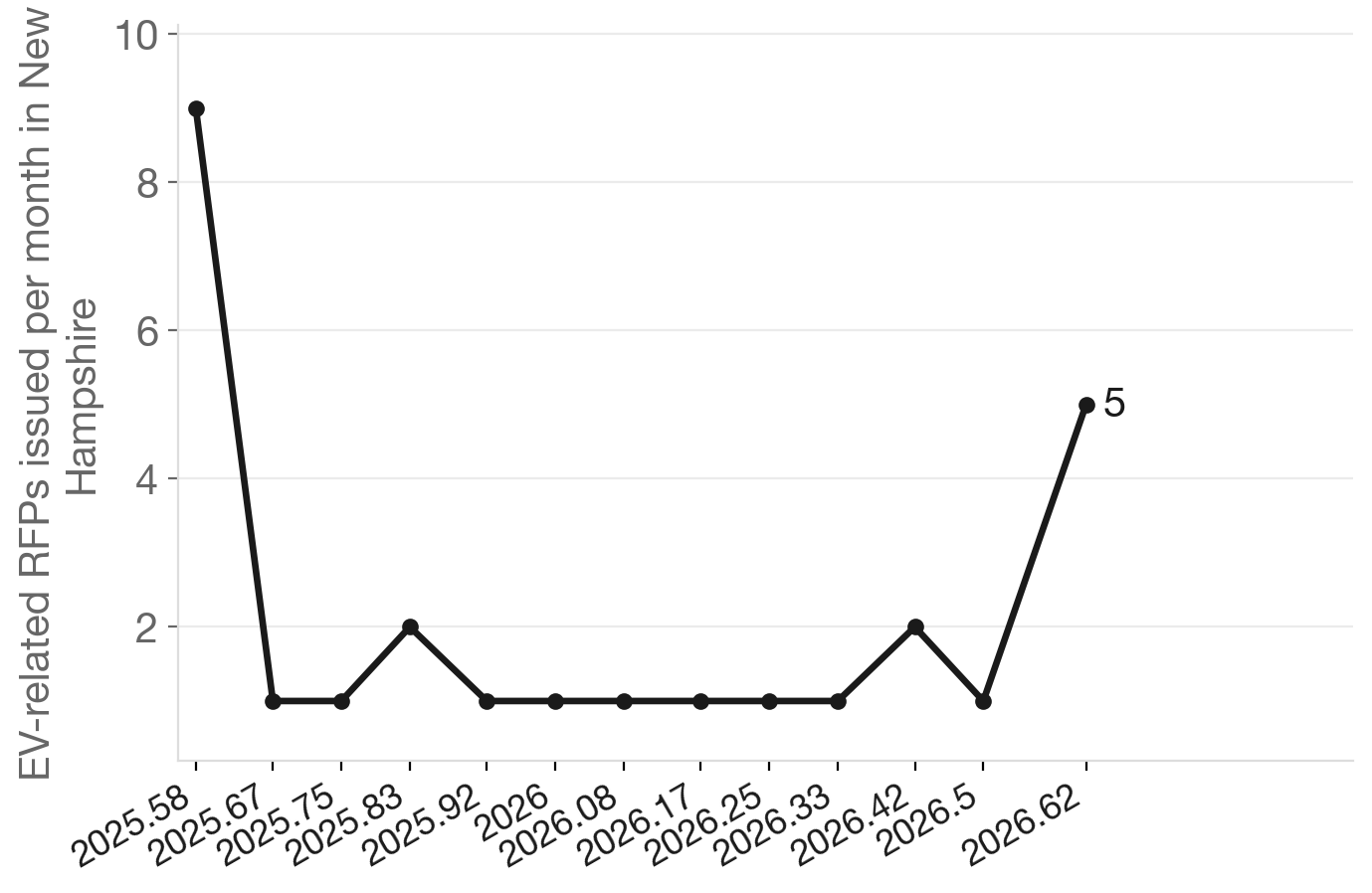
New Hampshire has issued five electric vehicle infrastructure RFPs in the last 30 days, four times its monthly average of roughly 1.25, the highest single-month volume since July 2025. The spike is not a policy shift. It is a procurement deadline arriving after two years of administrative and legal delay.
The mechanism is NEVI, the National Electric Vehicle Infrastructure formula program. Congress funded it; the states planned for it; then in early 2025 a federal funding freeze stopped the money from moving. A federal court overturned that freeze, and in October 2025 the Federal Highway Administration released an $885 million FY2026 national apportionment. New Hampshire's revised state NEVI plan was approved by FHWA on September 17, 2025, clearing the administrative runway. The result is that years of deferred procurement are now compressing into a single summer window.
The centerpiece is NHDOT's NEVI Phase II RFP, issued June 11, 2026, with proposals due August 21. The solicitation calls for private vendors to install DC fast-charging stations along major travel corridors and operate them for five years. It carries approximately 64 percent of New Hampshire's total five-year NEVI formula allocation, which runs just over $17 million. NHDOT program manager Michael Mozer is overseeing the solicitation. Miss the August 21 deadline, and the program's FY2026 window closes.
Source: NationGraph.
The pressure is compounded by a parallel expiration. The federal 30C commercial EV charging tax credit expired June 30, 2026. That credit had given private charging vendors a secondary incentive to absorb installation costs. With it gone, NEVI-backed public procurement is now the dominant lever left for expanding the network, and vendors who want to participate in a subsidized build-out have a narrow runway to do it.
At the municipal level, the dynamic looks similar but arrived through a different path. Nashua has issued three iterations of an RFP for Level 2 chargers at its Spring Street Parking Lot this summer, re-bidding a procurement that failed in May 2025. The re-bid is not cosmetically different from its predecessor: it has been updated with Davis-Bacon federal fund compliance requirements, reflecting that the project is now drawing on federal dollars subject to prevailing wage rules. As of late 2024, only 3 of the 13 municipalities in the Nashua Regional Planning Commission's coverage area had any public EV charging stations at all, according to NRPC infrastructure data. The Spring Street lot, modest as it is, represents a first public charging presence for a city of nearly 90,000 people.
New Hampshire is leading New England in EV RFP volume over this 30-day window: five, against three in Connecticut, one in Massachusetts, and one in Vermont. That ranking is partly a function of timing. NH's NEVI Phase II is arriving later than some neighboring states because the state's revised plan needed federal re-approval after the freeze. But it also reflects something structural: New Hampshire has no state EV purchase mandate and no state tax credit for EV chargers. Federal NEVI and CFI funds are not the primary lever for public charging buildout here. They are nearly the only lever.
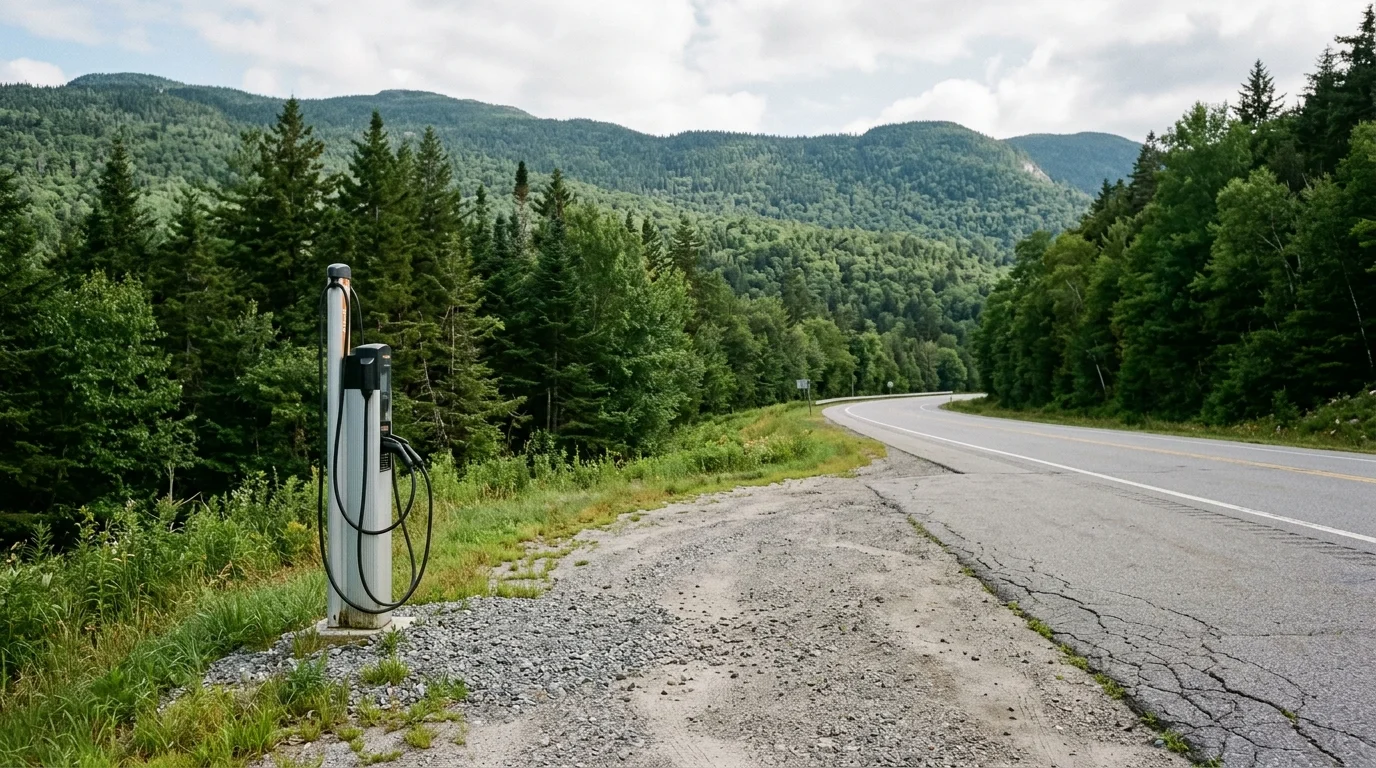
A separate $15 million CFI discretionary grant awarded to NHDOT in January 2025, targeting 199 new charging ports statewide, adds a second federal stream now moving into procurement alongside NEVI. Together, the two programs are expected to more than double New Hampshire's current public charging footprint of approximately 300 stations, with explicit attention to underserved corridors in the White Mountains and Lakes Region, where range anxiety is not an abstraction but a practical obstacle to EV adoption.
For residents in those corridors, the question is whether contracts awarded this fall translate into operational chargers before the 2027 summer travel season. NEVI-funded stations are typically subject to multi-year installation timelines; the five-year operation requirement in the Phase II RFP means vendors must be capitalized to run, not just install, infrastructure. That operational commitment is where past public charging programs in rural states have broken down.
The next signal to watch is August 21. If NHDOT receives competitive proposals by the Phase II deadline, awards could be announced by late fall, with construction beginning in 2027. If the solicitation draws thin interest, the agency will face the same question Nashua faced a year ago after its first RFP failed: whether to re-bid into a market that has fewer private incentives than it did twelve months ago.