Nevada posted six solar-tagged public procurement solicitations in the last 30 days against a 12-month monthly average of roughly 1.4, a 4.2x spike that has almost nothing to do with new state incentives and everything to do with a single pending regulatory decision.
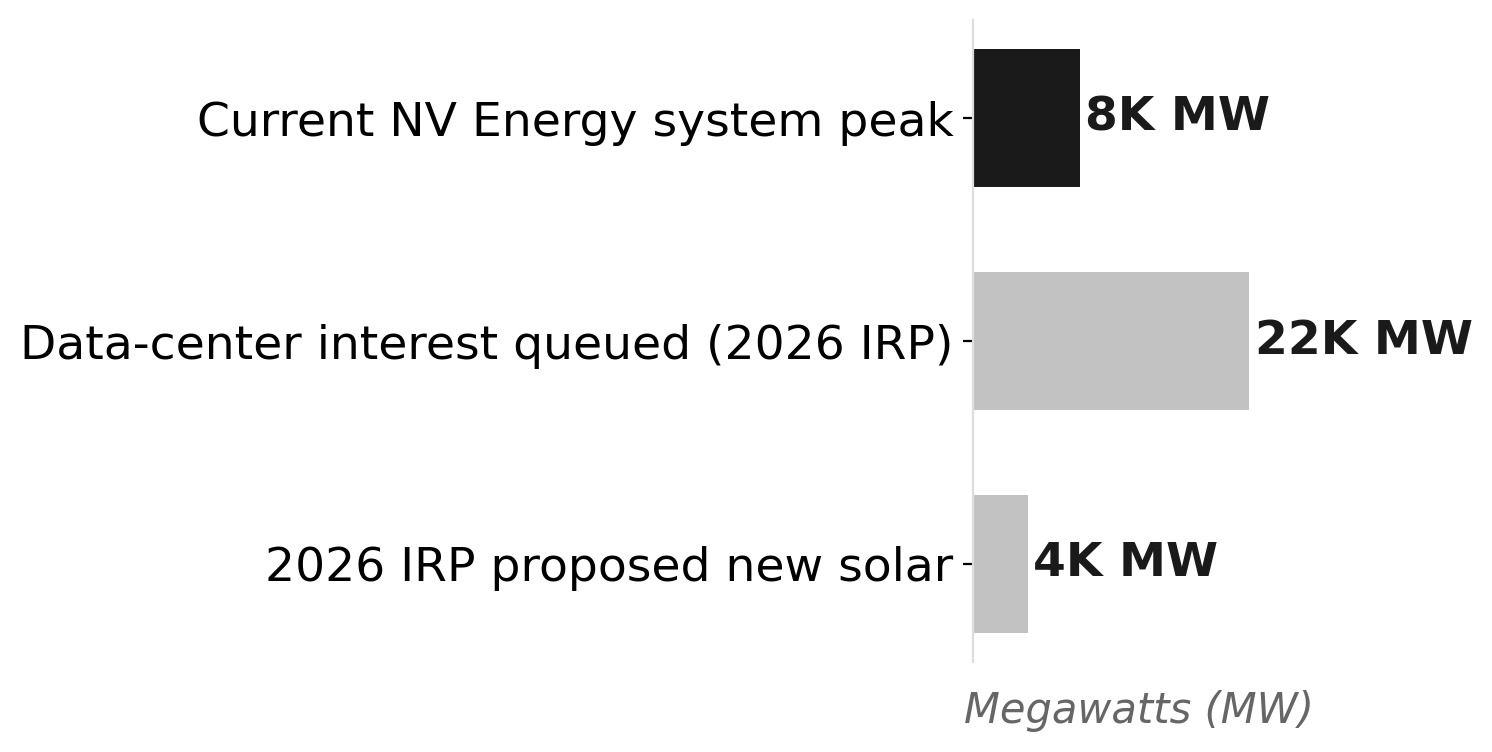
The trigger is NV Energy's 2026 Joint Integrated Resource Plan, filed with the Public Utilities Commission of Nevada in May 2026. As NV Energy's own IRP briefing materials lay out, the plan proposes 4,370 megawatts of new solar PV, 5,405 megawatts of battery storage, and $3.2 billion in transmission upgrades. It is the largest renewable expansion in the utility's history, and the PUCN is expected to issue a ruling before the end of 2026. Until that ruling lands, every city, county, and desert landowner who wants a piece of the buildout is racing to position their assets. That is what the procurement spike is measuring: not a policy push, but a pre-approval scramble.
The reason the IRP is so consequential is AI. NV Energy projects that data centers will grow from 5% of the utility's total sales today to 64% by 2046, an expansion with no close precedent in a regulated utility's planning history. The utility has already received expressions of interest representing roughly 22,000 megawatts of potential new demand against a current system peak of around 8,500 megawatts. The gap between what's being asked for and what the grid can deliver is the animating fact behind every RFP filed this month.
Source: NationGraph.
Boulder City is the dominant actor in the current spike. The city controls large parcels in the Eldorado Valley, a designated solar energy zone in Clark County, and it has been actively re-marketing two city-owned sites through competitive solicitations: a BESS site RFP (2025-21) and a Black Hills North RFP (2025-07), both seeking developers willing to build solar-plus-storage and lease the land from the city. Both solicitations have been updated multiple times since December 2024, each revision tracking a new milestone in the IRP docket. Boulder City is not trying to build a power plant; it is trying to be the landlord when someone else does, and the IRP pipeline is the mechanism that makes that land valuable. The city's position in the Eldorado Valley puts it directly in the path of the utility-scale procurement NV Energy will need to execute once regulators approve the plan.
The execution pipeline is already proven. Sierra Solar in Churchill County, a 400-megawatt PV and 1,600-megawatt-hour BESS project approved under NV Energy's prior IRP, reached commercial battery operation on March 20, 2026, with $1.28 billion expended at that date and the full PV field on track for April 2027. That project shows the distance between an IRP approval and a functioning power plant is measured in years and billions of dollars, which is precisely why the positioning window before PUCN approval matters so much.
The federal backdrop is real but separate. The Nevada Governor's Office of Energy holds roughly $102 million in active DOE State Energy Program grants across two tranches running through 2029, plus an $18 million DOE Grid Infrastructure grant. Those funds support state-level energy planning and grid modernization, but they are not the procurement vehicle behind the RFP surge. The mechanism driving municipal solicitations is state-regulated utility procurement under Nevada Revised Statutes, ratepayer-funded and PUCN-approved, operating on a completely different track from the federal grant programs. The two coexist, but collapsing them into a single "solar incentive" story would miss the actual dynamic.
The regulatory proceeding is also contested. Western Resource Advocates and Vote Solar have intervened in the IRP docket, objecting specifically to NV Energy's parallel proposal for 1.2 gigawatts of new gas peakers. The PUCN has full authority to reshape what gets approved, which means the solar buildout municipalities are racing to supply could look materially different after the ruling than what NV Energy filed in May. That uncertainty is baked into the current scramble: everyone is positioning for a plan that is still being argued in front of regulators.
For Nevadans, the most direct consequence is that the grid decisions being made in this docket will determine electricity costs, reliability, and air quality for the next two decades. The RPS escalates to 50% renewable by 2030 under state law, and the state has a statutory 2050 carbon-free target, so some version of this buildout is structurally required regardless of what data centers do. The data-center load surge simply accelerates the timeline and raises the stakes on who wins the procurement contracts.
The PUCN ruling, expected before year-end, is the next hard signal to watch. If regulators approve the IRP largely as filed, the RFP activity visible now will look like a preview of a multi-year construction wave. If the commission cuts the solar allocation or delays approval, the current positioning scramble will have gotten ahead of itself. Either way, the six solicitations filed this month are not a local government story. They are an early read on one of the largest grid transformations in Nevada's history.