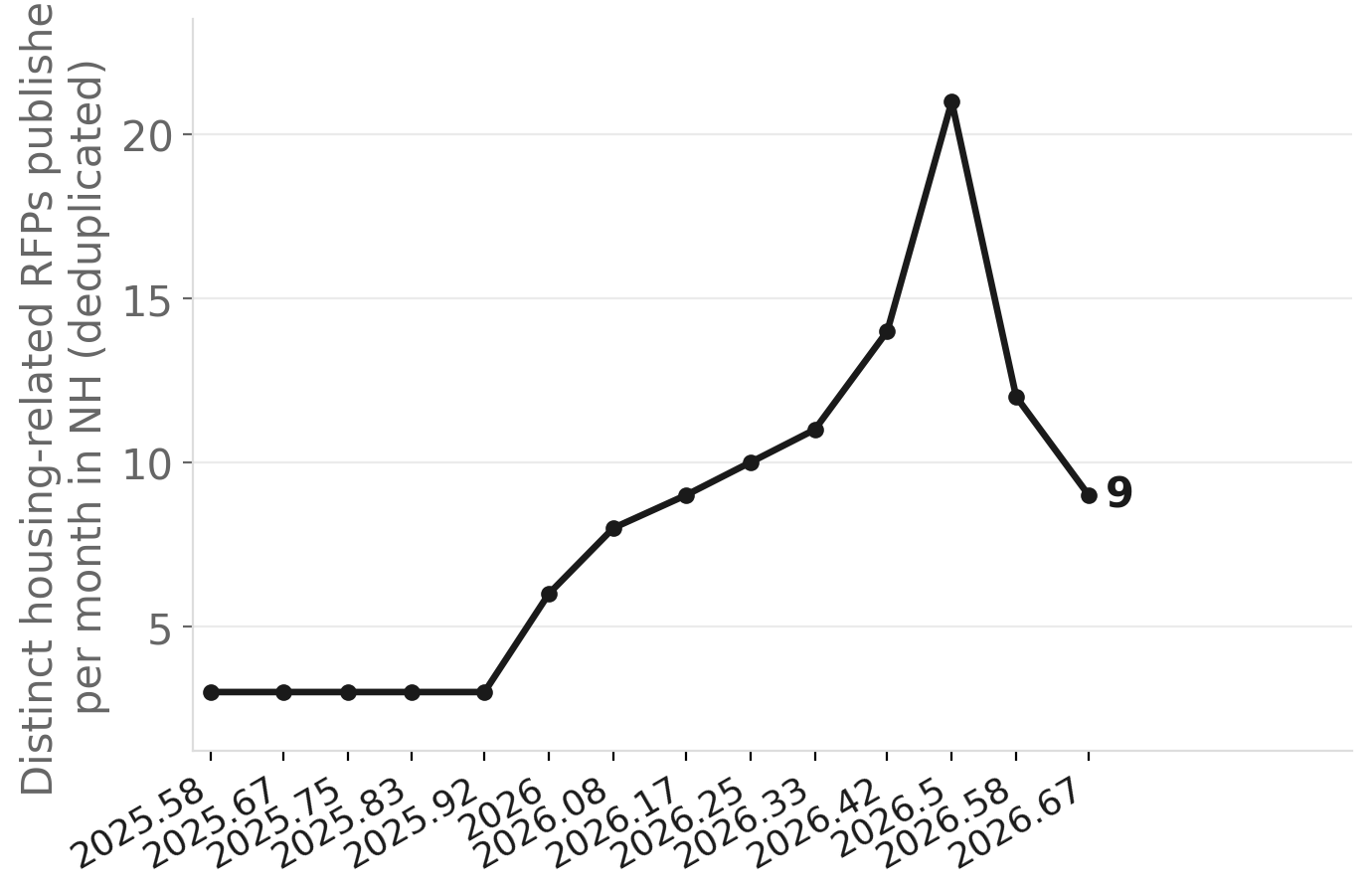
New Hampshire municipalities filed roughly nine distinct housing-related procurement requests per month from January through September 2026, triple the three-per-month average from the prior five months, and almost none of those procurements are for construction. They are for lawyers, planners, and zoning consultants.
The surge traces directly to three interlocking state laws that have rewritten the rules of local land use in New Hampshire faster than most town halls have been able to absorb. HB 631, signed in 2025, was the opening mandate: starting July 1, 2026, every municipality in the state must allow multifamily housing in commercially zoned areas, by right, without a special permit. Towns quickly found workarounds, density caps, conditional-use permits, 50-foot landscape buffers, and adopted them before the deadline.
The legislature's response was swift. On July 15, 2026, Governor Kelly Ayotte signed HB 1588, which took retroactive effect to July 1 and voided most of those local restrictions. As the New Hampshire Bulletin reported, towns and housing advocates were still grappling with the implications days after the signing. The law did something earlier zoning mandates in other states rarely attempted: it added a fee-shifting clause. If a municipality improperly denies a qualifying multifamily project, the developer can recover attorney's fees from the town. In a state with no income tax and no sales tax, where property taxes are already a primary revenue pressure, a litigation loss doesn't just sting, it lands directly on the municipal budget.
Source: NationGraph.
HB 1010, signed simultaneously with HB 1588, offered towns a narrow off-ramp: a municipality may deny a project if infrastructure studies demonstrate that traffic, water, or sewer capacity is genuinely inadequate. That provision gives local officials something to point to, but it requires documented studies, which themselves require procurements.
Together, the three laws function as a sequential tightening of a single preemption framework. HB 631 created the obligation. HB 1588 closed the exits and attached a financial penalty to delay. HB 1010 defined the one door left open. The legal analysis from Hinckley Allen describes the combined effect as a significant narrowing of municipal discretion with real litigation exposure for towns that move slowly.
The procurement wave reflects that exposure. RFP filings for planning services, zoning-ordinance rewrites, legal reviews, and infrastructure-adequacy studies began rising in January 2026, when the legislative session opened and the contours of HB 1588 became clear, and accelerated through the July effective date. This is not a construction boom. Developers are not yet breaking ground at scale. Towns are trying to get their ordinances in defensible shape before the first project application arrives and the fee-shifting clock starts.
Warner, New Hampshire, a town of roughly 3,000, held a Housing Committee meeting on July 29, 2026, one week after HB 1588 took effect. That a small rural municipality was already convening formal committee sessions on compliance is a signal of how broadly the pressure has distributed. New Hampshire has 221 municipalities; the fee-shifting provision treats them all equally.
The state's political and fiscal context amplifies the urgency. New Hampshire's 'Live Free or Die' tradition has long protected hyper-local zoning authority, and many towns resisted multifamily development for decades on exactly those grounds. The 2025 YouGov survey commissioned by NH Housing Action found that 88 percent of registered voters support allowing housing in commercial zones, a political signal the legislature used to justify the preemption, but one that does not make compliance any easier for planning boards that have never processed a by-right multifamily application.
Federal dollars are also flowing in parallel, though through separate channels and for separate purposes. The NH Housing Finance Authority is administering an active tranche of more than $24 million in HUD Section 8 Housing Choice Vouchers through October 2026. NH DHHS received a $3.5 million HOME Investment Partnerships grant and a $3.1 million Housing Trust Fund grant, both started in September 2025, focused on affordable housing production and extremely low-income households respectively. An $18 million DOE Weatherization Assistance Program runs through 2029. These federal commitments address affordability and condition of existing stock; they are not the driver of the procurement surge, which is entirely a creature of state law.
The next signal to watch is litigation. HB 1588's fee-shifting clause has been on the books for roughly two months. No major court filing has yet tested it publicly. When the first developer sues a town that denied a by-right multifamily application under a voided local ordinance, the resulting decision will set the compliance temperature for every other municipality still working through its rewrite. Town attorneys across New Hampshire are already advising boards not to wait for that case to land before updating their codes, which is precisely why the procurement numbers look the way they do.