Georgia has posted 42 EV-related solicitations in the last 30 days, nearly three times its monthly baseline, as a cascade of federal funding unlocks works its way downstream into county procurement offices and municipal fleet managers. The state now leads every Southern neighbor in active EV solicitation volume, and the timeline that produced this surge is worth understanding.
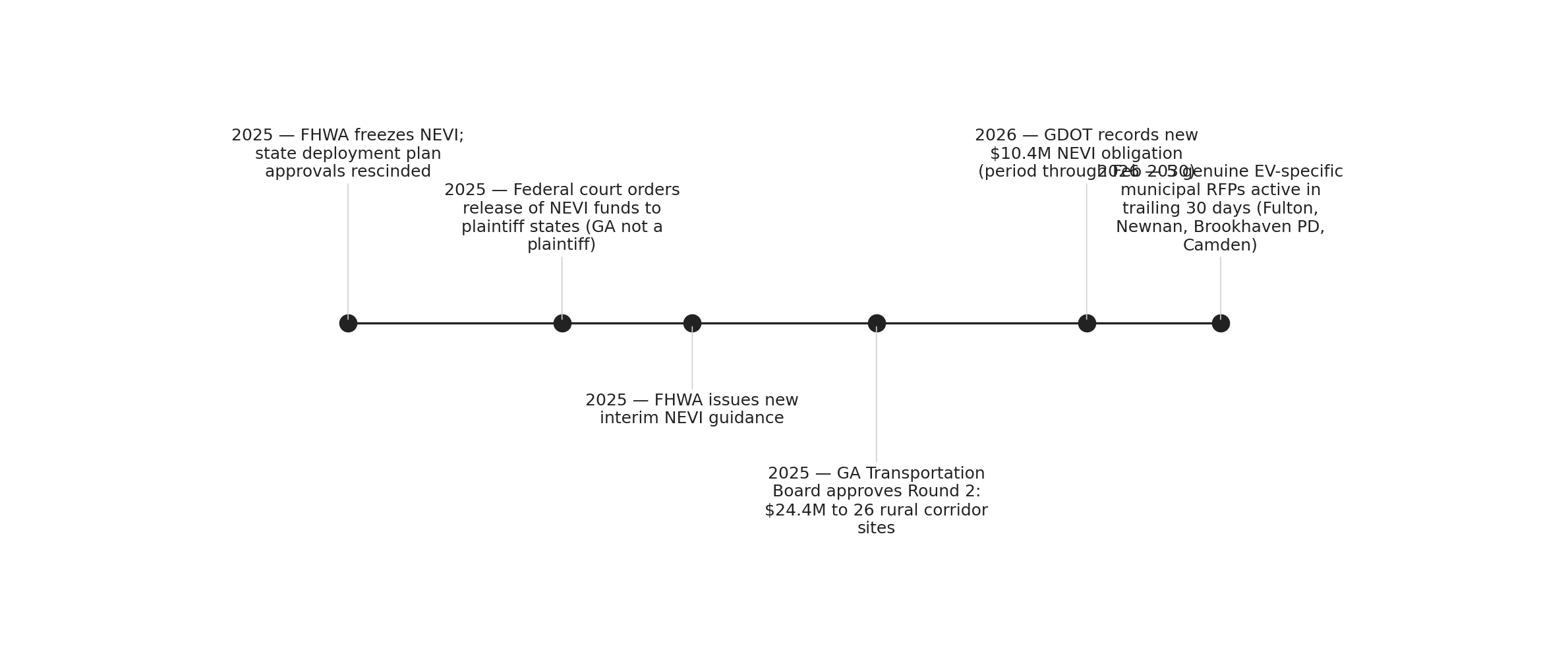
The backstory runs through a courthouse in Washington. The Trump administration froze the NEVI program on February 6, 2025, rescinding all state deployment plan approvals via an FHWA directive. Georgia did not join the multi-state lawsuit that followed. When a federal court ordered the funds released in June 2025, and FHWA issued new interim guidance on August 11, 2025, Georgia moved quickly on an opening it hadn't litigated for. GDOT resubmitted its state plan in September 2025. The Georgia State Transportation Board approved Round 2 NEVI awards in November 2025, committing $24.4 million to 26 highway-corridor locations through public-private partnerships with vendors including Pilot Travel Centers, Love's Travel Stops, and EnviroSpark Energy Solutions. A new $10.4 million NEVI obligation to GDOT was recorded on March 13, 2026, with a project period running through February 2030.
That three-stage sequence, court order to federal guidance to state awards to fresh grant obligations, is now producing the procurement activity visible in the RFP data. The money didn't materialize all at once. It moved in tranches, each requiring state plan approval and board sign-off, and vendors are only now receiving the solicitations that represent the downstream end of that process.
Source: NationGraph.
At the county and city level, the signal is concrete. Fulton County is seeking an EV charging-as-a-service provider with a revenue-sharing structure, with proposals due June 12, 2026. The City of Newnan has posted two separate solicitations for charger installation. Brookhaven's police department is sourcing electric pursuit vehicles. Camden County is building out its fleet. These are not announcements; they are binding procurement documents with deadlines and specifications. The distinction matters: RFPs represent committed budget authority, not aspirational planning.
Gwinnett County adds a separate $20 million National Infrastructure Investments grant awarded in January 2025, running through July 2030, to the picture. The City of Atlanta holds a $2.4 million EPA Clean Heavy-Duty Vehicles grant active through the end of 2026. Georgia's total NEVI allocation under the 2021 Infrastructure Investment and Jobs Act stands at approximately $135 million, with the federal share covering 80 percent of eligible project costs. GDOT now carries more than 20 active NEVI grants.
The state's urgency is partly industrial. Georgia is home to Hyundai's Metaplant America in Savannah and a Rivian facility, and the pressure on public charging infrastructure here isn't driven primarily by commuter demand. It's driven by a manufacturing supply chain that needs the grid to support vehicle throughput. When a state produces electric vehicles at scale, the absence of charging infrastructure becomes an economic liability, not just a convenience gap. Georgia's EV charging policy environment has been shaped by that industrial context, and it shows in the specificity of Round 2 targets: rural highway corridors, the gaps between the metro clusters, the routes the logistics economy actually uses.
The legislature has also moved. House Bill 652, passed in 2025, added a motor fuel excise tax exemption for nonprofit-owned EV chargers on federal interstates, a narrow but structurally useful provision that lowers the operating cost for corridor charging nodes. As of October 2025, Georgia had over 2,200 public charging stations, but rural coverage remains the explicit focus of the new round of awards. The Round 2 sites were selected with that gap in mind.
The comparison to neighboring states sharpens the picture. Florida, Texas, and Tennessee are all active in EV procurement, but none matches Georgia's current 30-day solicitation volume by a margin that reflects anything other than a genuine policy acceleration. Georgia's position, having stayed out of the litigation but moved fastest once the freeze lifted, suggests that the state had its planning machinery ready and was waiting for the legal environment to stabilize.
The next signal to watch is how many of the Round 2 NEVI sites move from award to construction contract by the end of 2026. The November 2025 board approval set a course; the March 2026 obligation locks in federal dollars. Vendors selected through the current RFP wave will likely break ground on the first corridor sites before the next hurricane season reshapes Southern infrastructure budgets. What's less certain is whether the pace holds once the immediate post-freeze backlog clears, or whether the solicitation volume returns to baseline once the catch-up cycle runs its course.