Sixty-four California institutions issued a housing-related RFP for the first time in over twelve months during the 30 days ending July 22, 2026. Not sixty-four new RFPs from active agencies. Sixty-four governments that had gone entirely quiet on housing procurement, suddenly back at the table.
The timing is not a coincidence. SB 79, the Abundant and Affordable Homes Near Transit Act authored by Sen. Scott Wiener and signed by Gov. Gavin Newsom on October 10, 2025, took effect July 1. The law overrides local zoning within a half-mile of qualifying transit stops in urban transit counties and requires cities to immediately process qualifying transit-oriented development projects at state-mandated height and density standards. Cities that deny qualifying projects in high-resource areas face Housing Accountability Act penalties beginning January 1, 2027. That six-month clock is the forcing function behind nearly every RFP in this surge.
As CalMatters reported in April, it was already "crunch time" for local governments hoping to retain any say over how and where apartment buildings rise near major transit stops. The July 1 date converted that pressure into procurement. Cities pursuing local implementing ordinances need planning consultants. Cities exploring SB 79 alternative plans need legal counsel. Cities doing nothing need, at minimum, someone to tell them what doing nothing will cost them after January 1. All of that work goes out to bid.
Source: NationGraph.
The geographic concentration of the reactivation follows the law's own footprint. SB 79 applies specifically to urban transit counties with fifteen or more passenger rail stations, which means the immediate pressure falls hardest on greater Los Angeles, the Bay Area, and Sacramento. Those are exactly the regions driving the first-in-12-months count: Los Angeles County institutions account for roughly nine of the sixty-four, Sacramento contributes five, and Alameda, San Diego, and Santa Clara each show three. The RFPs span the full implementation spectrum. Santa Cruz County Housing Authority is out with a co-development and construction management solicitation. South Bay Cities COG is evaluating affordable housing strategies across its member jurisdictions. Sand City and Modesto are seeking mixed-use development partners and housing rehabilitation program managers, respectively. UC Berkeley and the California Housing Finance Agency are each in the market for the first time in over a year.
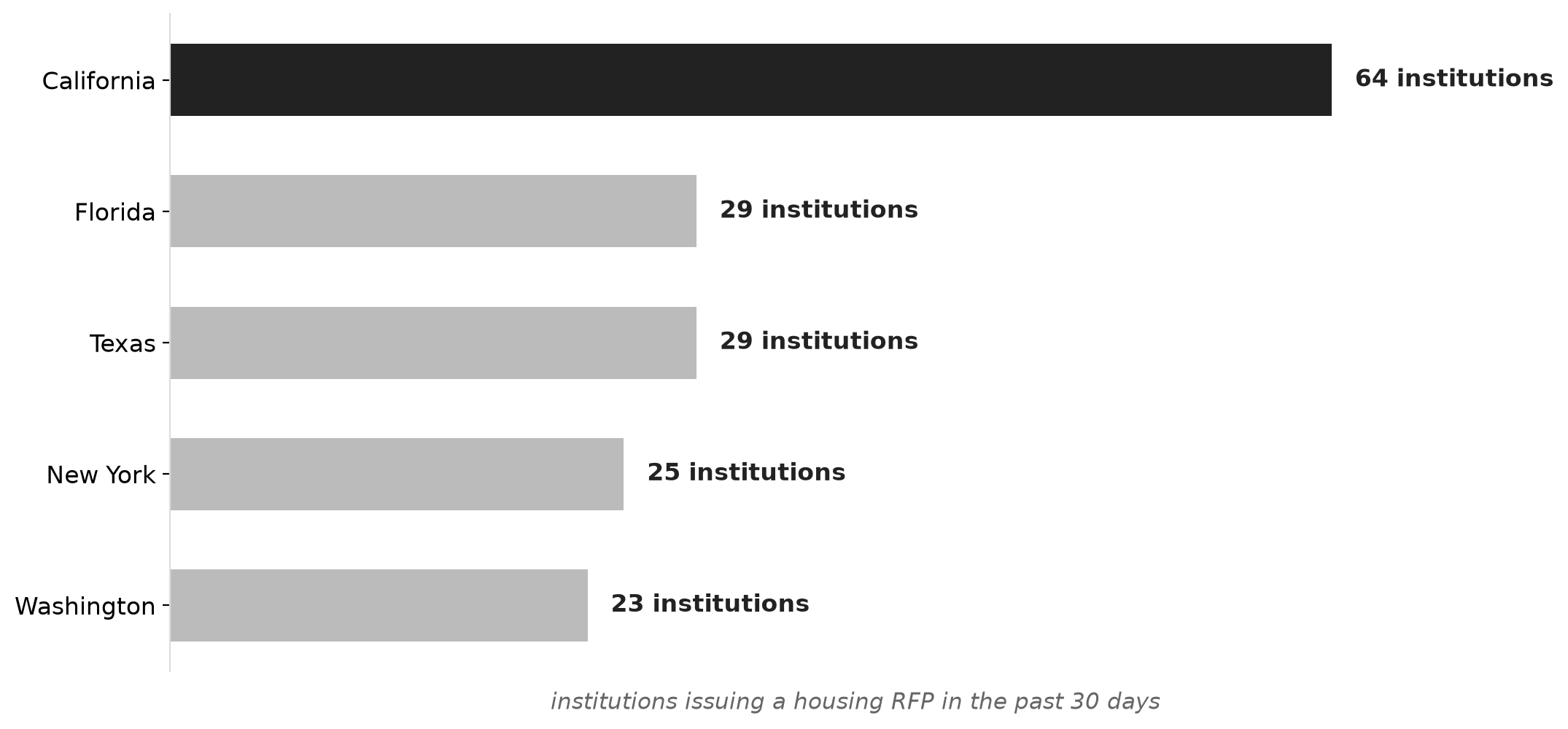
The scale of California's reactivation stands out even against the national baseline. Florida and Texas each had 29 housing-procuring institutions in the same 30-day window. New York had 25. California's 64 first-time-in-a-year institutions arrived on top of a month-to-date total of 56 procuring agencies and 168 housing RFPs through July 22, a pace consistent with the elevated activity of the prior several months. The dormant-institution signal is additive to an already-active market.
SB 79 is not the only deadline pushing spending. AB 130, signed as part of the 2025-26 state budget by Assemblymember Buffy Wicks, layered a new infill CEQA exemption on top of SB 79's streamlining, giving developers and their city partners additional legal cover to move quickly. The HCD is actively reviewing local SB 79 ordinances for substantial compliance, which means cities without a submitted ordinance are already behind on the regulatory calendar. REAP 2.0, the $600 million statewide housing planning grant program, had its expenditure deadline extended six months by the budget trailer bills, keeping pressure on regional councils of governments through 2026. SCAG alone manages $231 million of that for Southern California member agencies, and those dollars have to move.
A proposed $10 billion affordable housing bond (AB 736/SB 417), pending for the November ballot, is adding a second layer of positioning pressure. Jurisdictions that want to compete for bond capital need demonstration projects, planning frameworks, and development partners already lined up. Issuing an RFP now is also, in part, a signal to Sacramento that the city is ready to receive capital.
For residents in the Bay Area, greater Los Angeles, and the Sacramento metro, the procurement surge is a leading indicator of construction activity roughly 18 to 36 months out. RFPs issued this summer will produce consultant contracts by fall, developer agreements by early 2027, and entitlements shortly after. That timeline lines up with the HAA penalty window: cities that have selected development partners and initiated TOD projects before January 1, 2027 have a stronger legal posture if they face a denial challenge.
The next signal to watch is HCD's compliance review calendar. The department has indicated it will assess local SB 79 ordinances on a rolling basis through the fall. Cities that receive a non-compliance notice face not only the HAA penalty exposure but potential builder's remedy challenges on any project denied while out of compliance. How many of the sixty-four newly active agencies convert their RFPs into executed agreements before that review cycle closes will indicate whether this procurement surge produces housing or simply produces plans.