Iowa pulled in $7 million in new federal water infrastructure grants in the last 90 days, a 1,173% jump from the $550,000 the state received in the same window a year ago. The surge is less a sign of abundance than of urgency: the Bipartisan Infrastructure Law's five-year water infrastructure authorization expires September 30, 2026, and any funds states have not formally obligated by then are gone.
The clock is the driver. The IIJA authorized roughly $50 billion for water infrastructure nationwide, channeled primarily through EPA's Clean Water and Drinking Water State Revolving Funds. For five years, that money has been available. Now it isn't, not after September 30. The White House's proposed FY2026 budget compounds the pressure by calling for a 31.5% cut to SRF appropriations, meaning the pipeline that replaced this one-time federal push will be substantially narrower. Iowa's own Iowa Environmental Protection Commission, in its SFY2026 Intended Use Plan update approved March 24, 2026, made the stakes explicit: projects not under loan agreement within one year of eligibility will be bypassed. That language is a directive to get paperwork signed.
Two grants account for nearly all of the $7 million. Cedar Rapids received a $6 million Department of Transportation Bridge Investment Program award in June 2026 to replace the Eighth Avenue Bridge over the Cedar River, a project running through 2031. Mason City received $1 million from the EPA in April under the 2024 Consolidated Appropriations Act for drinking water infrastructure construction. Both awards land on top of a pre-existing active portfolio that is far larger: Iowa currently holds 53 active water infrastructure grants totaling roughly $340 million, the vast majority administered through Iowa DNR in partnership with the Iowa Finance Authority via EPA's SRF programs.
Source: NationGraph.
The single largest active commitment in that portfolio is a $37.8 million WIIN Emerging Contaminants grant to Iowa DNR, running from 2025 through 2030, targeted specifically at PFAS and other emerging contaminants in small and disadvantaged communities. That grant exists because Iowa's water contamination challenge has two overlapping faces: agricultural nitrate runoff, which is chronic and diffuse, and PFAS contamination from industrial and military sources, which is concentrated enough to generate a formal Iowa DNR PFAS action plan. The combination qualifies Iowa's disproportionately small water systems, many serving communities under 10,000 residents, for EPA's Emerging Contaminants in Small or Disadvantaged Communities grant program, a $5 billion no-cost-share PFAS fund under IIJA. Larger, wealthier states cannot access those grants as easily. Iowa can, and it has.
The federal funding picture is complicated by the Trump EPA's simultaneous moves on PFAS regulation. In May 2026, the same week the agency rolled back certain Biden-era PFAS rules, it announced $9.46 million in new EC-SDC PFAS grants for Iowa, confirming that the funding pipeline and the regulatory rollback are operating on separate tracks, for now. The money authorized under IIJA continues to flow even as the standards that would require some of it are being revised.
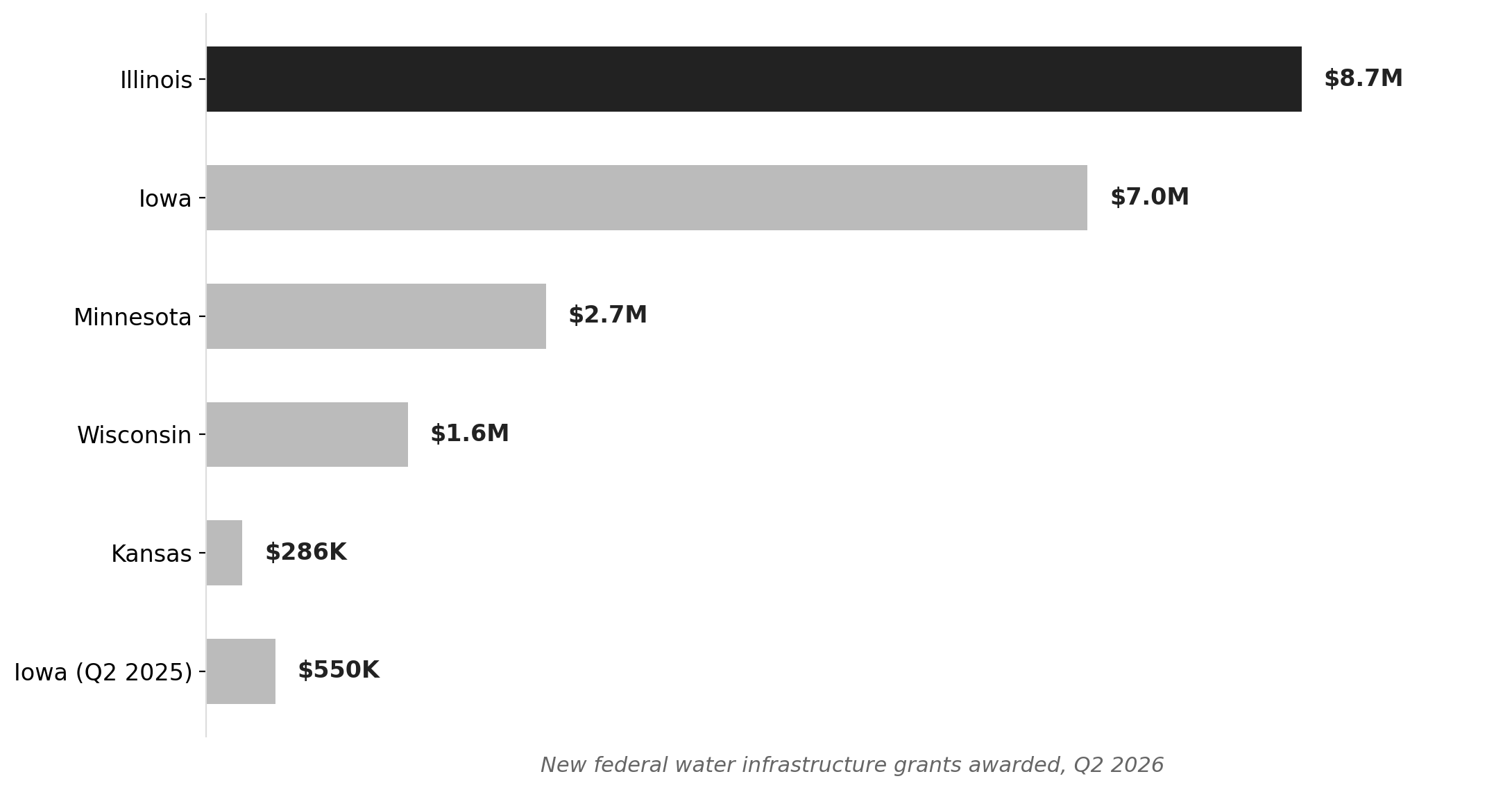
Nationally, IIJA SRF award volumes fell 53% in the first half of 2025, driven by EPA staffing reductions and prolonged regulatory uncertainty. Iowa's acceleration in Q2 2026 stands out against that backdrop. Among Midwestern peers, Iowa's $7 million in new grant starts this quarter trails only Illinois at $8.7 million; Minnesota recorded $2.7 million, Wisconsin $1.6 million, and Kansas $286,000. Part of Iowa's advantage is institutional: Iowa DNR and the Iowa Finance Authority have administered SRF programs jointly for decades, giving the state a tested deployment pipeline that newer or less capitalized state agencies in Nebraska and Kansas cannot easily replicate on short notice.
For Iowans living in the small communities most likely to qualify for EC-SDC funding, the practical question is whether their water utility has submitted an application and whether Iowa DNR has placed them on an eligibility list before the window closes. The spend-or-bypass rule in the March IUP update means that being eligible is not enough; projects must reach a formal loan or grant agreement on schedule or lose their place in the queue to communities that moved faster.
The September 30 deadline is fixed. What remains open is how much of Iowa's remaining IIJA allocation, spread across dozens of communities still in the planning or permitting stage, can clear that bar before the authorization lapses and a leaner federal water budget takes its place.