Federal AI grants to Nebraska reached $6.62 million in the trailing 90 days, a 322% jump over the $1.57 million recorded in the same window a year ago. Nearly all of it traces to a single source: an $8 million NSF E-RISE award to the University of Nebraska at Omaha, announced August 4, 2026, to establish the Nebraska Center for 3D Innovation. Of that award, $5.886 million has already been obligated. The remaining $304,000 disbursed against Nebraska's full $11.83 million active AI portfolio underscores how new this commitment is: the federal dollars are locked in, but most of the work is only beginning.
The force behind the surge is structural. NSF's E-RISE program, created under the CHIPS and Science Act of 2022, exists specifically to redirect competitive federal research dollars toward the 28 EPSCoR-eligible states, jurisdictions NSF formally designates as historically underrepresented in grant competition. Nebraska qualifies. For decades that designation carried a mild stigma, signaling a research ecosystem that couldn't compete with the coasts. Under E-RISE, it became a selection criterion. Nebraska's University system has now turned that eligibility into the largest single AI-related federal award the state has received.
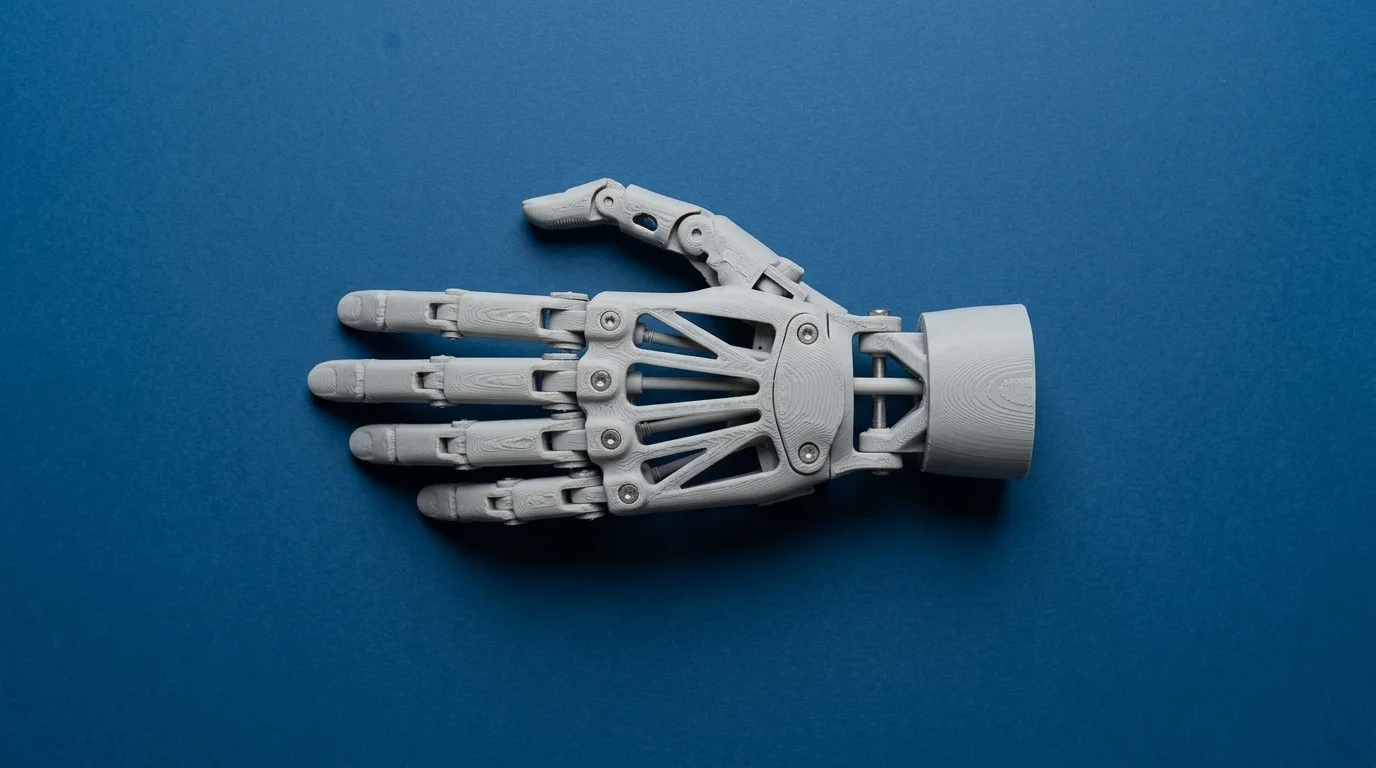
The NE3D center is not a new idea rushed together to chase a grant. Dr. Jorge Zuniga founded the precursor lab at UNO in 2016, building open-source prosthetics designs that could be printed and distributed globally. The E-RISE award formalizes and massively scales that decade of work into a statewide hub connecting UNO, the University of Nebraska-Lincoln, the University of Nebraska Medical Center, Children's Hospital, and industry partners. The center's research agenda centers on AI-enhanced medical imaging and next-generation prosthetics, two domains where machine learning is transforming what's possible for patients, particularly in pediatric care.
Source: NationGraph.
The NE3D award lands on a campus already preparing its infrastructure for exactly this kind of work. In May 2026, NSF funded a roughly $700,000 PLUMAGE GPU cluster at UNL's Holland Computing Center, as reported by HPCwire, giving Nebraska's researchers the compute backbone that AI-intensive medical imaging and modeling requires. Without that kind of cyberinfrastructure, the ambitions of NE3D would outpace the university's ability to execute them.
The institutional architecture is also in place. NU President Jeffrey Gold launched the University of Nebraska AI Institute in February 2026, framing it as a system-wide initiative targeting healthcare, agriculture, rural development, and national security. Final Board of Regents ratification was expected in June 2026. The AI Institute gives the E-RISE award an organizational home and a coordinating mandate across campuses, the grant funds the center, but the Institute provides the strategic logic connecting it to Nebraska's broader economy.
Two smaller grants round out the quarter and reveal the breadth of the university's positioning. A $433,000 NSF CAREER award funds research into trustworthy AI for 6G open radio networks. A $299,000 NSF mathematics grant touches AI pattern-recognition frameworks. Neither is transformative on its own. Together with NE3D, they signal that Nebraska's AI funding is spreading across computer science, engineering, and mathematics simultaneously, rather than concentrating in a single department.
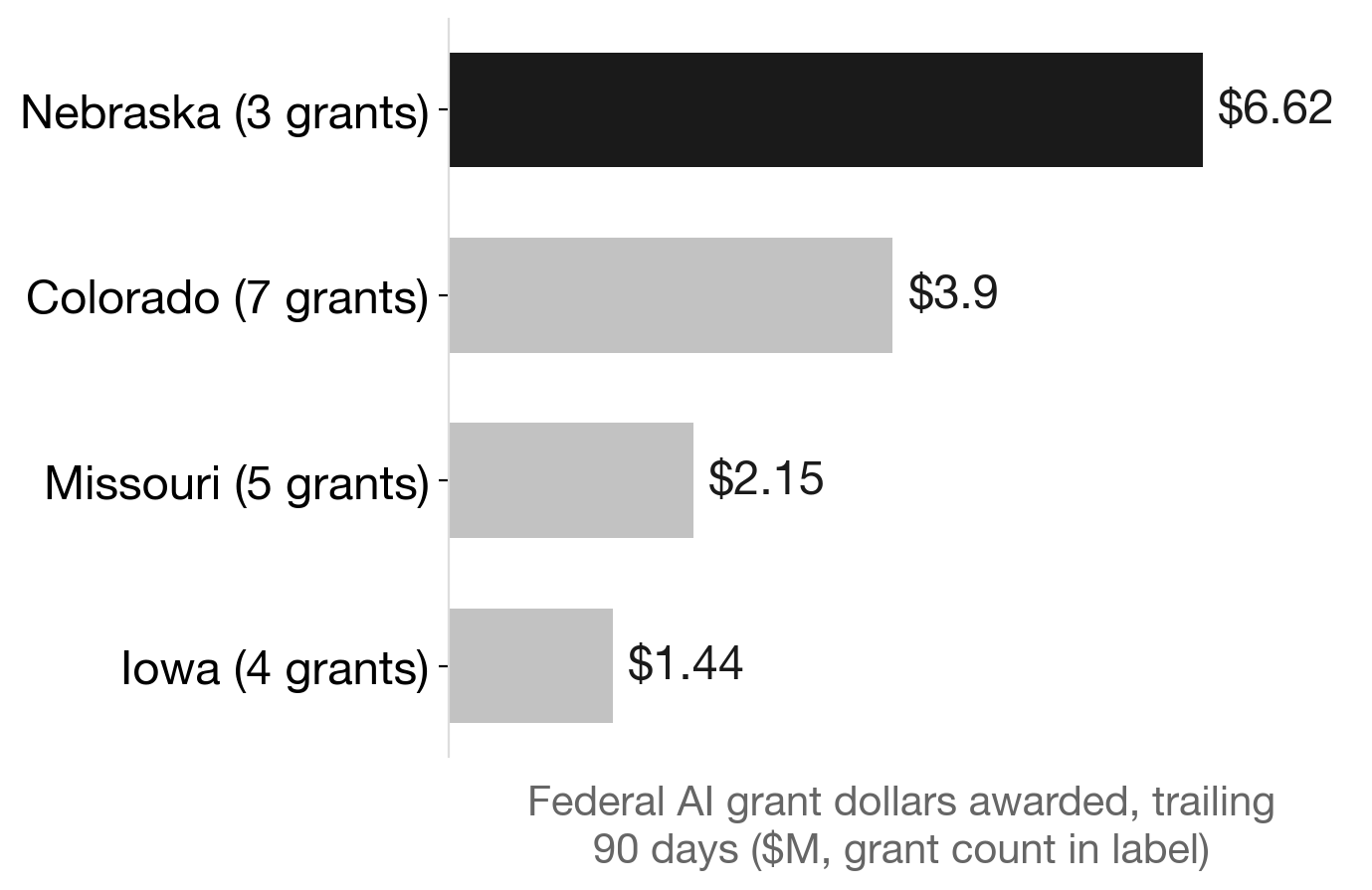
The scale of the quarter becomes clearer when set against peer states. In the same 90-day window, Colorado received $3.9 million across seven AI grants, Missouri $2.15 million across four, and Iowa $1.44 million across five. Nebraska's $6.62 million came from just three awards. That ratio, high volume from few grants, is a signature of winning large infrastructure bets rather than accumulating incremental project stipends. It is also more fragile: one declined renewal or one shifted federal priority and the curve reverses. But the NE3D award is structured as a multi-year infrastructure investment, not a single-year project grant, which provides some insulation.
For Nebraskans, the immediate stakes are in healthcare access. AI-enhanced prosthetics and medical imaging research carried out at a center connected to Children's Hospital has a direct path to clinical application, especially for rural patients who have historically had fewer options for advanced prosthetic care. The applied agricultural and rural development framing of the broader AI Institute adds a second channel: precision agriculture tools developed under that umbrella could reach farm operators across the state before the decade ends.
The next signal to watch is the Board of Regents' formal ratification of the AI Institute's structure and funding commitments, which had been expected this summer. If that vote solidifies the system-wide coordination framework, Nebraska's ability to compete for the next round of E-RISE and EPSCoR awards strengthens considerably. If the institutional backing stalls, the NE3D center succeeds, but the larger strategic bet on Nebraska as an AI research hub remains unfinished.