Federal transit grants committed to Mississippi in the last 90 days total $47.9 million across 14 awards, a 51% jump from $31.7 million in the same window a year ago. For a state where the car is not a lifestyle choice but a practical necessity, the scale of this investment is worth pausing on.
The largest single award is a $21.5 million Section 5311 Formula Grant for Rural Areas to the Mississippi Department of Transportation, obligated August 26 and running through 2034. The City of Hattiesburg's Hub City Transit followed with $6.5 million under the Buses and Bus Facilities program and an additional $1.4 million in FTA formula support. MDOT also collected $3.1 million in Section 5310 funds targeted at seniors and individuals with disabilities. All told, Mississippi's active federal transit portfolio now stands at $119.3 million, anchored by $76.4 million in rural formula grants spanning five active awards.
The driver is a deadline. The Bipartisan Infrastructure Law, signed in November 2021, authorized roughly $218 million in FTA formula transit funding for Mississippi over five years, approximately 36% above prior FAST Act levels in the first year alone. FY 2026 is the final year of that authorization window, and the Federal Transit Administration is locking in formula obligations before Congress must pass a new surface transportation reauthorization. As FTA's published fact sheets show, the Section 5311 national rural pool grew from $781 million in FY2022 to $856 million in FY2026. Mississippi, with roughly 60% of its population in areas under 50,000 people, captures a disproportionate share of that pool almost by design.
Source: NationGraph.
The formula, in other words, was written for a state that looks exactly like Mississippi. Section 5311 funds capital, planning, and operating costs for transit systems serving communities below the 50,000-population threshold. Section 5310 targets mobility for seniors and people with disabilities. Section 5339 backs bus fleet replacement and facility construction. Each program has its own eligibility rules and matching requirements, but all three flow through MDOT as the state's designated FTA recipient, and all three face the same end-of-authorization urgency simultaneously. The effect is a coordinated surge rather than a trickle of individual awards.
The demand-side case for that surge is acute. MDOT's own transit planning documents note that 40.7% of the state's transit vehicles are past their useful life. Mississippi has no large metropolitan transit authority on the scale of peer Southern cities. MDOT functions as the primary pass-through for federal dollars to dozens of small rural systems, which means capital replacement grants are not supplementing a base of local investment, they are often the only mechanism available for fleet renewal at all.
Hattiesburg's Hub City Transit is the clearest example of what that investment looks like in practice. Hub City is a direct FTA recipient and has been among the most consistent grant recipients in the state. Bipartisan congressional support for its awards has been explicit: Senators Wicker and Hyde-Smith and Rep. Palazzo have previously announced transit funding for the agency together, a notable show of unity in a state whose congressional delegation rarely splits on spending. The $6.5 million Buses and Bus Facilities award obligated August 25 runs through 2037, long enough to give the agency a planning horizon that previous grant cycles rarely allowed.
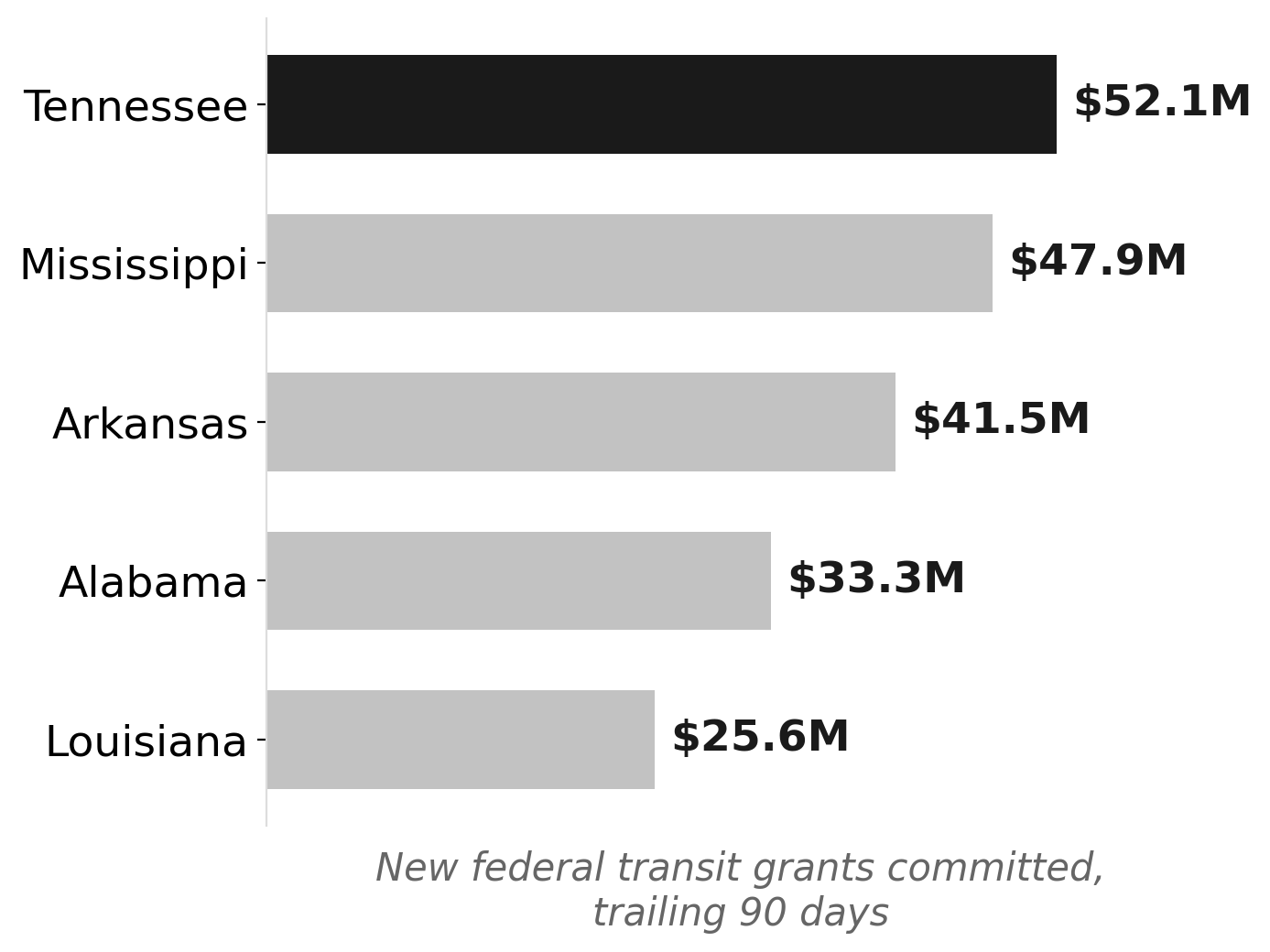
In a regional comparison, Mississippi's 90-day total of $47.9 million places it second among Southern neighbors, behind Tennessee at $52.1 million and ahead of Arkansas at $41.5 million, Alabama at $33.3 million, and Louisiana at $25.6 million. That ranking reflects the formula's weighting toward rural population and low-income households, not the presence of large transit systems. Non-white households in Mississippi are 2.9 times more likely to commute by public transit than white households, which means the equity stakes of this investment are concentrated among residents with the fewest alternatives.
There is a second wave potentially still incoming. The FTA's FY2026 Buses and Bus Facilities competitive funding opportunity, announced July 27, makes $610 million available nationally with applications due September 21, 2026. Mississippi agencies that missed the most recent award cycle, or that submitted competitive applications, may still see additional awards before the authorization year closes.
The open question is what comes after. If Congress does not pass a new surface transportation reauthorization before the IIJA authorization lapses, the formula pools that sent Mississippi $47.9 million in 90 days could shrink or freeze. Formula-dependent rural states would absorb that disruption more sharply than states with large metro systems that can access competitive grants and local revenue streams. The next reauthorization debate, likely to begin in earnest in early 2027, will determine whether the clock that just ran so fast in Mississippi's favor gets reset or stops entirely.