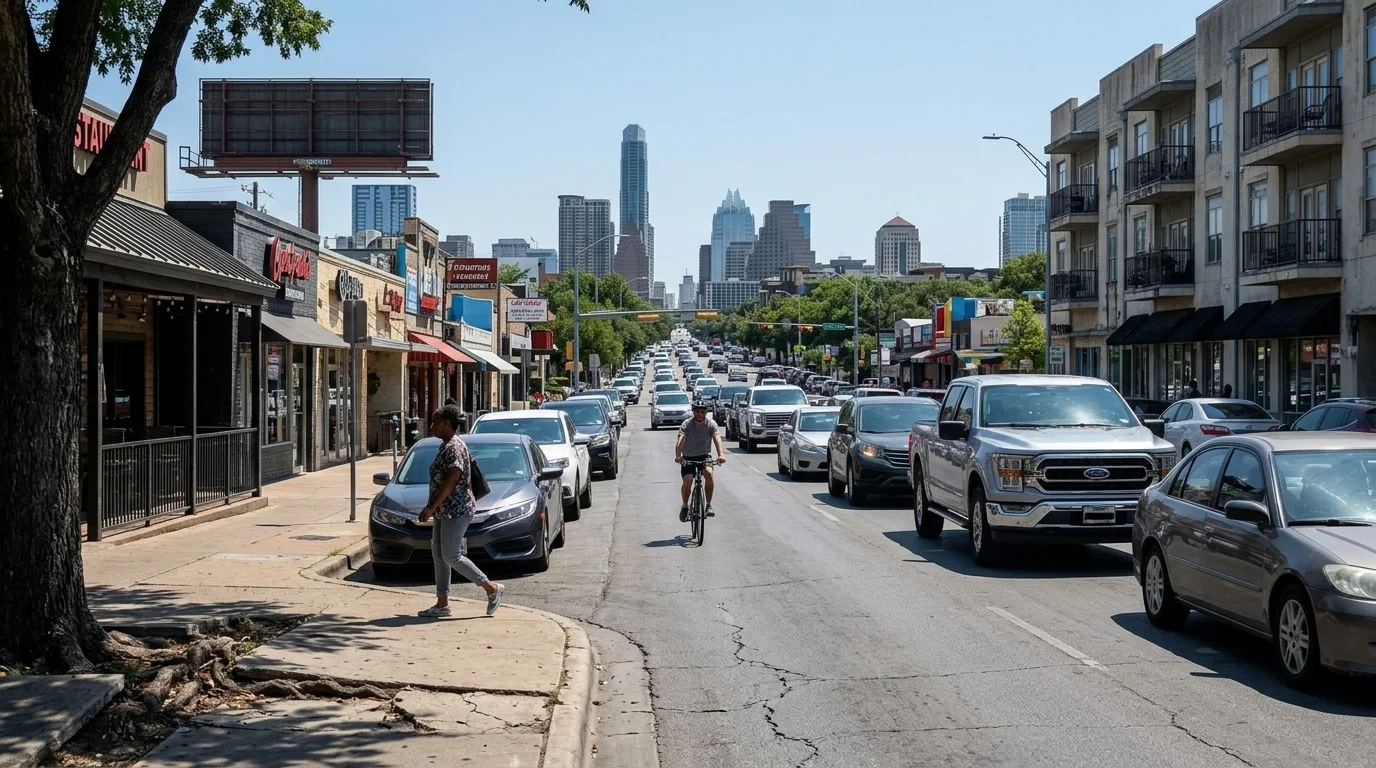
One of Austin's busiest and most dangerous corridors is finally getting the overhaul voters approved a decade ago. South Lamar Boulevard, a 1.5-mile stretch running from US 290 to Montclaire Street, is set for a ground-up redesign that will add dedicated bike lanes, ADA-compliant shared-use paths, upgraded bus stops, rain gardens, and new tree plantings.
The reconstruction targets infrastructure that hasn't kept pace with the neighborhood around it. South Lamar transformed over the past 15 years from a low-slung commercial strip into one of Austin's densest mixed-use corridors, filled with apartments, restaurants, and entertainment venues. The road itself stayed largely a 1960s-era arterial: narrow, broken sidewalks, no continuous bike facilities, and a crash rate bad enough to land it on Austin's High-Injury Network, the roughly 8 percent of city streets that account for more than 68 percent of serious injuries and fatalities.
The project is part of Austin's Corridor Construction Program, which voters funded through the 2016 Mobility Bond and a follow-on 2020 bond, together committing roughly $1.1 billion to redesigning major arterial roads into what planners call "complete streets" that serve pedestrians, cyclists, and transit riders alongside drivers. South Lamar was named as a priority corridor in the original 2016 package. The solicitation is now posted on the city's procurement portal, with bids due Sept. 3, 2026.
The work goes well below the surface. In addition to repaving, shifting curbs toward the centerline to narrow travel lanes, and installing new traffic signals, crews will replace storm drains, water lines, and wastewater infrastructure underneath the road. Rain gardens and an expanded tree canopy are woven into the streetscape design, part of Austin's broader push to manage stormwater runoff and add heat relief amid major flooding events and the February 2021 winter storm that exposed how fragile the city's infrastructure had become.
The 2016 bond's corridor program has faced persistent criticism for running years behind its original schedule, with projects initially planned for 2019 to 2022 slipping significantly. South Lamar businesses will likely watch closely: merchants along Burnet Road and Airport Boulevard raised concerns during those reconstructions about lost parking and customers during construction.
With bids opening this fall, construction is not expected to begin before 2027. How quickly the city can move from contract award to breaking ground will be an early test of whether Austin has tightened up delivery on a program that has long promised more than it has yet built.