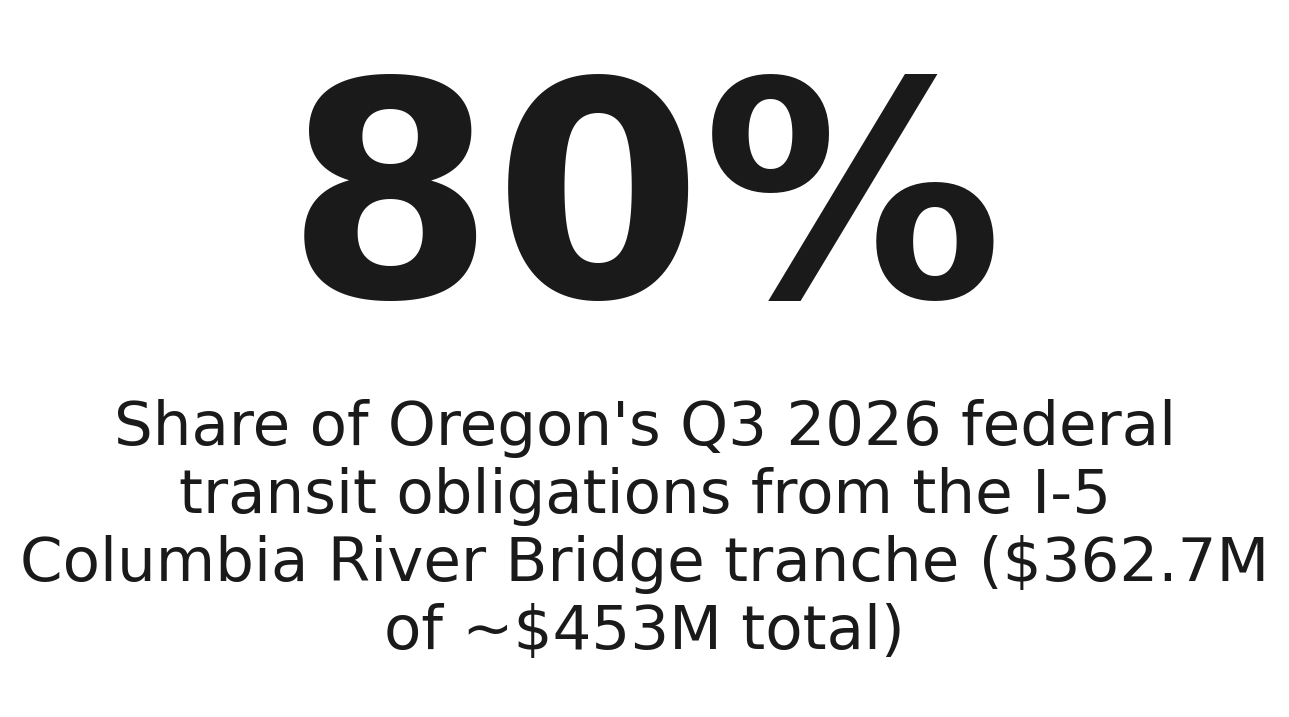
Oregon's federal transit grants hit $399.4 million in the past 90 days, a figure that looks like a broad acceleration of state infrastructure spending. It is not. Roughly $363 million of that total is a single wire transfer, obligated to ODOT on September 24, 2026, six days before the money would have legally ceased to exist.
The grant is a tranche of the $1.499 billion FHWA Bridge Investment Program award for the Interstate Bridge Replacement (IBR) Program, the long-stalled project to replace the century-old I-5 crossing over the Columbia River between Portland and Vancouver, Washington. Under the Bridge Investment Program's statutory terms, the funds had to be obligated by September 30, 2026. According to ODOT's briefing to the Oregon Transportation Commission, failure to amend the Statewide Transportation Improvement Program in time would have prevented the federal agencies from issuing the environmental clearance, and the full $546 million in unobligated BIP funds would have expired.
The prerequisite for any of that money moving was NEPA completion. FHWA and FTA issued the Amended Record of Decision on July 1, 2026, closing out an environmental review that had stretched across multiple administrations and a previous project collapse. That July clearance opened a narrow 91-day window. ODOT used 85 of them.
Source: NationGraph.
The prior-year comparison window, which showed $113.4 million in federal transit dollars for Oregon, consisted of roughly 20 smaller awards distributed across TriMet, Lane Transit District, Salem Area Mass Transit District, and ODOT for bus replacement, formula programs, and planning work. That is the normal shape of Oregon's federal transit grant activity. The 252% year-over-year surge is not a signal that Oregon transit agencies suddenly have more federal support; it is what a megaproject obligation looks like when it finally clears its legal prerequisites.
The remaining awards in the 90-day window are worth noting in their own right. A $6.4 million bus facilities grant, a $5.3 million PROTECT resilience grant to the Lane Council of Governments, and roughly $12 million in rural transit and seniors-mobility awards represent the kind of steady-state federal investment that typically defines an Oregon grant quarter. They are simply invisible next to the bridge number.
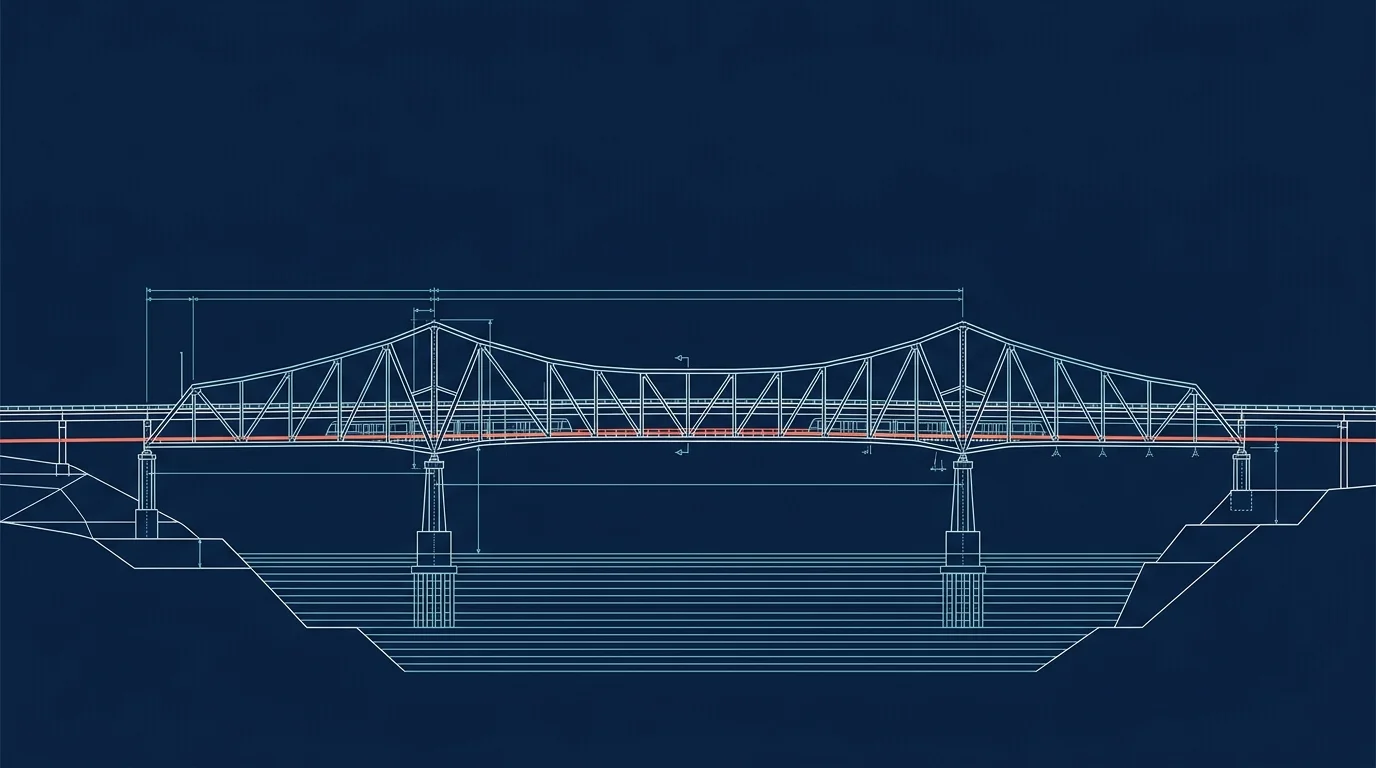
What the obligation actually funds is the replacement of a structure that carries more than 143,000 vehicles per day and sits atop the Cascadia Subduction Zone. According to the IBR Program's announcement of the BIP award, the full grant is $1.499 billion, making it one of the largest single bridge grants in the program's history. Oregon and Washington have each committed $1 billion in state appropriations toward the project's first funded phase, which is estimated at roughly $5.7 billion and also anticipates approximately $1.5 billion in future toll revenues.
The full 5-mile corridor program, at its 70th-percentile cost estimate, runs to $14.4 billion. The first phase covers the bridge replacement itself. The transit piece, an extension of Portland's MAX light rail into Vancouver, is on a separate federal track. The IBR Program applied in September 2026 to advance that component from Project Development to Engineering under the FTA Capital Investment Grant framework, a roughly $1 billion ask that has not been awarded and could be evaluated independently of the bridge work already underway.
The political history here is load-bearing context. An earlier version of this project, the Columbia River Crossing, collapsed in 2013 when the Washington State Legislature refused to approve funding for the light rail component. The current program has navigated that same tension for years. As OPB reported on the July 1 federal approval, the NEPA clearance represented the first time in the project's current iteration that federal agencies formally signed off on a path that includes light rail. Whether Congress funds that path is a separate question.
In August 2026, WSDOT issued the request for qualifications for the Columbia River Bridge Replacement contract, estimated at $3.3 to $3.9 billion. A progressive design-builder is expected to be selected in 2027, with construction targeted for 2028. The next signal to watch is whether the FTA advances the MAX light rail extension to Engineering, a decision that would determine whether the full multimodal vision of the IBR Program moves forward on a parallel timeline or gets deferred while the highway structure goes up on its own.